CONTENT
Silage Production: How to Make and Store High-Quality Silage
Silage is a fermented feed produced by storing high-moisture crops, usually green forages, under anaerobic conditions with minimal nutrient loss in a structure known as a silo.
Silage is one of the most effective methods of preserving forage for livestock feeding while maintaining much of its nutritional value. Produced through controlled anaerobic fermentation, silage provides a dependable source of high-quality feed during periods when fresh forage is limited.
This guide covers the principles of silage production, including crop selection, forage preparation, additives, silo management, storage practices, and the characteristics of good-quality silage.
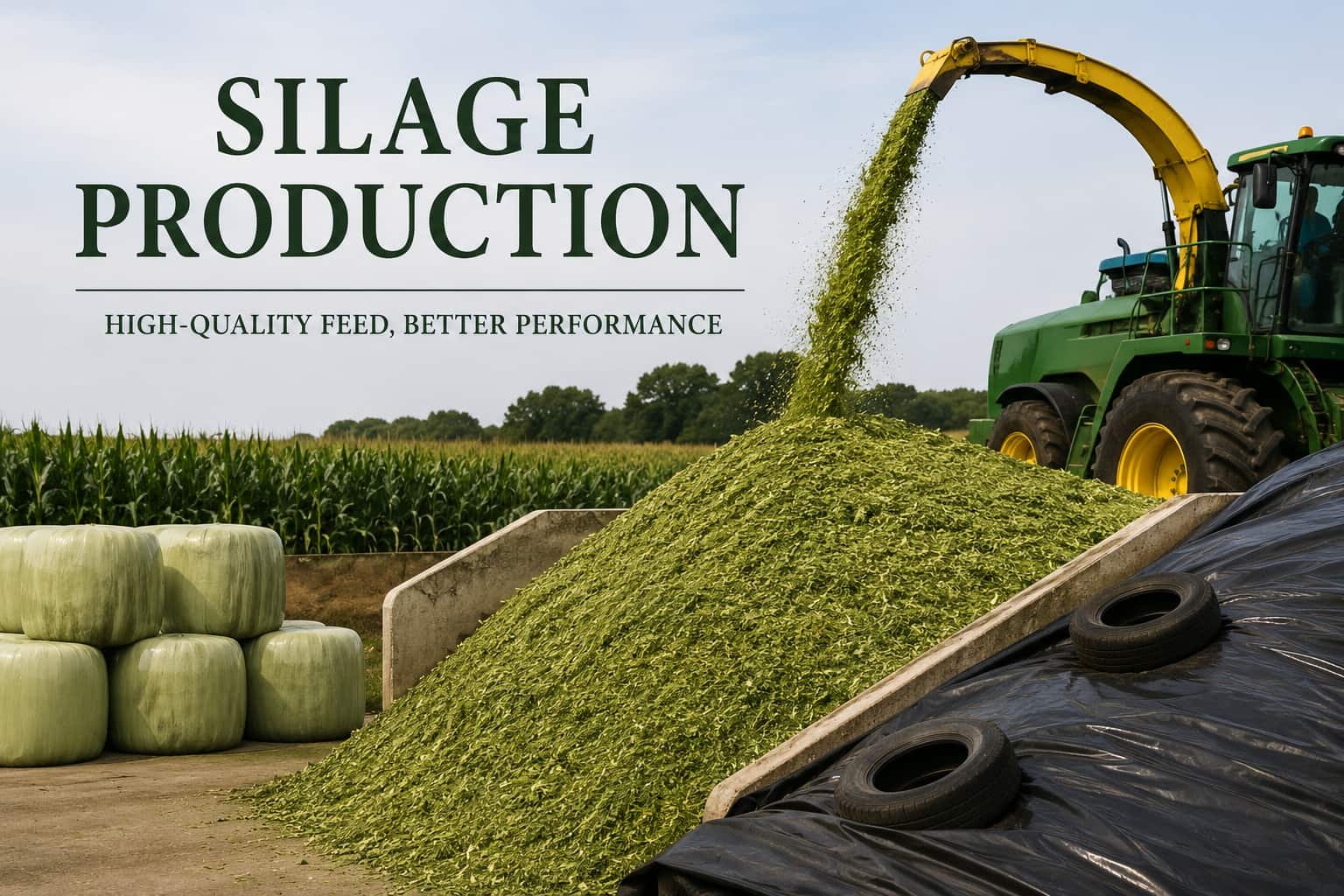
Ensiling/Ensilage
The term refers to all physical and chemical changes that occur when forage or feed with sufficient moisture is stored in a silo in the absence of air. The entire ensiling process generally requires two to three weeks to convert forage into silage.
Silo
A silo is an airtight or semi-airtight structure designed for the storage and preservation of high-moisture feeds as silage. Silos are available in different types.
Crops Used for Silage Making
The most commonly used silage crops are:
- Grasses: maize (corn), sorghum, Sudan grass, pearl millet, hybrid Napier grass, etc.
- Legumes: alfalfa (lucerne), berseem clover, cowpea, etc. Grass forage crops can be mixed with legumes to produce high-quality silage.
Preparation of Forage for Silage Making
- Harvest at the Proper Stage of Maturity: Crops intended for silage are generally harvested at the stage when they contain the maximum amount of nutrients. For maize, this is the early dent stage (well-matured stage), and for sorghum, the late dough stage (when the seeds are soft and immature). Silage materials containing less than 25% dry matter produce very sour silage and usually lose significant amounts of silage juice during storage, resulting in considerable nutrient loss. Therefore, crops may be allowed to mature until the dry matter content reaches 35–40%.
- Cut to the Proper Length: The length of chopped forage affects packing and, consequently, silage quality. Silage crops are typically chopped from a fraction of an inch to over an inch in length. Chopping forage into 1–2 cm lengths is generally ideal. Grass silages require finer chopping than maize or sorghum. Wilted and dry forages, as well as forages with hollow stems, should be chopped more finely than high-moisture forages to permit thorough packing and eliminate air pockets.
- Control the Moisture Content: Practical experience indicates that 35–40% dry matter is ideal for most crops being ensiled.
Forage containing more than 60–65% moisture:
- Is heavier and more costly to handle than necessary.
- May produce poor-quality silage (slimy and putrid) due to the presence of butyric acid.
- May result in excessive seepage of juices and nutrient loss.
- May cause excessive deterioration of silo walls because of high acidity.
- May exert high pressure on silo walls.
High moisture content can be reduced by one or a combination of the following methods:
- Conditioning/Wilting: Suitable for grass silage. Conditioning and/or wilting for 3–4 hours during favorable drying conditions may reduce moisture content by 10–15%.
- Adding Dry Hay or Straw: During periods of poor drying weather, the moisture content of forage can be reduced to the desired range by adding 5–20% straw.
- Combining High- and Low-Moisture Crops: Mixing crops in calculated proportions can help achieve the desired moisture content.
- Adding Dry Preservatives: Dry preservatives such as ground grains, corn-and-cob meal, or dried molasses can help reduce moisture content.
If the crop is overripe and too dry when harvested, or if it becomes excessively wilted, water may need to be added during chopping and packing to achieve the proper moisture level.
Additives or Preservatives
Additives or preservatives may serve one or more of the following purposes:
- Add nutrients
- Provide fermentable carbohydrates
- Supply additional acids
- Inhibit undesirable bacteria and molds
- Reduce the amount of oxygen present, directly or indirectly
- Reduce moisture content
- Absorb acids that might otherwise be lost through seepage
- Increase nitrogen content
Common additives and preservatives used in silage include:
- Molasses: Some green forages, particularly legumes and certain grasses, are low in sugar content. Adding molasses improves silage quality by increasing lactic and acetic acid production. It also enhances palatability and nutritive value. Molasses may be added at 3.5–4% in either liquid or dehydrated form.
- Urea: Adding urea at 0.5% of fresh forage is recommended. The primary purpose is to enrich silage with nitrogen because cereal forages are often deficient in nitrogen.
- Limestone: Calcium carbonate (CaCO3) may be added at 0.5–1.0% to maize silage. It neutralizes some initial acids as they form, allowing lactic acid bacteria to remain active longer and produce more desirable fermentation acids.
- Sodium Metabisulfite: Sulfur dioxide (SO2) is an effective antibacterial preservative and may help improve carotene retention.
- Organic Acids: Propionic and formic acids are used to improve forage preservation while maintaining palatability, although they are relatively expensive.
- Bacterial Cultures: Preservatives containing acid-forming bacteria such as Lactobacillus acidophilus, Torulopsis spp., and Bacillus subtilis may be added. Their purpose is to provide an inoculum and increase bacterial populations for rapid fermentation.
Silo Filling and Sealing
Once silo filling begins, it should proceed rapidly, preferably within two days. To create the desired anaerobic conditions, forage should be thoroughly compacted during filling. Filling during rainy weather should be avoided.
Distribute Forage Uniformly in the Silo
To avoid air pockets and spoilage, chopped forage should be distributed uniformly throughout the silo and packed tightly.
Sealing of the Silo
To maintain anaerobic conditions, atmospheric air must be prevented from entering the silo.
This may be accomplished by:
- Leveling the top and thoroughly compacting the upper layers, especially near the walls.
- Covering the surface with an insulating material such as soil, plastic, or loose earth.
- Applying sufficient weight on bunker or trench silos to improve compaction.
Depending on crop type, additives used, packing density, sealing efficiency, and weather conditions, the duration of silage preparation varies. Generally, 6–8 weeks are sufficient for anaerobic fermentation to produce high-quality silage.
Silage may be removed from the top of tower and trench silos and from the exposed face of bunker silos. Once opened, silage should be fed continuously. A 2–4 inch layer should be removed daily. Fermentation byproducts help preserve the forage indefinitely, provided air is excluded.
A Simple Method of Ensiling
Silo pits of convenient size (one cubic foot can hold approximately 30 kg of green forage) are constructed below ground level, and the bottom and side walls are coated with mud or similar sealing material.
Plastic sheets are spread along the bottom and side walls to make the pit airtight. Chopped forage is then added in layers 15–30 cm thick. About 0.5 kg of salt and 1–2 kg of molasses or another suitable fermentable carbohydrate source may be applied uniformly between layers. Each layer should be packed firmly.
The process is repeated until the pit is filled to approximately 4 feet above ground level. The top is then sealed with plastic sheeting to prevent air entry. The silo is left undisturbed for approximately three months. After opening, silage should be removed from one corner and used daily.
Ideally, the entire pit should be consumed within one month after opening. Hybrid Napier grass, sugarcane tops, sorghum, and other suitable forage crops may be used for silage production.
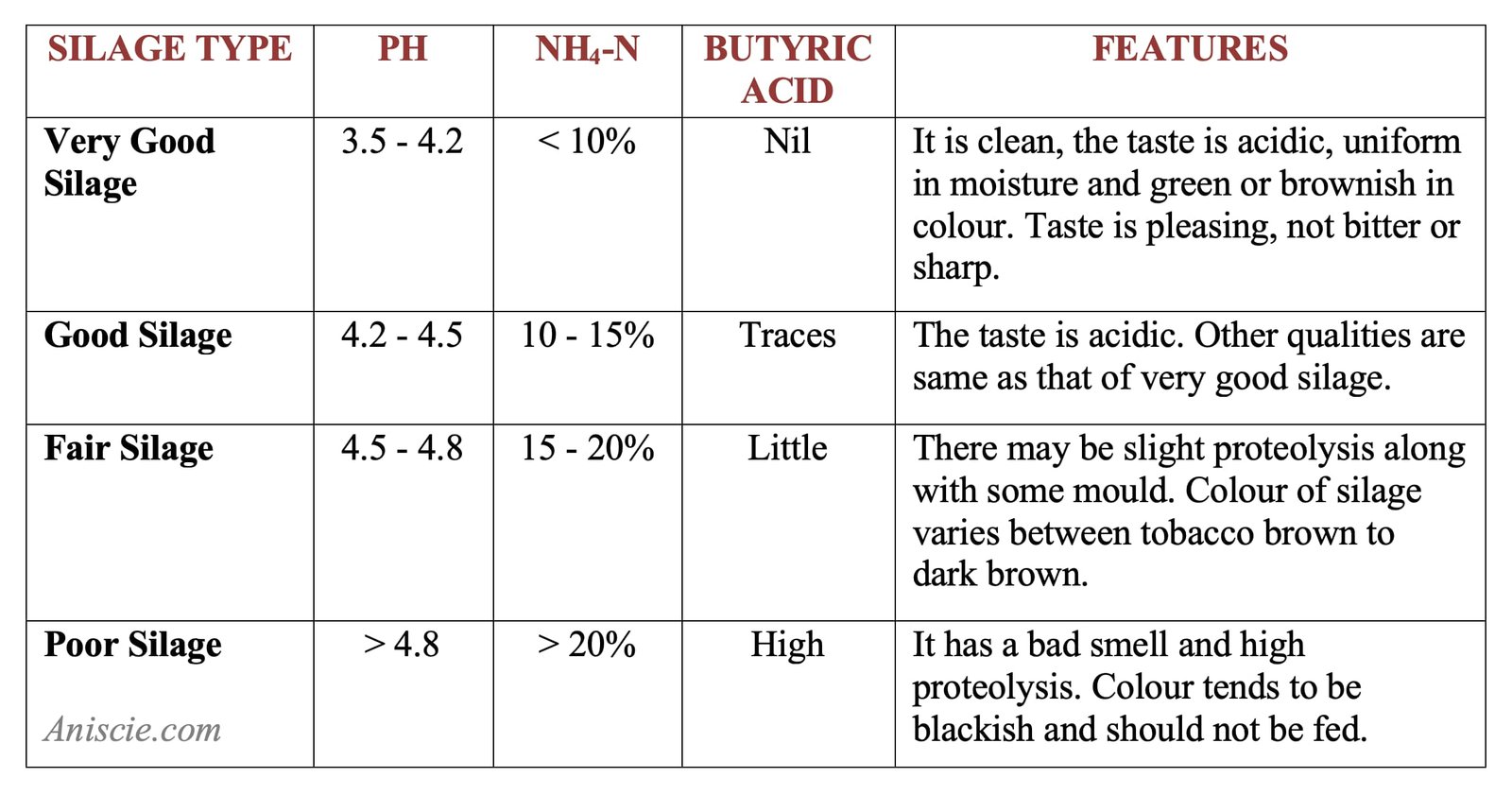
Quality Classification of Silage
Advantages and Disadvantages of Silage
Advantages of Silage
- Green forage can be preserved in a succulent condition for an extended period. As shortages of green forage often occur during dry seasons, silage can help overcome these deficiencies.
- Grass silage preserves 85% or more of the feed value of the crop, whereas haymaking generally preserves a lower percentage of nutrients.
- It is one of the most economical methods for processing and storing the entire maize (corn) or sorghum plant.
- During periods of unfavorable weather, when haymaking becomes difficult, preserving forage as silage provides an effective alternative.
- Weed species that produce poor-quality hay may still yield good-quality silage. The ensiling process also helps reduce weed seed spread by harvesting plants before seed maturity.
- Silage is highly palatable and has a mildly laxative effect.
- It is a good source of protein and certain vitamins, particularly carotene.
- Plant wastage is minimized because the entire forage crop is utilized, which is particularly beneficial for coarse or stemmy forages.
- It helps control weeds that are often spread through hay or other stored forages.
- A given quantity of forage can be stored in less space than the equivalent amount of dry forage. A cubic foot of silage contains approximately three times more dry matter than a cubic foot of long hay.
Silage offers several advantages over pasture, including:
- No fencing requirements.
- Approximately one-third more forage harvested from the same acreage.
- Harvesting at optimum maturity.
- More uniform forage quality.
- Closer observation and management of livestock.
Disadvantages of Silage
- Silage requires a silo, which is generally a permanent structure and may involve higher initial costs compared to haymaking.
- Improper silage-making practices can result in substantial forage losses.
- Poor-quality silage is often rejected by livestock.
- Silage contains considerably less vitamin D than sun-cured hay.
- The use of preservatives may increase production costs.
- Additional labor is required during silo filling and packing.
- Transportation of silage is generally more difficult than transportation of hay because of its higher moisture content and weight.
Haylage
Haylage is a low-moisture silage containing approximately 40–45% moisture. It is produced from grass and/or legumes that are wilted to the desired moisture level before ensiling. Haylage is similar to silage but contains less moisture, resulting in a product that combines some of the advantages of both hay and silage.