CONTENT
Introduction to Sheep and Goat Farming: Advantages, Domestication, Characteristics, and Scientific Classification
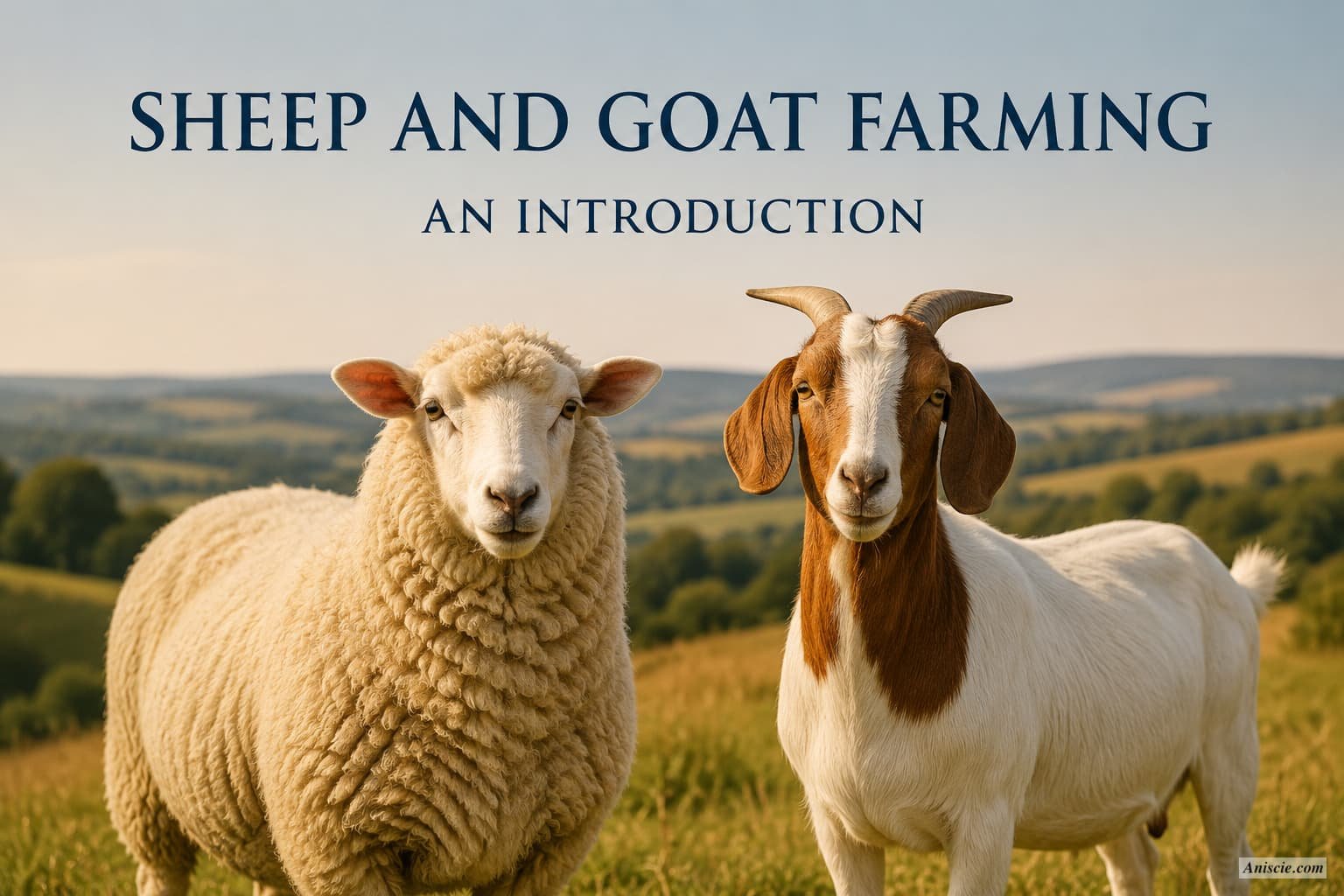
Sheep and goat farming is an important branch of livestock production worldwide. These small ruminants are valued for their ability to produce meat, milk, wool, fiber, skin, and manure while efficiently utilizing forage resources. This article provides an introduction to sheep and goat farming, including its advantages, domestication, characteristics, and scientific classification.
Sheep and goats are among the most important small ruminants raised worldwide and are managed under a wide range of production systems, from extensive grazing operations to intensive commercial farms. They contribute significantly to the production of meat, milk, wool, fiber, skin, and manure and play an important role in sustainable livestock agriculture. Flock sizes may range from a few animals to several thousand, depending on production objectives, available resources, and management practices.
There are several advantages associated with sheep and goat farming, including:
- Sheep and goats require less concentrate feed than many other livestock species and can efficiently utilize forages, shrubs, crop residues, and other vegetation unsuitable for human consumption.
- They are efficient converters of forage resources into valuable products such as meat, milk, wool, fiber, and skin.
- Sheep and goats are well suited for the utilization of marginal lands, crop stubbles, rangelands, and areas where conventional crop production is limited.
- They can adapt to a wide range of climatic conditions and production environments, making them suitable for both small-scale and commercial farming systems.
- Sheep and goats generally require lower initial investment, less housing infrastructure, and less labor than many large livestock species.
- Their relatively short generation interval and higher reproductive rate contribute to faster flock expansion and improved economic returns.
Sheep and Goats in Dryland Agriculture
Sheep and goats play an important role in arid and semi-arid agricultural systems throughout the world. Their ability to efficiently utilize sparse vegetation, tolerate water scarcity, and survive under harsh environmental conditions makes them particularly suitable for dryland farming regions. In many areas, these small ruminants complement crop production systems by converting crop residues and low-quality forage resources into valuable animal products.
Because of their adaptability and efficient feed utilization, sheep and goats are frequently raised in regions where environmental conditions limit the productivity of other livestock species. Their contribution to food security, rural livelihoods, and sustainable land use is particularly important in resource-limited production systems.
Domestication of Sheep and Goats
Sheep and goats were among the earliest livestock species domesticated by humans, with evidence suggesting domestication occurred approximately 10,000 years ago. Their domestication played a significant role in the development of early agricultural societies and contributed to the transition from hunting and gathering to settled farming systems.
Modern domestic sheep are believed to have originated from wild sheep species inhabiting regions of Western and Central Asia. Through centuries of selective breeding, sheep have evolved into numerous breeds adapted to diverse environmental conditions and production objectives, including meat, wool, and milk production.
Domestic goats are believed to have descended primarily from the Bezoar goat (Capra aegagrus). Selective breeding and adaptation over thousands of years have resulted in the development of specialized goat breeds used for meat, milk, fiber, and dual-purpose production systems.
Scientific Classification of Sheep and Goats
- Kingdom: Animalia – Animals
- Phylum: Chordata – Vertebrates
- Class: Mammalia – Mammals
- Subclass: Eutheria – Placental mammals
- Order: Ungulata – Hoofed mammals
- Suborder: Artiodactyla – Even-toed ungulates
- Section: Pecora – True ruminants
- Family: Bovidae – Hollow-horned ruminants
- Subfamily: Caprinae – Sheep and goats
- Genus: Ovis – Domestic and wild sheep
- Species: Ovis aries – Domestic sheep
- Genus: Capra – Domestic and wild goats
- Species: Capra hircus – Domestic goat
Sheep and goats contribute significantly to livestock production systems worldwide due to their ability to produce meat, milk, wool, fiber, skin, and manure under a wide range of environmental conditions. They are particularly valuable in regions where crop production is limited by poor soil quality, low rainfall, rugged terrain, or scarce feed resources.
Both species possess a remarkable ability to survive under challenging environmental conditions. They can efficiently utilize low-quality forage resources and maintain productivity in areas where many other livestock species may not perform efficiently. Their adaptability, hardiness, and economic value have contributed to their widespread distribution across diverse ecological regions throughout the world.
Sheep and goats possess physiological and behavioral adaptations that enable them to regulate body temperature, conserve water, and utilize a wide variety of feed resources. Sheep are efficient grazers of grasses and short vegetation, whereas goats are selective browsers that readily consume shrubs, leaves, and woody plants. These complementary feeding behaviors make them valuable components of sustainable grazing and integrated livestock production systems.