CONTENT
Housing of Sheep and Goats: Types, Design, Floor Space Requirements & Management
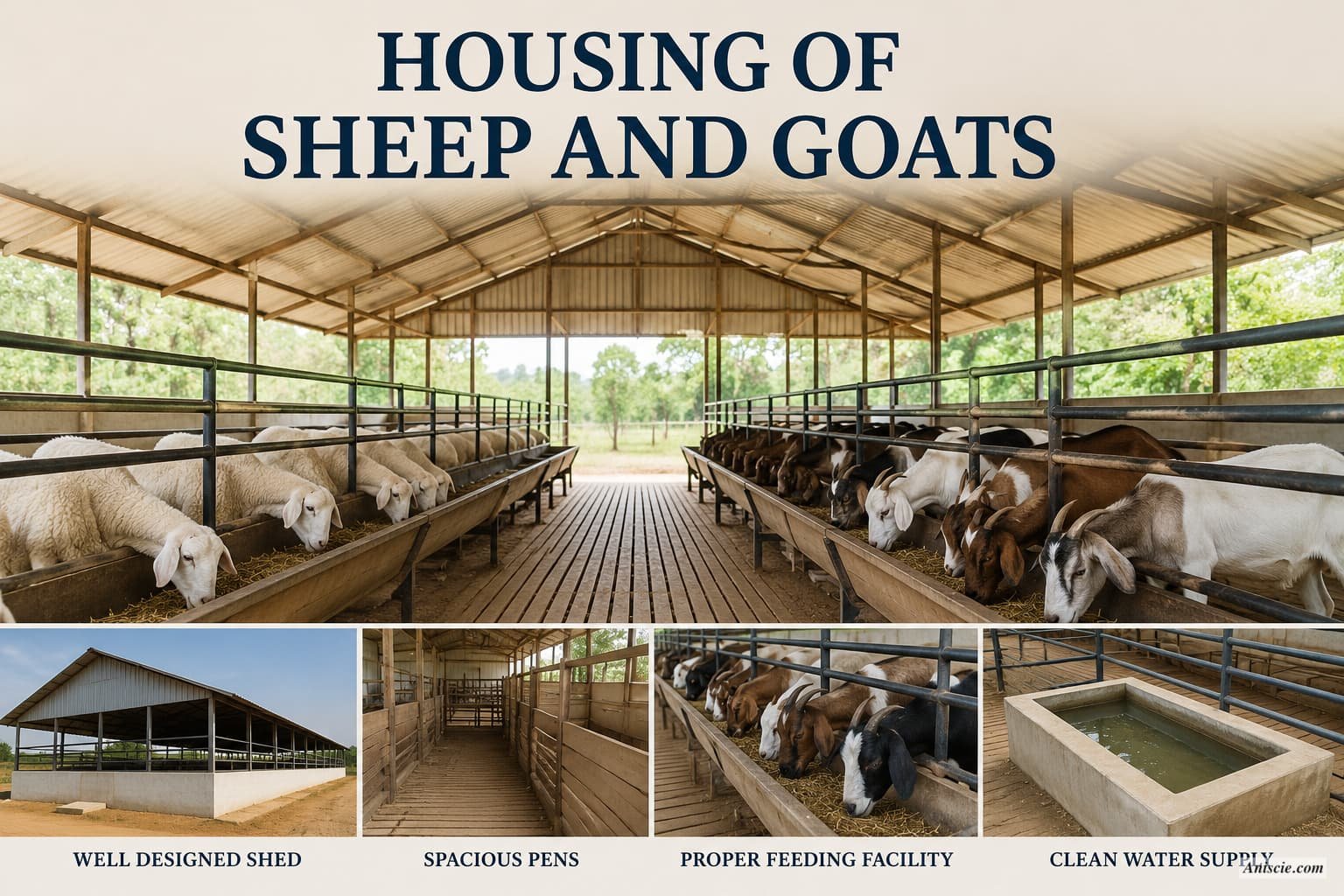
Proper housing is an essential component of successful sheep and goat production. A well-designed housing system protects animals from adverse weather conditions, reduces stress, improves health and welfare, and enhances overall productivity. Factors such as shed orientation, ventilation, roof design, floor space, feeding facilities, and hygiene management play a crucial role in maintaining a favorable environment for sheep and goats.
This article discusses the principles of sheep and goat housing, including shed design, floor space requirements, ventilation, feeding and watering facilities, hygiene measures, and housing systems for dairy goats.
Normally, sheep do not require elaborate housing facilities, but minimum provisions are necessary to increase productivity, especially protection against inclement weather conditions (sun, rain, and wind).
A shed may be built along the wall of a house. Additional protection can be provided using burlap sacks, or temporary or removable structures made of thatched materials and bamboo. The roof may be constructed from asbestos sheets supported by tubular or angle steel. Wooden rafters and thatching materials may also be used.
The instinct for shelter is widely prevalent in the animal kingdom, and goats are no exception. Since this species has lived in diverse microclimates of the Indian subcontinent—with mean maximum temperatures of 30°C and minimum temperatures of -40°C in the western Himalayan region, and mean maximum temperatures of 49°C and minimum temperatures of 2°C in the trans-Gangetic plains, along with relative humidity ranging from 20% to 95% during different seasons—it has exhibited a remarkable ability to adapt to varying climatic conditions.
Orientation of Sheds
Sheds with their long axis running east-west provide a cooler environment underneath than those with a north-south orientation. The latter, however, keeps the shed drier and promotes sanitation because sunlight enters the shed for a longer period. This orientation may impose greater heat stress on animals if they remain inside the shed during daytime in hot arid climates. A northeast-to-southwest orientation is expected to provide maximum comfort in hot arid environments.
Ventilation
The efficiency of ventilation is greatly affected by the prevailing summer and winter wind directions at a given location. Therefore, air inlets should be provided at the height of the goats to prevent drafts.
An attempt to cover sheds from all sides to protect animals from low temperatures may result in an increase in humidity up to 90% and ammonia concentrations up to 20 ppm.
Good ventilation in the shed is very important in hot-dry and warm-humid climates to promote heat loss from animals through increased convection and radiation.
In tropical regions, the long sides of a goat shed should not have solid walls above 1 m from the floor. The open area should remain uncovered when ambient conditions are warm-humid or hot-humid and should be partially covered when conditions are hot and dry.
Protection from hot winds in arid regions requires special consideration. During winter in variable climates and for most of the year in temperate zones, the sides may be closed while maintaining cross-ventilation openings at roof level. Panels of thatch or fire-resistant thatch made from locally available grasses are inexpensive and convenient for adjusting ventilation as needed along the two long sides of the shed.
Height and Shape of Roof
The height at the center of an A-shaped roof is suggested to vary from 3 to 3.5 m. A height of less than 3 m interferes with proper ventilation, resulting in reduced convective heat loss from animals. In temperate and hot-humid climates, where additional height provides little benefit, a height of 3 m is generally sufficient.
Radiative heat loss from goats to the cooler sky is reduced in sheds with low roofs. An A-shaped roof is better suited for hot climates because one side of the roof shades the other side from direct solar radiation. This helps reduce heat gain from the roof. Double-roof systems, whether constructed from the same or different materials, are effective in reducing heat load; however, their use is often limited by higher construction costs.
Floor Type and Space
The surface on which an animal lies can potentially be a source of thermal and physical discomfort, injury, and infectious disease. Therefore, the ideal bedding surface should be hygienic, dry, resilient, and reasonably resistant to temperature fluctuations.
The relative importance of these four criteria differs considerably among species and classes of farm animals. Deep, clean, dry straw can provide ideal bedding for weaners and growers during cool periods, whereas a thinner layer of straw may be more suitable during warm or hot weather.
Floor space allowances for different age groups should be slightly increased during hot weather compared to cool weather. This facilitates radiant heat loss and convective removal of heat and moisture from the animal’s body. In tropical climates, huddling is disadvantageous to animal health and productivity.
Exotic breeds should be provided with 0.9–1.1 m2 of floor space per animal, while native and indigenous crossbred sheep should be provided with 0.8–0.9 m2 per animal. Sheds measuring 18 m × 6 m can accommodate approximately 120 sheep.
A chain-link fence or thorn-bush enclosure measuring 12 m × 6 m may be provided on each side of the shed for night paddocking of sheep.
Minimum floor space requirement per animal (BIS standard):
| S. No. | Type of Animal | Minimum Floor Space per Animal (m²) |
|---|---|---|
| 1 | Ram or buck in groups | 1.8 |
| 2 | Ram or buck individually | 3.2 |
| 3 | Lambs or kids in groups | 0.4 |
| 4 | Weaners in groups | 0.8 |
| 5 | Yearlings or goatlings | 0.9 |
| 6 | Ewes or does in groups | 1.0 |
| 7 | Ewe with lamb | 1.5 |
Different types of sheds required on a sheep or goat farm:
- Ewe/Doe Shed: Should measure 15 m × 4 m × 3 m and can accommodate up to 60 breeding ewes.
- Ram/Buck Shed: Should measure 4 m × 2.5 m × 3 m and can accommodate approximately three rams. The shed should be partitioned lengthwise into three equal compartments. The partition height between animals should not exceed 1 m.
- Lambing/Kidding Shed: These sheds serve as maternity pens for ewes or does. The shed should measure 1.5 m × 1.2 m × 3.0 m. A manger for feed and hay, along with a water bucket, should be provided.
- Lamb/Kid Shed: The shed should measure 7.5 m × 4 m × 3 m and accommodate no more than 75 animals. The shed should be partitioned widthwise into two compartments. The compartment measuring 5 m × 4 m × 3 m should be used for unweaned animals, while the compartment measuring 2.5 m × 4 m should be used for weaned animals.
- Sick Animal Shed: A separate shed should be provided for isolating sick and diseased animals. The shed should measure 3 m × 2 m × 3 m.
- Shearing Room/Storage Room: This may consist of two compartments separated by a dividing wall. One compartment may be used exclusively for storing wool and shearing equipment, while the other may be used for feed and medications. The room may measure 6 m × 3.5 m × 3 m and should be located at the front of the facility.
- Attendant’s Room: This room is intended for the caretaker and should be located at a convenient location on the farm.
Essential Appliances Required
Feeders
Feed wastage and contamination with feces and urine have been major problems associated with conventional feeders used on goat farms. Rectangular and hexagonal feeders have been developed to facilitate feeding of green forages, dry roughages, and concentrate feeds.
The use of these feeders can significantly reduce wastage of all three types of feed. For goats, it is preferable to provide feed above ground level when animals are maintained under stall-fed conditions. Feed racks can be used for this purpose and can further help minimize feed wastage.
Water Troughs
Contaminated water is an important source of infection. Water tanks or troughs should be covered and cleaned regularly. Water trough space of 3–4 cm per goat is generally sufficient when goats are housed in groups. Water tanks equipped with float valves may be suitable for large-scale intensive goat production systems.
Continuous access to clean drinking water in the goat house is beneficial for achieving optimum productivity under any production system.
Feeding and watering space requirements for sheep and goats, along with recommended manger and water trough dimensions (all measurements in cm):
| Type of Animal | Space per Animal | Width of Manger/Water Trough | Depth of Manger/Water Trough | Height of Inner Wall of Manger/Water Trough |
|---|---|---|---|---|
| Sheep and goats | 40–50 | 50 | 30 | 35 |
| Kids/lambs | 30–35 | 50 | 20 | 25 |
Shed Hygiene
Shed management includes maintaining general cleanliness, carrying out timely repairs, and performing necessary renovations. Seasonal spraying may be required to protect the flock from ectoparasites, along with routine disinfection, particularly before lambing or kidding. Earthen floors, where used, may require replacement every three months, along with disinfection using suitable disinfectants.
Annual whitewashing with lime before winter is recommended. Painting of sheds before the rainy season is also advisable. The use of thatch panels to regulate excessive airflow during summer and winter in hot arid environments may help improve the microclimate within the shed.
Housing for Goats Kept for Milk Production
The housing system for dairy goats may include the following units:
- Sheds
- Milk room
- Storage room
The following four types of sheds are required for housing goats exclusively maintained for milk production:
- Dairy goat shed
- Buck shed
- Kid shed
- Kidding shed
1. Dairy Goat Shed
The shed should consist of stalls for housing milking does. The stalls may be arranged in two rows with a central passage between them. The dimensions of each stall intended for a single milking doe may be 1.2 m wide and 1.4 m long.
The length of the shed will depend on the number of milking does maintained for production. Partitions should be provided between individual stalls. Racks for hay and green forage may also be installed within the shed.
2. Buck Shed
The buck shed is intended for housing breeding bucks. Partitions made of wooden planks or split wooden poles may be used to divide the shed into two equal compartments for housing two bucks. The buck shed should be located away from the milk room and the kidding shed.
3. Kid Shed
A shed designed to accommodate young goats or kids.
4. Kidding Shed
A kidding shed serves as a maternity unit for does. Individual, spacious pens are essential for housing does during late pregnancy. Movable hurdles may also be used to create kidding pens. Individual kidding pens become contaminated quickly and therefore require frequent cleaning and disinfection; otherwise, they may become an important source of navel infections in newborn kids.
Rearing young kids requires special attention when planning goat housing. A fly-proof shed for kids up to 3 months of age can be highly beneficial. Kidding pens should be located in the warmest section of the goat housing complex when kidding is expected during cool weather. Protection of newborn kids from low ambient temperatures is essential for reducing kid mortality.
Constructional Details of the Shed and Milking Room
- Floor: The floor may be constructed of cement concrete or of movable or fixed slatted wooden platforms raised 45 cm above ground level. The floor should have a slope of 2.5 cm for every meter of length. For each row of stalls, a brick masonry drain measuring 30–40 cm wide and 7.5 cm deep should be provided.
- Walls: The walls may be constructed of brick masonry in cement mortar up to a height of 1.2 m. The remaining upper portion may be covered with wire mesh supported by angle iron sections measuring 5 × 5 × 6 cm or by suitably sized wooden posts. The walls of stalls adjoining the passage should be 1.5 m high and constructed of brick masonry in cement mortar.
- Roof: The roof may be of lean-to or gable design and may be constructed from plain or corrugated asbestos cement sheets, galvanized steel sheets, aluminum sheets, or thatch in areas with low rainfall.
- Partitions: Partitions separating individual stalls may be constructed from wooden planks, galvanized steel sheets, or asbestos sheets. The partitions should be positioned at least 15 cm above floor level.
- Manger: The manger may be constructed as a raised wooden frame fitted with galvanized steel containers for feed and water. It may be built into partition walls and supported by iron or wooden brackets. Mangers should be raised approximately 45–60 cm above ground level. A rack for hay and green forage may be installed on the front wall, allowing animals to pull forage as needed. A feed trough may also be used.