CONTENT
Management of Bulls: Feeding, Training, Care, and Breeding Management
Proper management of breeding bulls is essential for maintaining fertility, genetic improvement, and reproductive efficiency in cattle and buffalo herds. Successful bull management involves proper selection, handling, training, housing, exercise, feeding, and reproductive care.
The bull is half of the herd. Not only should bulls be of genetically superior quality, but they must also be maintained in prime breeding condition through proper feeding and management.
Bulls should be selected based on their pedigree, and bull calves should be separated from breeding cows and heifers by the time they attain puberty, which occurs between 1½ and 2½ years of age in zebu and buffalo breeds and at a younger age in crossbreds.
The bull calf should be dehorned within a few days of birth by chemical or hot-iron disbudding. This practice is considered to make the bull less dangerous.
Restraining and Handling of Bulls
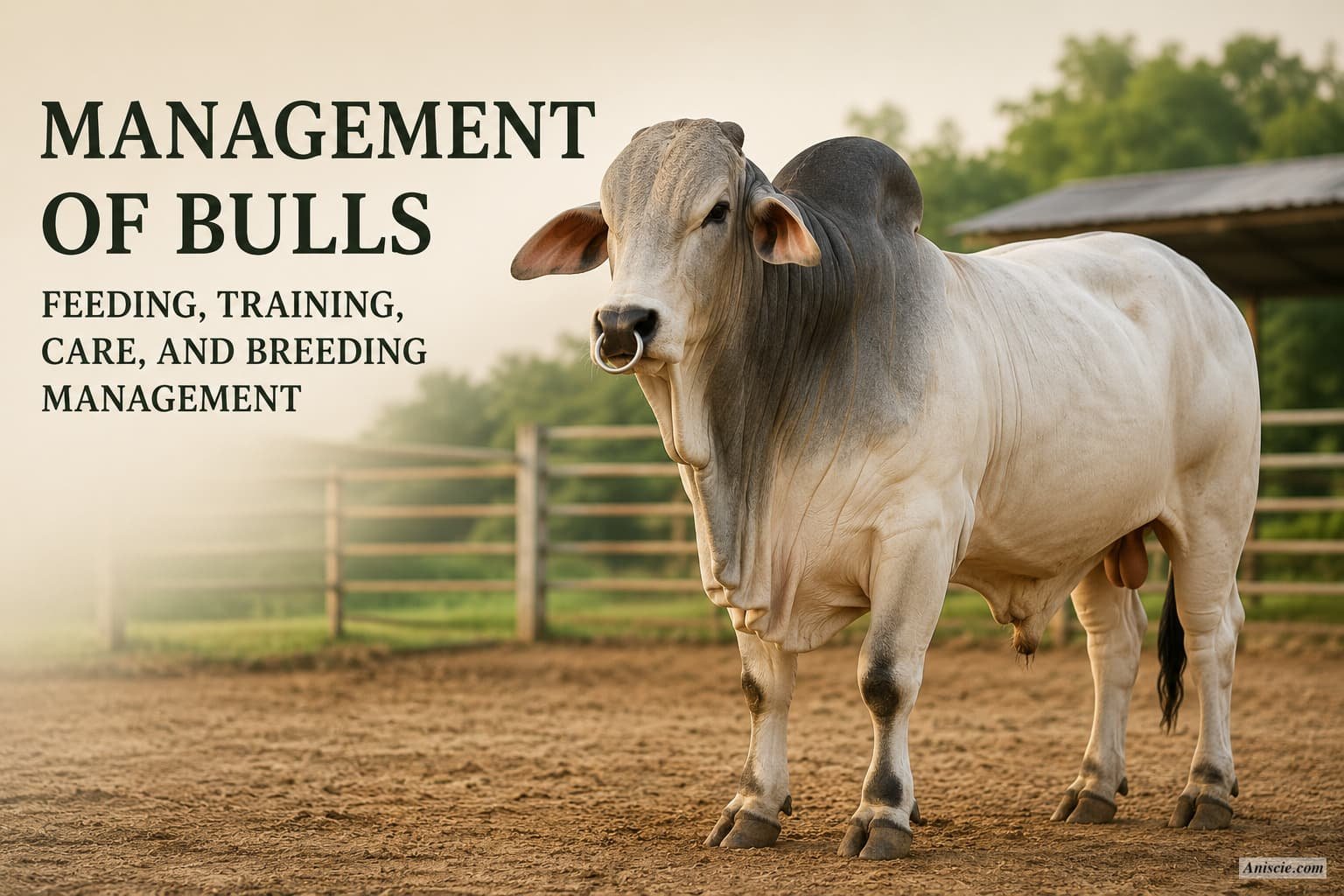
The bull should be ringed at about one year of age, by which time he begins to show his strength. A smaller ring can be fitted at this age and replaced with a larger one when he matures. Nose rings are made in two semi-circular pieces hinged together and are made of aluminum, copper, or another non-rusting alloy.
Since the nose is extremely sensitive to touch, a nose ring enables the attendant to keep the neck extended and the head raised while restraining or parading the bull. A nose ring is an essential item for controlling bulls. Bull-leading poles can be conveniently attached to the nose ring and are often necessary. The bull can be effectively controlled by means of a chain or rope around the horns threaded through the nose ring.
Training Young Bulls
Young bulls should be trained for handling and leading. It is much easier to maintain control of a mature bull if he was properly trained when young. Even when the bull is 4–6 months old, a simple halter may be placed over his head to accustom him to handling. After the nose ring is fitted, he should be led using either a chain or a pole.
While leading, the attendant should never walk in front of the bull but must lead from the side, keeping the nose higher than its natural position. If the nose is allowed to drop, the bull may develop an inclination to butt. While handling and leading, all bulls should be considered potentially dangerous, and no complacency should be shown at any time, even with older and well-acquainted bulls.
Exercise Requirements for Bulls
Growing as well as mature bulls should be exercised regularly so that they do not become excessively fat and thus remain in thrifty condition. Exercise also helps keep their hooves properly worn. Overgrown hooves may hinder walking as well as the mounting behavior of bulls.
Care of Mature Bulls
Breeding bulls should never be allowed to run with the herd. They should be housed individually in separate paddocks. This helps control the number of services performed by the bulls and facilitates the recording of breeding data.
The hair around the prepuce should be trimmed periodically. The hair should not be clipped too closely, as this may cause irritation and itching of the prepuce. A length of about 1 cm may be ideal.
Factors Affecting Sexual Libido in Bulls
Causes of Reduced Libido in Bulls
Several factors can reduce libido in bulls, including young or old age, inexperience, excessive exercise, overly frequent use, semen collection in unfamiliar places under unfavorable conditions, the use of unsuitable equipment, improper feeding, obesity or poor body condition, inherent defects, temporary injuries, or chronic defects of the legs, back, or penis. All such problems should be corrected as soon as they are noticed.
Handling and Semen Collection Factors
Some bulls are sensitive to the artificial vagina, whereas others seem able to withstand considerable rough handling. The well-known reflexes of mounting the cow, protruding the penis, thrusting, and ejaculating can easily be delayed or even inhibited in a bull by unnatural handling methods. Most bulls perform well in familiar surroundings and when handled by the same attendant, provided these conditions are associated with previous satisfactory experiences.
Sexual reflexes can be inhibited by painful, uncomfortable, or distracting situations. In sensitive bulls, inhibition may develop quickly, even when collections are performed carefully.
The animal should be given a rest period from semen collection for as long as possible when inhibition begins to develop. This problem can often be overcome by changing the surroundings.
Overuse and Service Management
Overuse is common in young bulls that are allowed free access to cows and heifers. The number of services, rather than the number of cows served, is the important consideration. No bull should be allowed to serve the same cow more than twice during a single estrous period.
A young bull may be placed with two or three cows per week and can be put into regular service after 2–2½ years of age. A mature bull may ejaculate many times per week without any adverse effect on libido or semen quality.
A bull with reduced libido may be stimulated by teasing and delaying service. Bulls can become bored with their surroundings, particularly when confined to a small paddock, and may lose interest. The presence of another bull or a change in surroundings may help overcome this problem.
Effects of Heat Stress on Libido
Heat stress leads to reduced sexual libido and poor semen quality, especially in purebred exotic and crossbred bulls. To overcome such problems during hot weather, bulls should be housed in cool, well-ventilated, dry sheds. Showering or splashing cool water on the bull two or three times during the hottest part of the day, along with protection from direct and reflected solar radiation, has been found to be very useful.
Feeding of Mature Bulls
A good rule for feeding mature bulls is to provide about 1 kg of hay and ½ kg of concentrate daily per 100 kg of body weight. Thus, a 400 kg bull should receive 4 kg of hay and 2 kg of concentrate. These amounts should be adjusted according to the body condition of individual bulls because there is variation in response. Excess fatness in mature bulls should be avoided at all costs, as it reduces libido and may cause severe stress and strain on the feet and legs.
Excess calcium in a bull’s ration can cause problems, particularly in older bulls. When legume roughage is fed, the concentrate mixture should not contain a calcium supplement. Generally, bulls do not lose large amounts of calcium, and over time, excess calcium may cause the vertebrae and other bones to fuse together. Therefore, bulls may require a different concentrate mixture than lactating cows.