CONTENT
Dairy Farm Record Keeping: Importance, Performance Recording, and Milk Recording Methods
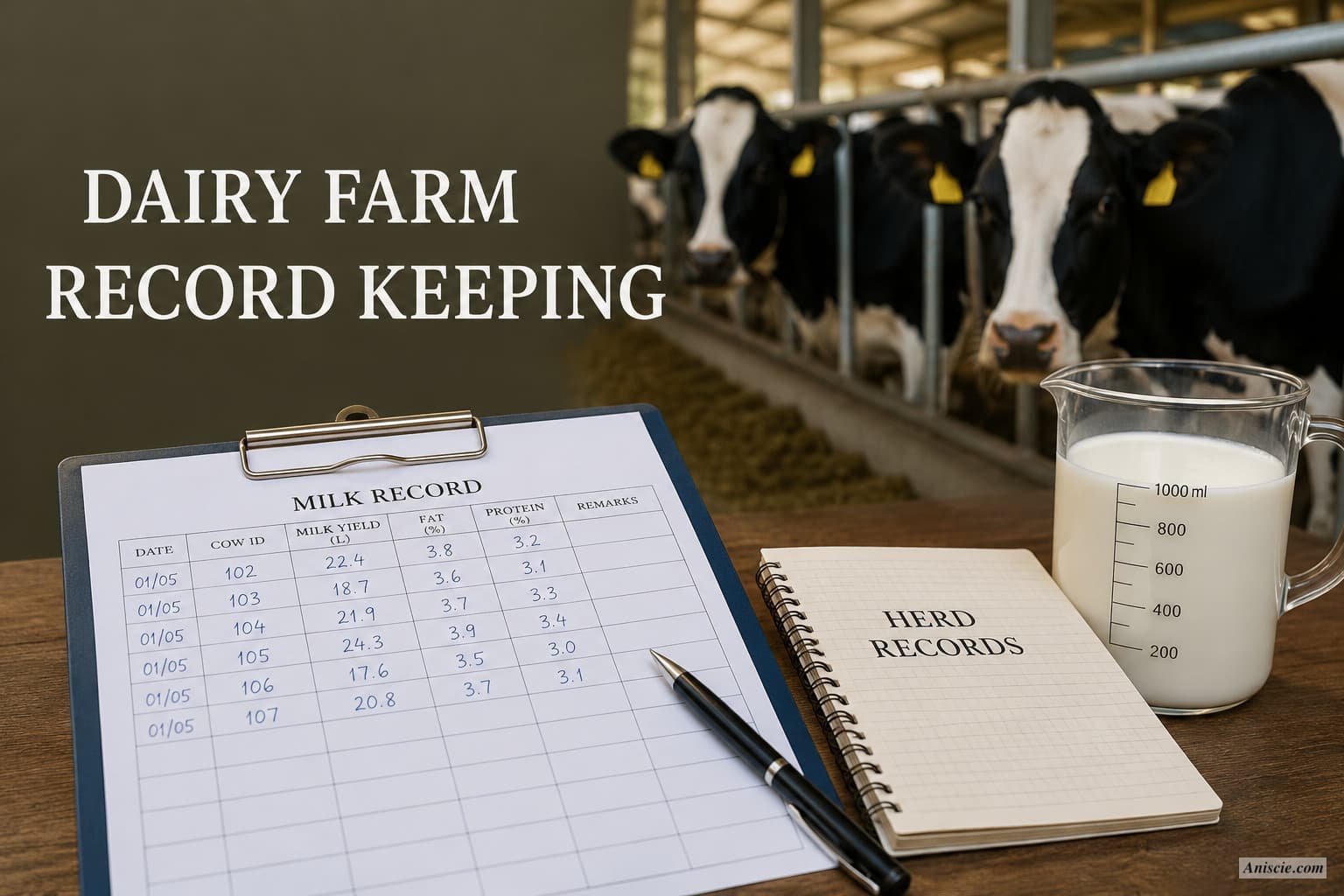
Dairy farm record keeping is a fundamental management practice that helps producers monitor herd performance, improve productivity, and make informed decisions related to breeding, nutrition, health, and overall farm operations. Accurate production and reproduction records provide valuable insights into the efficiency of individual animals and the herd as a whole, enabling producers to identify strengths, address weaknesses, and enhance profitability. This article discusses the importance of dairy farm record keeping, the objectives and requirements of performance recording, common milk recording methods, and the essential registers required for effective herd management.
The complex task of managing a dairy herd requires sound planning to synchronize all inputs and factors that are interrelated. It requires day-to-day planning, coordination, execution, and evaluation while keeping the ultimate objective in mind. This is possible only when the manager has all the relevant facts pertaining to the herd readily available. Such information can be obtained from production and reproduction records.
Significant advances in the development of the dairy industry in the United States, the United Kingdom, the Netherlands, and other countries have been achieved only after the introduction of scientific record-keeping and the effective use of performance records. Thus, record-keeping serves as a management tool that supports decision-making in the following areas.
On-Herd Uses of Records
- Each animal in the herd can be identified based on its production performance.
- Close management and appropriate feeding levels can be provided based on production level.
- The efficiency of culling and selection can be improved, which in turn increases profitability.
- The relative influence of feeding, management, and breeding on production performance can be assessed.
- Livestock marketing can be enhanced through the use of performance records.
Off-Herd Uses of Records
- Comparison of herd performance within and between breeds is possible.
- Superior stock can be identified for extensive use in breeding programs.
- Herd and breed registration programs can be implemented more effectively.
- Effective research, development planning, and program implementation become possible.
The twin objectives of performance recording in rural areas are:
- To help dairy managers and farmers produce greater quantities of milk at a lower cost.
- To provide the required data to administrators (for planning), research organizations (for scientific analysis of the enterprise), breeders (for developing selection and breeding programs), and extension personnel (for obtaining feedback from farmers).
In many developing countries, performance recording at the farm level remains limited, except on some government-operated farms. Illiteracy, poverty, lack of awareness, and insufficient incentives are common factors contributing to this situation. Creating the following incentives for farmers can be an effective approach to developing field-recording systems in rural areas.
- Paying for milk based on fat and protein content.
- Providing free advice on feeding and management to farmers who maintain records.
- Providing access to artificial insemination (AI) services using superior sires at no cost or reduced cost for farmers participating in performance recording programs.
- Providing incentives for daughter records of selected young bulls.
Major practical requirements of performance recording in developing countries:
- The system should be simple and require minimal paperwork from farmers.
- The system should appeal to the average farmer, who should clearly recognize its benefits for improved herd management.
- The direct cost to the farmer should be minimal.
- The records maintained should enable farmers to identify the best and poorest producers and support progeny testing of bulls.
- Information derived from the records should be made available to farmers promptly and in a simple format and should be utilized for extension and research purposes.
- The milk recorder should visit each farm at least once a month to maintain contact and provide advice.
Monthly test-day recordings have been found to be reasonably accurate in North America and Europe for selection purposes and for progeny testing. However, in Kenya, it appears preferable not to exceed a 14-day recording interval if a relatively high level of accuracy is desired when selecting individual cows.
Methods of Milk Recording
Two main methods are generally used:
- Cow-Day Method
- Lactation Method
1. Cow-Day Method
This method is particularly applicable to commercial milk producers. The end result is obtained by relating the total milk produced by a herd over a 12-month period to the number of cows, with adjustments made for feeding costs. This provides an estimate of average herd performance.
2. Lactation Method
This method meets the requirements of pedigree breeders, where emphasis is placed on lactation yields rather than annual yield. Breeders are more concerned with the specific performance of individual animals within the herd and comparisons among them to evaluate the effectiveness of the breeding program.
Registers to Be Maintained on a Dairy Farm
- Daily stock register
- Birth/calving register
- Calf/young stock register
- Adult stock register
- Breeding register/AI register
- Weight/growth register
- Milk yield and distribution register
- Sales/disposal register
- Mortality register
- Feed stock register
- Forage stock register
- Receipts/income register
- Herd health register