CONTENT
Milking and Methods of Milking in Dairy Cattle: Hand Milking, Machine Milking, and Best Practices
Milking is one of the most important management practices in dairy farming. Proper milking techniques help maximize milk yield, maintain udder health, and reduce the risk of mastitis. Milking may be performed manually or by using milking machines, and each method requires proper hygiene and technique to ensure complete milk removal. This article explains the prerequisites for good milking, preparation for milking, hand milking methods, machine milking principles, and best practices used in modern dairy production systems.
Prerequisites for Good Milking
Milking is a skill that requires experience and proper technique. It should be performed gently, quietly, quickly, hygienically, and completely. Cows that remain calm and comfortable during milking generally produce more milk than those that are handled roughly or become excited.
Maintaining hygienic conditions in the milking parlor promotes better udder health and helps produce milk that remains wholesome for a longer period. The milking process should be completed within 5 to 7 minutes. Complete milking is essential. If residual milk remains in the udder, it may serve as a nidus for mastitis-causing organisms, and overall milk yield may also be adversely affected.
Preparation for Milking
Dairy Cows and Housing Facilities
- The milking barn should be thoroughly washed and scrubbed after each milking and kept clean and dry before the next milking session begins.
- Dusty feed and silage should be avoided in the milking barn.
- The hindquarters, thighs, and udder should be washed thoroughly before milking.
- Excess hair growth in the udder region should be clipped periodically.
- Buffaloes should be thoroughly washed before milking.
- Just before milking, the udder should be wiped with a dry cloth.
- The teats should be dipped in a weak antiseptic solution. In cold weather, a warm antiseptic solution may be used.
Milkers and Milking Equipment
- The milker’s hands and milking pails or cans should be thoroughly washed or scrubbed and kept clean.
- Milkers should wear clean clothing and cover their heads with a suitable cap to prevent loose hair from falling into the milk.
- Nails should be trimmed regularly and kept smooth. Hands should be thoroughly washed and cleaned with an antiseptic solution.
Methods of Milking
- Hand milking
- Machine milking
1. Hand Milking
Hand milking is one of the most commonly practiced methods worldwide. Cows are generally milked from the left side. Stripping and full-hand milking are two commonly used methods of hand milking.
Wet-Hand Milking
Wet-hand milking is performed by lubricating the milker’s hands and the teat with water or oil. This practice may cause the teats to become dry and chapped. Cracks and sores may develop, resulting in pain and discomfort for the animal. In such cases, an antiseptic cream should be applied after milking.
Dry-Hand Milking
In this method, milking is performed without lubricating the milker’s hands or the teats. It is considered the best method because it minimizes the risk of chapping and soreness of the teats.
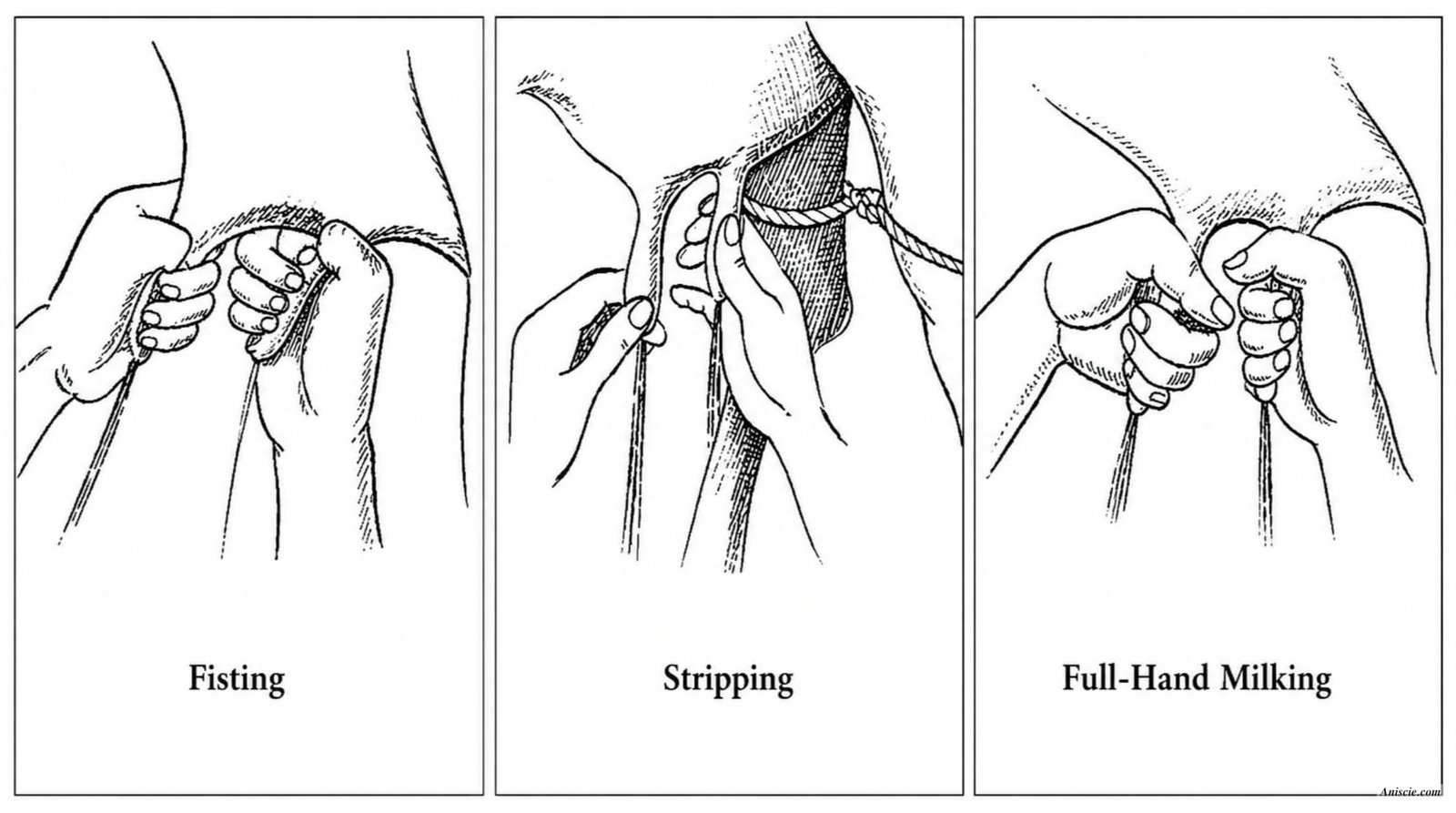
Different Methods of Hand Milking:
Full-Hand Milking
Full-hand milking involves holding the entire teat within the ring formed by the thumb and forefinger. The teat is then squeezed sequentially using the middle, ring, and little fingers along with the hollow of the palm, forcing the milk out.
This process is repeated in quick succession. Full-hand milking removes milk more rapidly than stripping. Cows with large teats and buffaloes are commonly milked using the full-hand method. This method is considered superior to stripping.
Stripping
Stripping consists of firmly holding the teat at its base between the thumb and forefinger and drawing downward along the entire length of the teat while applying pressure to force milk to flow out in a stream. The process is repeated in quick succession. Both hands may be used, with each hand holding a different teat and stripping alternately.
Stripping is practiced in cows with very small teats. It causes greater irritation and teat injury due to the repeated sliding motion of the fingers. Despite this, a few stripping movements are often performed at the end of milking to ensure complete milk removal. The last milk obtained, known as stripping milk, is richer in fat.
Knuckling
In the knuckling method, the teat is bent and pressed with the knuckles of the fingers to force milk out. This technique exerts excessive pressure on the teat tissues and teat sphincter, causing pain and discomfort to the animal. Repeated use of knuckling may lead to teat injuries and predispose the udder to infection. Therefore, this method is not recommended.
Fisting
In the fisting method, the teat is grasped tightly with the entire fist and squeezed forcefully to expel milk. This method is generally used only under special circumstances and is not commonly practiced in routine milking. Excessive force during fisting may injure the teat tissues and cause discomfort to the animal.
Pinching
In the pinching method, the teat is compressed between the thumb and one or two fingers to force milk out. This method causes considerable irritation and pain because pressure is concentrated on a small area of the teat. Frequent pinching may damage teat tissues and increase the risk of teat injuries. Therefore, this method is not recommended.
2. Machine Milking
Machine milking is now widely used in most Western and industrialized countries. It utilizes alternating negative pressure (vacuum) and atmospheric pressure through a double-chambered teat cup assembly. A continuous partial vacuum is maintained inside the inflatable rubber tube, known as the teat cup liner, into which the teat is inserted.
Partial vacuum and atmospheric pressure are alternated in the space between the rubber liner and the metal shell of the teat cup by means of a pulsator. When negative pressure is applied between the liner and shell, milk flows from the teat. When atmospheric pressure enters the chamber, the rubber liner collapses, resulting in compression and massage of the teat. Continuous vacuum without pulsation would cause congestion and irritation of the teats.
Factors Influencing the Efficiency of a Milking Machine:
Vacuum Level
The vacuum level directly affects milking efficiency, milk flow rate, teat health, and animal comfort. Excessively high vacuum levels may cause teat congestion and injury, whereas low vacuum levels may result in incomplete milking and reduced efficiency.
The degree of vacuum in a milking system during operation, expressed as inches of mercury (inHg), millimeters of mercury (mmHg), or kilopascals (kPa), measured relative to atmospheric pressure and indicated by a vacuum gauge.
- Pulsation Rate: The number of cycles of alternating vacuum and atmospheric pressure that occur per minute. It may vary between 40 and 60 cycles per minute in most milking machines.
- Milking or Pulsation Ratio: The proportion of time spent under vacuum compared with atmospheric pressure, usually maintained at approximately 60:40.
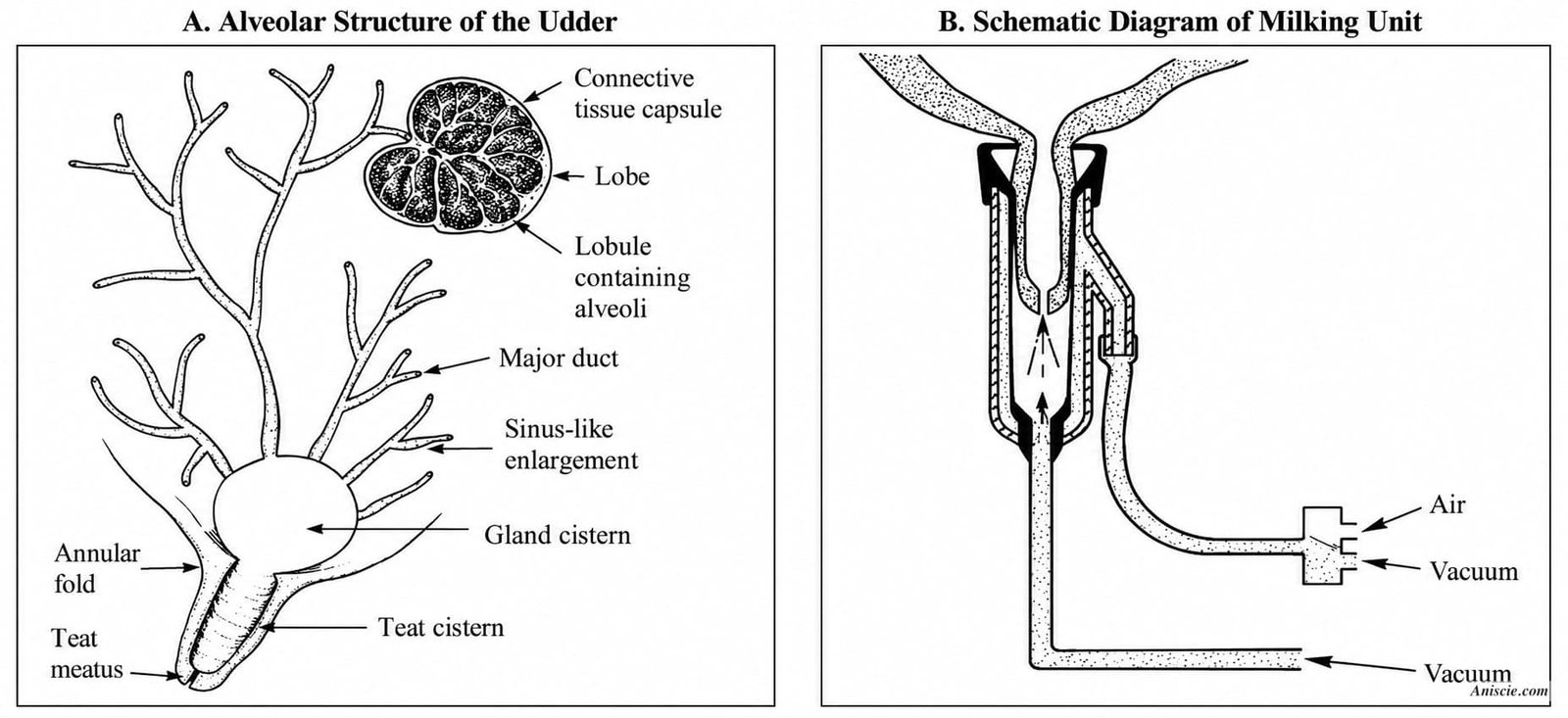
Ideal Practices for Machine Milking
- Prepare the cow for milking by wiping and massaging the udder and teats for 30 seconds to 1 minute. Use a cloth dipped in a warm, mild antiseptic solution and wrung out before use.
- Strip Cup Test: Use a strip cup and draw the first streams of milk from each quarter into the cup to check for any abnormalities.
- Attach the teat cups promptly.
- Using a timer is a good practice to prevent overmilking.
- Break the vacuum before removing the teat cups. After removal, massage the udder by hand if necessary.
- Apply a post-milking teat dip.
- Record the milk yield.
- Thoroughly clean and sanitize the milking machine after every milking session.
- Follow the manufacturer’s instructions for operation, maintenance, and servicing of the milking machine.
History of the Milking Machine
| Year of Invention | Inventor | Type of Milking Machine |
|---|---|---|
| 1865 | L.O. Colvin | First vacuum-type milking machine |
| 1878 | Mrs. Anne Baldwin | Hygienic glove milker with a hand pump |
| 1884 | J.P. Martin | Milking machine with teat cups, connecting tubes, and a vacuum pump |
| 1885 | Modestus Cushman | Pulsator |
| 1892 | Mehring Milker | Milking machine powered by a hand pump and later a foot pump |
| 1903 | Alexander Gillies | Modern milking machine |