CONTENT
Management of Pregnant Ewes and Does: Pregnancy, Parturition, Lambing, Kidding, and Weaning Care
Proper management of pregnant ewes and does is essential for improving reproductive performance, neonatal survival, growth rates, and overall flock productivity. Special attention during pregnancy, parturition, lactation, and the early life of lambs and kids helps reduce mortality, prevent health problems, and promote healthy growth and development.
This article outlines the important management practices for pregnant, parturient, and lactating ewes and does, as well as the care of newborn lambs, kids, and weaners.
Pregnant, Parturient, and Lactating Ewes/Does
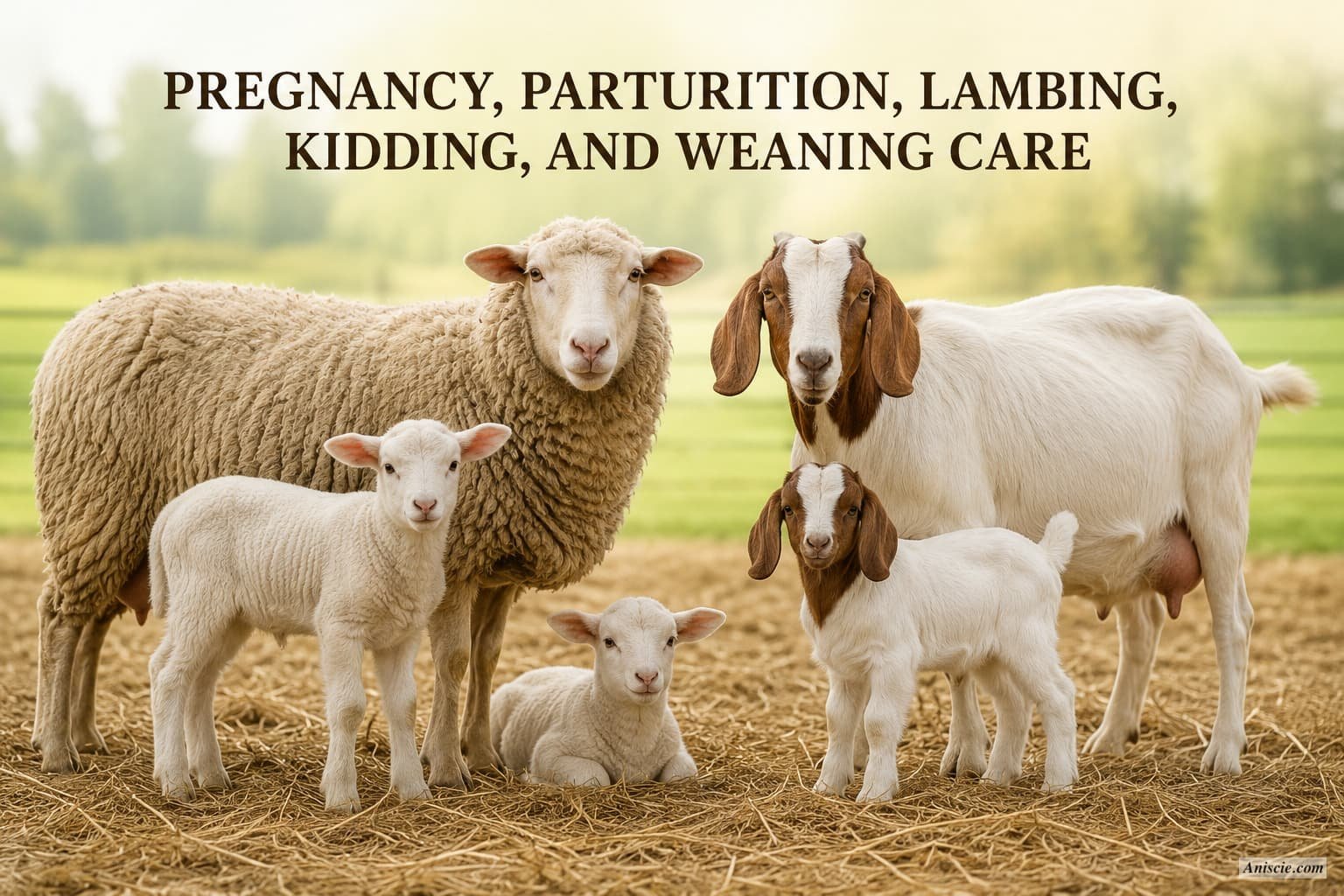
Careful management of pregnant, parturient, and lactating ewes and does has a marked influence on the survival and growth of lambs and kids.
The following recommendations are important for proper care and management:
- Pregnant ewes should not be handled frequently.
- Ewes/does in the advanced stage of pregnancy should be separated from the flock, and special attention should be given to their feeding.
- Providing extra feed during the later stage of pregnancy (3–4 weeks before parturition) is beneficial for maintaining the condition of pre-parturient ewes. It also helps improve milk production and increases the birth weight and growth rate of lambs.
- Inadequate nutrition may result in pregnancy toxemia, abortion, and the premature birth of weak lambs.
- Ewes/does in the advanced stage of pregnancy should be kept in a separate lambing pen or shed 4–6 days before parturition. Maximum comfort should be provided through soft, clean bedding and individual lambing pens.
- The ewe/doe should be protected from cold weather conditions.
Care at Lambing/Kidding/Parturition
A ewe/doe about to lamb or kid often prefers to leave the flock and may appear restless. The udder is usually distended, and the external genitalia become swollen and relaxed. In healthy ewes, parturition is generally normal. The following precautions may be taken during and after parturition.
- Keep a vigilant watch for dystocia or difficult birth.
- Maiden ewes in poor condition or small-framed ewes mated to large rams may experience difficulty during parturition and may require assistance.
- Newborn lambs generally stand and begin searching for the teat after being licked by the mother. If they are unable to do so within a reasonable period, assist them in suckling colostrum. Colostrum, the first milk, is essential for the health and survival of newborn lambs.
- The newborn should be protected from cold, wind, and rain.
- Artificial milk feeding or the use of a foster mother should be arranged for orphaned or rejected lambs. Goats can serve as excellent foster mothers, and ewes that have lost their lambs shortly after birth may also be utilized.
- Ligate, cut, and antiseptically dress the navel cord of the lamb.
- Administer a teaspoonful of castor oil or liquid paraffin, preferably mixed with a small quantity of milk, curd, or buttermilk, to facilitate the passage of meconium and reduce the risk of E. coli infection.
- Lambs/kids should not be handled excessively immediately after birth. Allow the dam to lick and recognize them properly. The first 1–2 hours after birth are critical for establishing the maternal bond. Therefore, the dam should be kept in a calm environment free from disturbance by dogs or other animals.
- Allow newborn lambs to remain with their mothers continuously during the first week of life.
- Provide sufficient quantities of high-quality hay and concentrate feed to lactating ewes to meet the nutritional demands of early lactation.
- Provide ample clean, fresh drinking water, as lactating ewes consume significantly more water during lactation.
Care of Lambs/Kids
Lambs and kids require special attention during the early stages of life to ensure optimal survival, health, and growth. The following management practices are recommended.
- Ensure that lambs/kids receive an adequate quantity of colostrum within the first hour after birth to enhance disease resistance.
- Ensure proper suckling of lambs. Examine the udder for blind teats or mastitis.
- Pay special attention to indifferent mothers and facilitate suckling by restraining such ewes when necessary.
- Provide creep feed (high-quality hay with or without a concentrate mixture) to suckling lambs from approximately 10 days of age until weaning, in addition to milk feeding.
- Where possible, provide green leguminous fodder or fresh tree leaves for lambs to nibble during the suckling period.
- Lambs may be ear-tagged or tattooed for identification. Tail docking and castration may also be performed during the first week of life using an elastrator placed at the intervertebral space rather than directly over the vertebrae.
- Alternatively, a sterilized and clean knife may be used for castration and tail docking, followed by proper ligation and antiseptic dressing of the surgical site.
- Following castration, lambs should be maintained in a dry, clean, and hygienic environment to minimize the risk of tetanus and other infections.
- Kids are naturally playful; therefore, adequate space should be provided for movement and exercise.
- A salt lick or mineral block should be provided in the lamb pen to discourage soil or floor licking.
Weaning and Care of Weaners
The management of weaners plays an important role in successful sheep and goat production. The following practices are important for their proper care and management.
- Weaning should preferably be carried out at 90 days of age, although it may be done around 60 days in breeds with lower milk production or when early rebreeding is desired.
- Provide supplementary feeding and access to clean, high-quality pasture for growing weaners.
- Weaned lambs should be dewormed against gastrointestinal parasites during the first month after weaning and vaccinated against enterotoxemia and sheep pox according to local vaccination schedules.
- Weaners should not be grazed on poor-quality, thorny, or burr-infested pastures, as these may cause skin irritation, eye injuries, and wool damage.
- They should be protected from adverse weather conditions and predation.