CONTENT
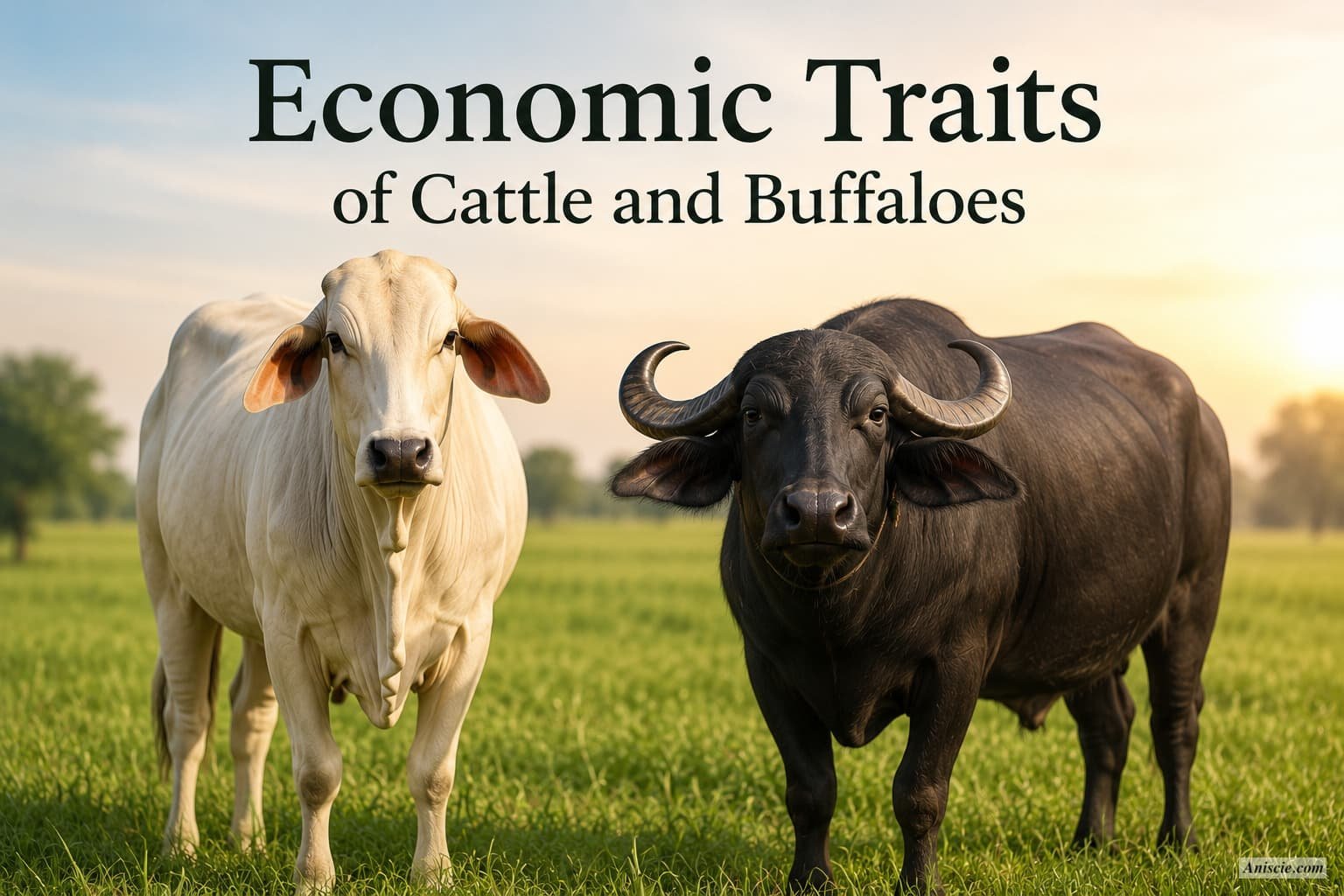
Economic Traits of Cattle and Buffaloes: Definitions, Characteristics, and Importance
Economic traits are characteristics of cattle and buffaloes that directly influence their productive and reproductive performance and, consequently, their economic value. These traits are important in dairy herd management, animal breeding, and selection programs because they affect milk production, reproductive efficiency, longevity, and overall profitability.
The major economic traits of cattle and buffaloes include age at first calving, calving interval, service period, lactation performance, milk composition, and related reproductive parameters.
Age at First Calving
It is the age of the cow or buffalo at the time of first calving, usually expressed in days or months. Most indigenous breeds are late maturing and show wide variation due to differences in management and climatic conditions. Among various breeds, Sahiwal (41 months), Red Sindhi (44 months), and Ongole (39 months) have a lower age at first calving.
Other breeds such as Kankrej (47 months), Hariana (59 months), Tharparkar (48 months), and non-descript cattle (56 months) have a longer age at first calving. In contrast, exotic breeds such as Holstein Friesian (36 months), Jersey (29 months), Brown Swiss (34 months), and their crosses (B. indicus × B. taurus, 34 months) possess a shorter age at first calving under tropical climatic conditions.
This indicates that most indigenous breeds do not mature early. Further nutritional studies have shown that the age at first calving cannot be reduced below 35 months, even with improved feeding and management, and that further reduction can only be achieved through the introduction of new genetic variability. In buffaloes, the age at first calving ranges from 40 to 50 months.
Intercalving Period
The number of days from one calving to the next. This may be designated as the first intercalving period, second intercalving period, etc. (calving interval = service period + gestation period, or lactation period + dry period).
The average calving interval in indigenous Indian breeds varies between 16 and 18 months. Hariana, Red Sindhi, and Ongole have a longer calving interval (16–18 months), whereas Sahiwal, Tharparkar, and Deoni have a shorter calving interval (around 15 months). In B. indicus × B. taurus crosses, the calving interval is less than 13 months. Research findings have shown that the calving interval can also be improved through better feeding and management.
Service Period
The interval between calving and the subsequent service resulting in conception (as determined by the birth of a calf).
Most reproductive traits depend largely on the service period, which influences other reproductive parameters. The service period ranges from 138 to 170 days in most milch and dual-purpose breeds, including Sahiwal, Red Sindhi, Tharparkar, Gir, Hariana, and Deoni.
It is longer in Ongole (221–240 days), Kankrej (206–220 days), and non-descript cattle (271–284 days), whereas the service period is shorter in crossbred cattle (105–122 days). In buffaloes, the service period ranges from 193 to 236 days.
Breeding Efficiency (Conception Rate)
Measured as the number of services per conception. This should be calculated separately for the first calving, second calving, etc.
Dry Period
The number of days from drying off to the next calving. A dry period of 130–160 days is common in Sahiwal, Red Sindhi, Tharparkar, Hariana, and Kankrej cattle. A longer dry period, exceeding 205 days, has been observed in Ongole and non-descript cattle.
The average dry period in crossbred cattle in India is around 90–94 days. In buffaloes, wide variation has been observed (60–200 days in Murrah and 111–343 days in Surti buffaloes).
Lactation Length
The number of days in milk from calving until final drying off or cessation of milking.
Most indigenous breeds have a lactation length of 230–306 days, whereas buffaloes generally have a longer lactation length (228–350 days). In exotic breeds such as Holstein Friesian and Jersey, lactation length is also longer (279–411 days).
Lactation Yield
Milk yield (kg) from the date of calving to the date of drying off. The order of lactation should be indicated as I, II, etc.
The average lactation yield in Sahiwal cattle is 1500–2300 kg, followed by Red Sindhi (1500–1650 kg), Tharparkar (1450–2200 kg), and Gir (1300–1800 kg). Lactation yield is lower in breeds such as Hariana (721–1436 kg), Ongole (613–1120 kg), and Kankrej (960–1856 kg), and even lower in non-descript cows (376–535 kg). Crossbred cattle, however, produce an average milk yield of 2000–3100 kg per lactation.
The mean lactation yield of most buffalo breeds ranges between 1000 and 2500 kg, whereas non-descript buffaloes produce lower milk yields (500–650 kg).
Lactation yield (305 days):
- When daily milk records are available: milk yield (kg) from the date of calving to the 305th day of lactation.
- When milk recording is performed once weekly: milk yield (kg) from the date of calving to the 305th day, calculated from weekly records (weekly milk yield multiplied by 7 and accumulated up to 305 days).
- When lactation length is shorter than 305 days: milk yield (kg) during the actual lactation period is considered the 305-day lactation yield.
- When lactation length exceeds 305 days: milk yield (kg) is adjusted to a 305-day equivalent using correction factors.
- Lactation yield (180 days): Milk yield (kg) from the date of calving to the 180th day of lactation.
- Milk yield per day of lactation: Average daily milk yield (kg).
- Milk yield per day of calving interval: Average daily milk yield (kg) over the calving interval.
Peak Yield
The highest daily milk yield (kg) attained during the lactation period.
Daily milk yield increases after calving, reaching a maximum approximately 4–6 weeks postpartum. After attaining this maximum, or peak yield, milk production gradually declines until the animal dries off. Peak yield is generally attained by the second month of lactation in buffaloes, zebu cattle, and their crossbreds.
Persistency of Lactation
Persistency of lactation refers to the ability of a dairy animal to maintain milk production after attaining peak yield. Animals with high persistency show a slower decline in milk yield during the later stages of lactation and are generally considered more economical because they produce a greater quantity of milk over the lactation period.
Average Fat Percentage
Average of fat tests conducted on milk samples collected at two-week intervals during lactation.
Milk fat percentage is an important economic trait because it directly influences the market value of milk and dairy products. Buffalo milk generally contains a higher fat percentage than cow milk. Fat percentage is influenced by breed, stage of lactation, feeding management, season, and individual animal variation.