CONTENT
Feeding Management of Sheep: Complete Guide to Ewe, Ram, and Lamb Nutrition
Sheep feeding management involves providing balanced nutrition to ewes, rams, and lambs according to their age, physiological status, and production stage. Proper feeding practices during breeding, pregnancy, lactation, and growth are essential for maintaining flock health and maximizing productivity.
Adequate nutrition improves fertility, increases lambing rates, supports healthy fetal development, enhances milk production, promotes rapid lamb growth, and improves wool yield. Effective grazing management and strategic supplementation with concentrates, fodders, and protein sources help meet the nutritional requirements of sheep throughout their production cycle.
Sheep have a small muzzle and a split upper lip, which help them nibble small blades of grass on pasture. In many parts of the world, sheep and goats are raised primarily on roughages, making their production costs lower than those of poultry and pigs.
At present, extensive grazing on marginal grasslands is widely practiced. The animals graze on crop stubbles, weeds, and grasses on fallow lands as well as rangelands. This meets the nutritional requirements of the animals only partially.
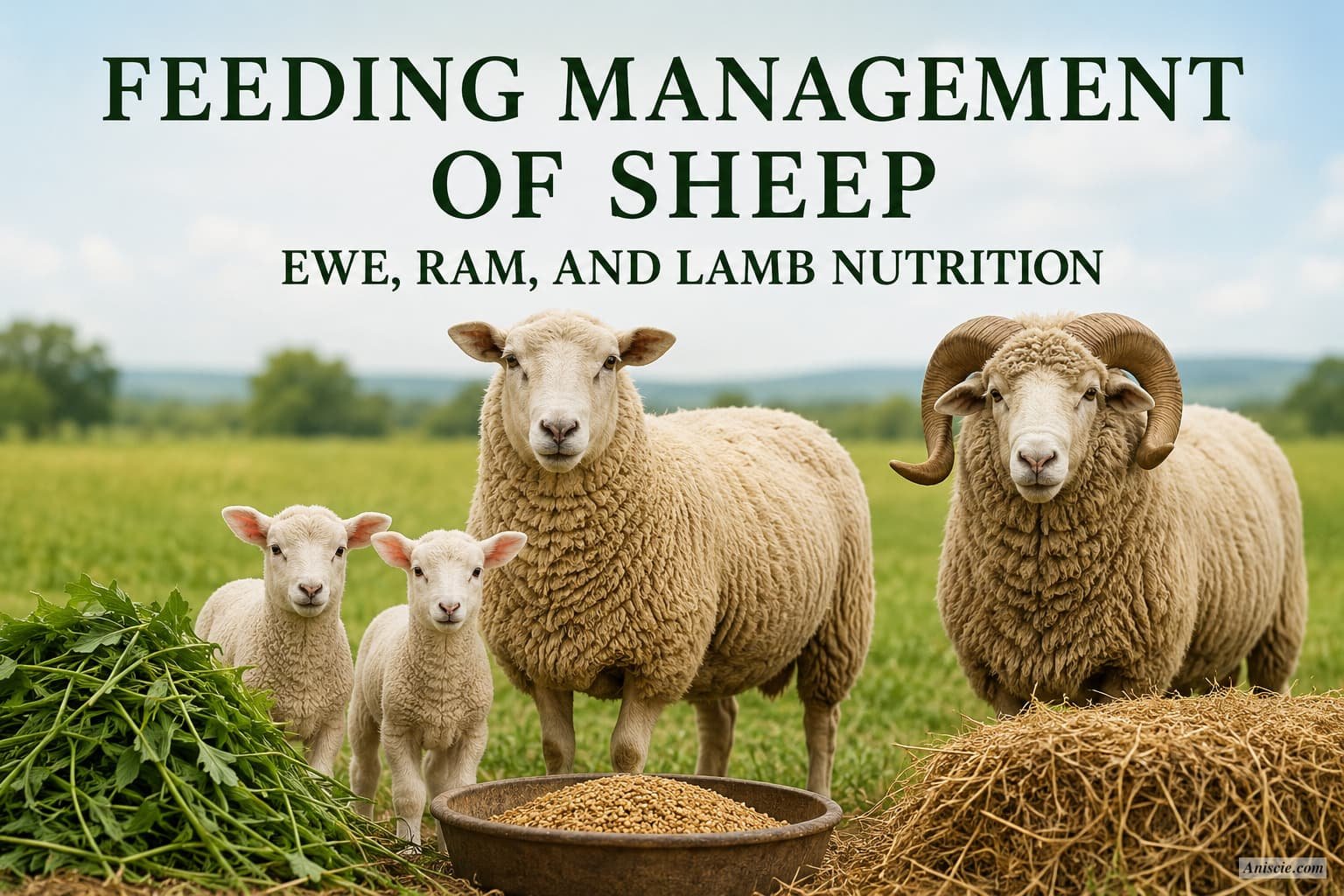
Their diet may be supplemented with cultivated fodders, grains, and oil cakes, especially during critical periods of the production cycle when nutrient supply is inadequate.
Feeding Management of Breeding Ewes
The feeding of the ewe will be discussed under the following headings:
- Flushing ewes
- Feeding during breeding
- Feeding during early and mid-pregnancy
- Feeding during late pregnancy
- Feeding at lambing time
- Feeding lactating ewes
- Feeding ewes from the time lambs are weaned until flushing time
1. Flushing
About 2 to 3 weeks before the onset of the breeding season, the nutritional plane of ewes should be increased to promote weight gain. This practice brings ewes into estrus earlier in the season, resulting in earlier lambing. It also tends to synchronize estrus among ewes, resulting in a more uniform lamb crop.
In addition, flushing increases the lambing rate and the incidence of multiple births within the flock.
- Different flushing rations are provided below, and any one method may be followed depending on the availability of feed resources.
- A good mixed pasture of legumes and grasses.
- A grass pasture plus 150 g of wheat bran per head per day.
- Grass pasture plus 250 g of grains and 450 g of oil cakes.
- Legume hay fed ad libitum plus 100 g of wheat bran and 150–200 g of grain.
- Green fodder at the rate of 10% of body weight and 150–200 g of concentrate per head per day.
Over-fat Ewes
Over-conditioning results in excessive fat deposition, leading to reduced fertility. A good shepherd should monitor ewes for excessive body condition at least one and a half to two months before the onset of the breeding season.
Over-fat ewes may be gradually brought to the desired body condition by reducing feed intake and increasing exercise.
The producer should regularly monitor body condition and maintain ewes in an appropriate condition for flushing, preferably on the slightly lean side, through mild feed restriction and adequate exercise.
2. Feeding During the Breeding Season
The ration provided during flushing should be continued throughout the breeding season.
3. Feeding During Early and Mid-Pregnancy
Good nutrition during gestation is the cornerstone of producing a healthy and vigorous lamb crop. If feeding is inadequate or deficient, weak or dead lambs may result.
A weak lamb at birth is more of a liability than an asset to the sheep enterprise. Moreover, the productive life of a ewe is extended when she receives adequate nutrition throughout gestation.
Proper feeding of ewes is advantageous because it:
- Increases the number of strong, healthy lambs born alive.
- Prolongs the productive life of the ewe.
- Increases milk yield, resulting in healthier weanlings.
- Improves wool production.
- Reduces the incidence of pregnancy toxemia (lambing paralysis).
- Decreases the likelihood of ewes rejecting their lambs due to exhaustion and weakness.
The early and mid-pregnancy periods are generally not critical from a nutritional standpoint. This does not mean that ewes do not require a properly balanced ration. Rather, the additional nutritional requirements associated with pregnancy are relatively low during these stages, and their needs can often be met through good-quality grazing alone.
Some rations recommended for improved or exotic breeds of ewes during this period include:
- Grazing: On a good-quality pasture.
- Sorghum Silage: One to two kilograms of sorghum silage plus 0.5–1.0 kg of legume hay per head per day.
- Ad libitum maize or sorghum fodder plus 50 g of oil cake, such as groundnut cake, per head per day.
- Grazing on crop stubbles and harvested fields supplemented with 100 g of oil cake per head per day.
4. Feeding During Late Pregnancy
Late pregnancy is the most critical stage from a nutritional standpoint. During the early portion of this period, ewes may be allowed to graze on crop aftermaths (crop stubbles), wild grasses, and weeds.
Their ration should be supplemented with available green fodder at the rate of 5 kg per head per day. During the final month of pregnancy, fetal growth accelerates rapidly within the uterus.
Insufficient dietary energy can result in pregnancy toxemia in ewes. Therefore:
Provide 600 g of high-quality legume hay or 300 g of concentrate containing 12–14% DCP and 65–70% TDN during the last 45 days of pregnancy.
Molasses or grains (barley, maize, oats, etc.) may be fed at the rate of 225 g per head per day. Ewes should also receive available green fodder at the rate of 7 kg per head per day.
5. Feeding at Lambing Time
As lambing time approaches or immediately after lambing, the grain allowance should be substantially reduced, while good-quality dry roughage should be provided free choice.
After parturition, the ewe’s ration may be gradually increased until she receives the full ration in six to seven divided feedings per day. In general, bulky and laxative feedstuffs may be included in the ration during the first few days.
A mixture of wheat bran and barley, oats, or maize in a 1:1 proportion is considered an excellent feed. Soon after lambing, the ewe should be provided with an adequate quantity of slightly warm water.
As soon as the first lamb is born, creep feeders should be supplied with a lamb starter ration. An ideal starter ration may consist of 16 parts groundnut cake and 84 parts barley or maize grain, along with available green or dry fodder.
6. Feeding Lactating Ewes
The ration of lactating ewes should be supplemented to maintain adequate milk production, which is essential for the rapid growth of lambs. When ewes are provided with good-quality pasture, their nutritional requirements are generally met.
When supplementary feeding is necessary, the amount of additional feed may be estimated as follows:
An average ewe’s daily pasture requirement can be replaced by approximately 450 g of good-quality hay, 1.4 kg of silage, or 250 g of grain. When cultivated green fodder is fed, about 10 kg per head per day is sufficient.
Alternatively, 400 g of concentrate mixture or 800 g of high-quality legume hay per day may be provided for approximately 75 days after lambing, in addition to 8 hours of grazing.
7. Feeding Ewes from Weaning Until Flushing
This is the least critical period with respect to nutrient requirements. Ewes may be maintained entirely on pasture during this stage. Poor-quality pastures and other low-quality roughages can be utilized efficiently during this period.
Feeding Rams for Breeding
Rams in normal body condition require additional nutrients during the breeding season. An over-conditioned ram, on the other hand, should be brought to an appropriate body condition before the breeding season begins. This can be achieved gradually through a combination of feed restriction and regular exercise.
A common practice is to allow rams to graze with the ewes, enabling them to consume the same ration. If separate feeding is practiced, rams may be provided with 300–500 g of concentrate mixture per day consisting of three parts oats or barley, one part maize, and one part wheat.
Feeding Management of Lambs
1. Feeding Suckling Lambs
This is the early stage of a lamb’s life during which it depends largely on its mother’s milk for nutrition. This period ends when the lamb is weaned. It is generally most economical to maintain ewes and lambs on high-quality pasture, as good grazing supports milk production in ewes and promotes lamb growth.
Lambs will also nibble succulent green forage. However, available pastures are often of poor quality or inadequately managed. Under such conditions, lambs may be supplemented with grains and oil cakes in addition to their mother’s milk and pasture.
Depending on economic considerations and pasture availability, producers may decide whether to continue raising lambs or market them at weaning.
2. Feeding Early-Weaned and Orphan Lambs
Lambs are usually weaned at approximately three months of age. Some lambs may also become orphaned due to the death of the ewe or maternal rejection. Young lambs receiving creep feed, early-weaned lambs, and orphan lambs must be provided with adequate nutrition.
Up to six weeks of age, grains should be cracked before feeding. After this stage, grains may be fed whole, although hard grains may still be cracked, crimped, or rolled.
These young lambs should have access to good-quality pasture or high-quality legume hay, preferably in pelleted form, in addition to grain. If good pasture or legume hay is unavailable and only poor-quality roughage is fed, the grain ration should be supplemented with a protein-vitamin supplement containing approximately 12% digestible crude protein.
Complete pelleted rations containing both roughage and concentrate have been found to be advantageous. Lambs consuming such rations generally eat more and grow faster. These pellets can be self-fed, and nutrient intake may be adjusted by altering pellet composition as lambs grow. Initially, pellets should contain 65–70% roughage, which may be gradually reduced to about 50% by 10–12 weeks of age.
Some recommended rations for creep-fed and early-weaned lambs include:
- Maize 40%, oats 30%, barley 30%, plus lucerne hay fed ad libitum.
- Oats 20%, maize 40%, barley 20%, groundnut cake 20%, plus vitamin supplementation.
- Maize 25%, oats 40%, wheat bran 20%, groundnut cake 15%, plus vitamin supplementation.
3. Feeding from Weaning to Market
The types of feed used and the methods of feeding vary depending on economic conditions, climate, and feed availability. In many developing regions, the preferred strategy is to utilize grazing lands, rangelands, and crop aftermaths as much as possible and supplement nutritional deficiencies with harvested fodder, hay, or concentrate feeds.
An average lamb may be provided with 225–450 g of concentrate mixture daily, depending on grazing conditions. Where grazing is abundant, 225 g is generally adequate. On heavily grazed or poor-quality pastures, lambs may receive 450 g of concentrate mixture along with 0.5–2.0 kg of high-quality green fodder.
Concentrate Mixtures for Supplementing Lamb Grazing
| Summer Ration | |
|---|---|
| Groundnut cake | 20% |
| Wheat bran | 35% |
| Crushed gram | 10% |
| Oats/Barley | 35% |
| Winter Ration | |
| Wheat bran | 25% |
| Oats/Barley/Sorghum | 50% |
| Groundnut cake | 25% |
Rate of Concentrate Feeding Per Day
| S. No. | Body Weight | When Legume Fodder is Available | When Non-Legume Fodder is Available |
|---|---|---|---|
| 1 | Up to 12 kg | 25–50 g | 200–300 g |
| 2 | 12–15 kg | 50 g | 300 g |
| 3 | 15–25 kg | 100 g | 400 g |
| 4 | 25–35 kg | 150 g | 600 g |
Grazing Management in Sheep
In many regions, grazing lands are overgrazed and often poorly managed. Pasture improvement is therefore of critical importance for profitable sheep production. Uncultivated lands may be converted into productive community pastures through fencing, land reclamation, soil preparation, irrigation where feasible, and establishment of suitable forage legumes and grasses.
Pastures should be divided into paddocks to facilitate rotational grazing. Properly managed pasture can support approximately 10–12 ewes and their lambs per acre, depending on forage productivity.
Grazing systems should be managed to maintain pasture quality and productivity. Periodic rotation between grazing areas is desirable, as sheep may reduce feed intake when grazing the same pasture continuously for extended periods.