CONTENT
Draught Ability of Cattle and Buffalo: Working Capacity, Selection, Training, Care and Feeding of Bullocks
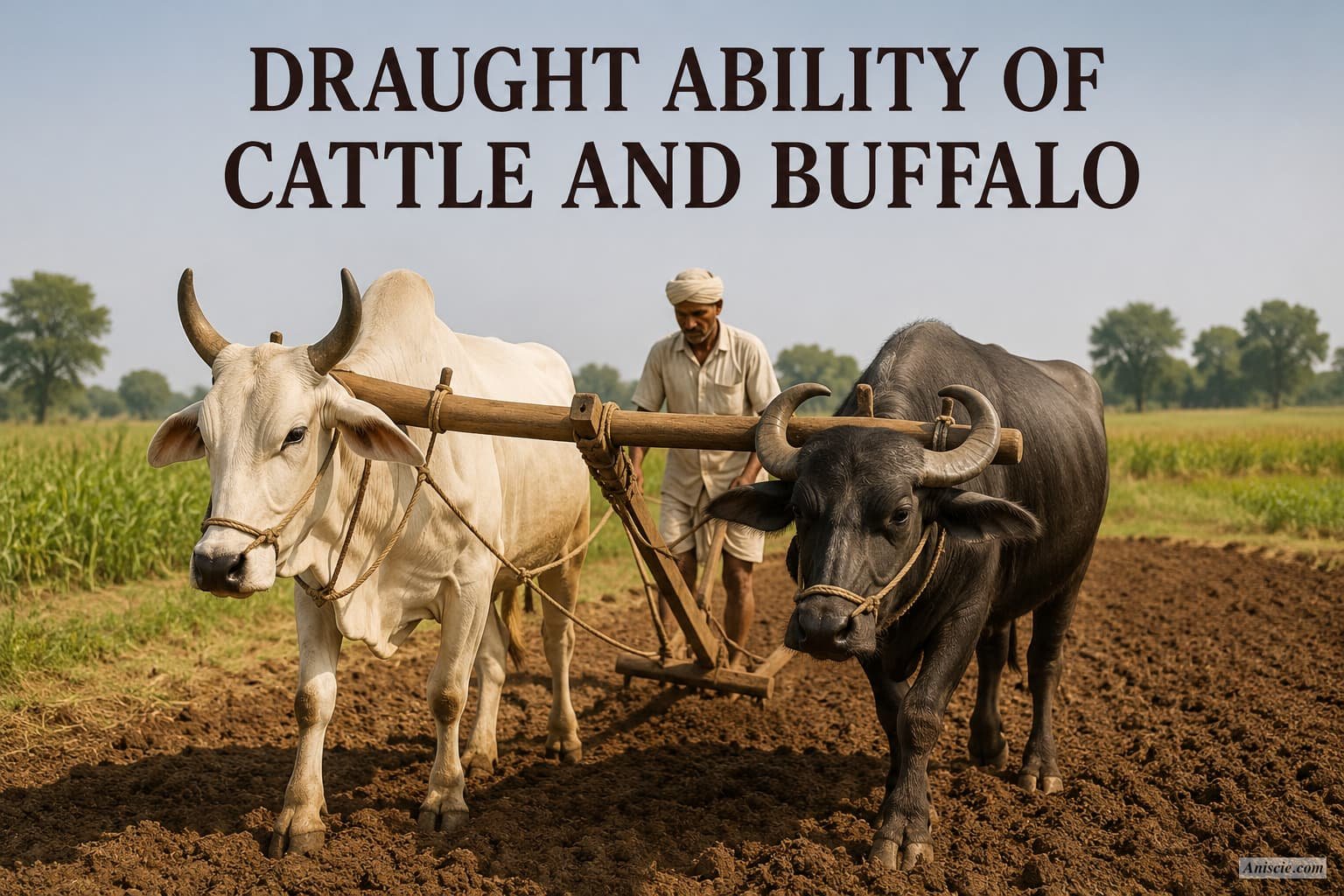
Draught animals have long played an important role in agriculture and rural transportation. Among domestic livestock, cattle and buffaloes are widely used for plowing, carting, and other farm operations because of their strength, endurance, and adaptability. The draught ability of these animals depends on factors such as body weight, age, breed, training, nutrition, and working conditions.
Draught ability refers to the capacity of an animal to perform work by pulling, carrying, or transporting loads over a specified period. It is influenced by body weight, muscular development, speed, endurance, training, nutrition, and environmental conditions. In cattle and buffaloes, draught ability determines their suitability for agricultural operations such as plowing, carting, cultivation, and transport.
Bullocks form the backbone of agriculture and transportation in many rural areas. Farmers traditionally regard the cow as the mother of the work bullock and the buffalo primarily as a milk-producing animal. A study by the FAO indicated a high rate of increase in crop yield with increasing power inputs up to a level of about 0.4 kW/hectare, which corresponds to a crop yield of approximately 2.5 tonnes/hectare. One adult worker plus a pair of oxen can provide such power for about 3–4 hectares of land, i.e., approximately one small farm holding. Thus, draught animal power is particularly suited to the conditions of smallholder farming commonly found in developing countries.
Draught capacities of bullocks and buffaloes are as follows:
| Type of Animal | Mature Weight (kg) | Low Speed | Average Speed | ||||
|---|---|---|---|---|---|---|---|
| Speed (km/h) | Tractive Effort (kgf) | Power (kW) | Speed (km/h) | Tractive Effort (kgf) | Power (kW) | ||
| Ox | |||||||
| Light | 210 | 2.5 | 30 | 0.21 | 4 | 21 | 0.23 |
| Medium | 450 | 2.5 | 64 | 0.44 | 4 | 45 | 0.50 |
| Heavy | 900 | 2.5 | 129 | 0.89 | 4 | 90 | 0.99 |
| Cow | |||||||
| Light | 200 | 2.5 | 20 | 0.13 | 3.5 | 16 | 0.15 |
| Heavy | 575 | 2.5 | 58 | 0.40 | 3.5 | 48 | 0.46 |
| Buffalo | |||||||
| Light | 400 | 2.5 | 56 | 0.39 | 3.2 | 40 | 0.35 |
| Medium | 650 | 2.5 | 91 | 0.63 | 3.2 | 65 | 0.57 |
| Heavy | 900 | 2.5 | 126 | 0.87 | 3.2 | 90 | 0.80 |
Estimated capabilities of cattle and buffaloes for carrying pack loads over 6–8 hours per day:
| Animal | Mature Weight (kg) | Speed (km/h) | Load (kg) | |
|---|---|---|---|---|
| Average | Maximum | |||
| Ox | ||||
| Light | 210 | 3.5 | 25 | 55 |
| Medium | 450 | 3.5 | 55 | 115 |
| Heavy | 900 | 3.5 | 110 | 225 |
| Buffalo | ||||
| Light | 400 | 3.0 | 50 | 60 |
| Medium | 650 | 3.0 | 82 | 100 |
| Heavy | 900 | 3.0 | 110 | 140 |
In terms of horsepower, the approximate power developed by cattle is 0.74 hp, by buffaloes 0.75 hp, and by cows 0.45 hp.
Working Capacity of Bullocks
The average speed of a pair of bullocks pulling a cart is around 4–5 km per hour. If not overdriven, they can travel 25–30 km or even up to 40 km daily under favorable conditions. The pace and distance covered by bullocks depend not only on the weather but also on their physical condition, the type of harness and equipment used, and to a considerable extent on the driver. In general, bullocks should not be used for more than 5 hours per day for strenuous work such as plowing and heavy transportation over uneven terrain.
The average draft (weight borne on the neck) developed by bullocks varies from one-fifth to one-sixth of their body weight. The optimum draft for an average pair of Hariana bullocks is about 60 kg. The maximum load pulled by indigenous as well as crossbred bullocks varies between 1,210 and 1,310 kg.
Generally, a pair of good bullocks is sufficient to carry out all cultivation and transportation work during one year on a 5-hectare farm.
A good bullock should possess adequate size, height, and body length; the latter characteristic is associated with greater speed. The animal should have an easy natural gait and a good pace. A thick and muscular neck indicates high draught capacity, whereas a slender and sinewy neck denotes speed. Tight skin is generally considered indicative of high sensitivity and a spirited temperament, as seen in some South Indian draught breeds such as Amritmahal, Kangayam, and Hallikar.
Selection of Work Bullocks
Indigenous bullocks of about 4 years of age are suitable for work. Animals that are too young are not strong enough, as they have not completed their growth and their bones are not fully developed. The incidence of yoke injuries and yoke galls is greater when immature animals are put to work. Conversely, older animals are more difficult to train. Even when successfully trained, they generally remain productive for fewer years than bullocks trained at a younger age.
Bull calves intended to be converted into bullocks should be castrated between 1 and 1½ years of age. Bull calves castrated at the proper age generally develop into better work animals, with markedly improved docility and robustness.
The larger a bullock is, the greater its potential strength for work. A good bullock should not have any underdeveloped or malformed quarters or limbs. The hump should be firm and well developed, the back level, the legs strong, the bones thick, and the entire body muscular.
Malformed hooves and excessive outward turning of the toes are undesirable. The hooves should be hard, black, and waxy. The two halves of the hoof should be symmetrical, and the cleft should be narrow.
Lameness resulting from sprains and enlargements of the knee or hock joints should be carefully evaluated. The neck should also be examined for swelling or yoke galls, which can be severe enough to render the animal unfit for work.
An ideal draught bullock should exhibit good carriage and disposition, reflecting health and vigor.
Animals that keep their heads erect while standing and carry their tails high while working are generally considered more alert and active.
Bullocks should have a docile temperament; otherwise, they may be difficult to train. On the other hand, excessively sluggish and lazy animals are unlikely to perform substantial work.
The two members of a pair of bullocks should be of similar size and temperament. If one animal is larger than the other, the yoke cannot be fitted properly. In such cases, the yoke may cause discomfort to both animals, while the larger animal may bear most of the strain.
Training of Young Bullocks
When bullocks are properly trained, a single person can drive a pair while plowing or carting. If the bullocks are not trained, one person may be required in front to lead the animals, a second person to handle the plow, and perhaps a third to encourage the bullocks from the side.
The first step in training is to accustom the bullocks to being led by a person. The trainer should be calm and gentle, patting and encouraging the animals during training. Offering small amounts of fodder or grain periodically helps the animals feel at ease. Abuse, beating, and rough handling of young bullocks at this stage may cause them to become fearful of people.
The second step in training is to teach the bullocks to carry a yoke. The same pair should always be trained together, with each bullock consistently placed on the same side.
Once the bullocks become accustomed to carrying a simple yoke on their necks, additional weight of up to 75 kg may be suspended from the center of the yoke. After the bullocks become accustomed to pulling a weight attached to the yoke, they can be trained to obey commands such as stop, start, run, turn right, turn left, and walk straight. This is achieved by repeatedly performing the same maneuver while simultaneously giving the appropriate command and ensuring that the bullocks respond correctly.
Newly trained bullocks should initially be used for light work, such as light transportation and cultivation. Later, they may be employed for more strenuous tasks, including heavy transportation and plowing.
Training of bullocks can begin at 2–3 years of age, but they should be used for regular work only after reaching 4 years of age.
Care and Feeding of Bullocks
Bullocks should not be required to work in direct sunlight during the hottest part of the day. During summer, working hours may be restricted to approximately 5:00 AM to 10:00 AM in the morning and 4:00 PM to 7:00 PM in the evening.
Bullocks should be properly shod before being used for work on hard ground; otherwise, their feet may become injured. Animals working in the field generally require renewal of their shoes every 2–3 months.
The maintenance requirements of bullocks are similar to those of cows. For light work, feeding roughage alone is generally sufficient. However, for heavy work, supplementation with energy-rich concentrate feed (1–2 kg daily) is recommended.