CONTENT
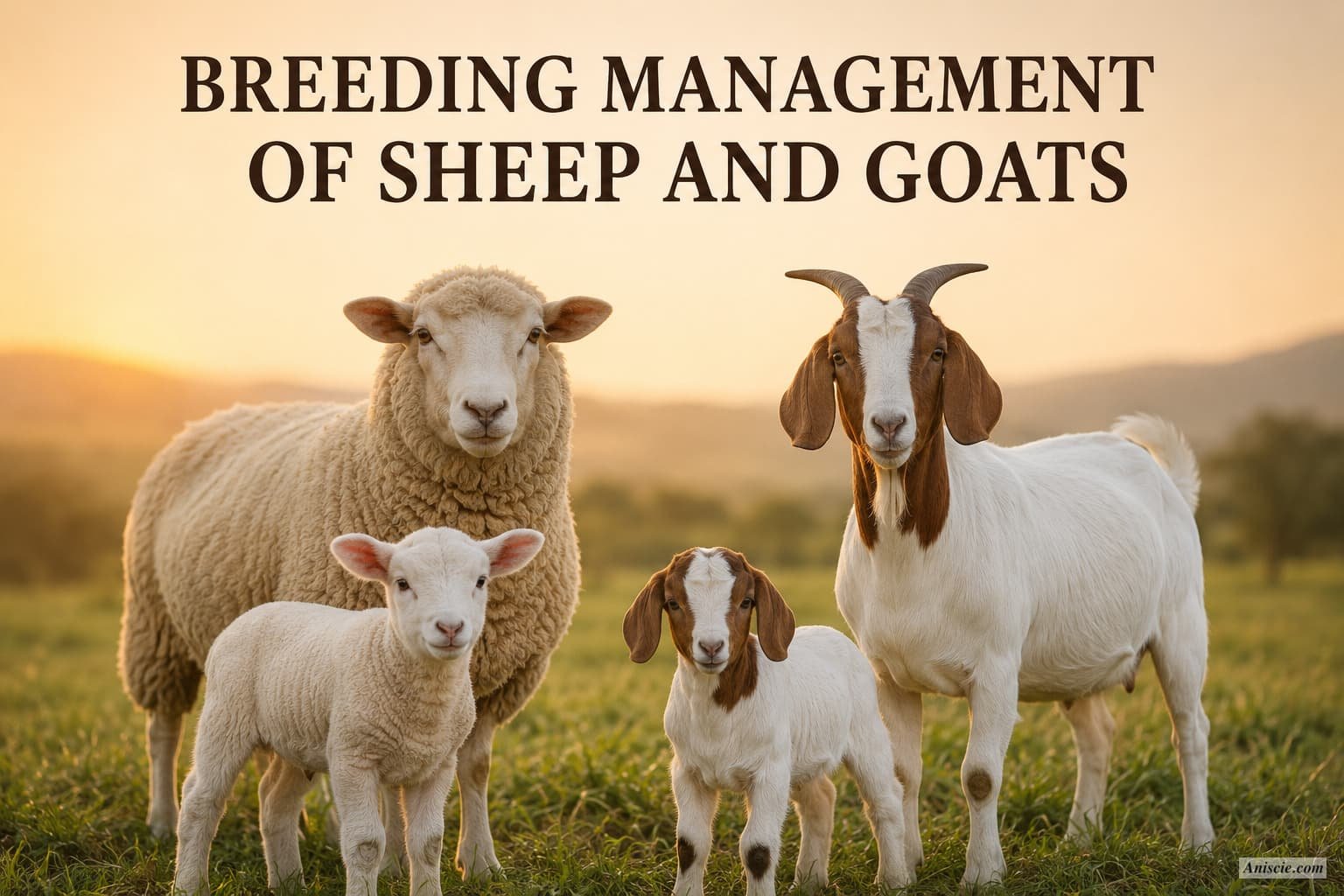
Breeding Management of Sheep and Goats: Reproductive Parameters, Estrous Cycle, Heat Signs, and Breeding Season
Breeding management of sheep and goats is a critical aspect of small ruminant production that directly influences reproductive efficiency, flock productivity, and farm profitability. Effective breeding management involves understanding reproductive parameters, breeding seasons, estrous cycles, heat detection, selection of breeding animals, and proper preparation of males and females before mating.
This article discusses the important principles of breeding management in sheep and goats, including reproductive parameters, estrus detection, breeding season, flushing, and selection of breeding stock.
Reproductive Parameters
The normal heat period in ewes lasts for 6 to 48 hours, with an average of 24 hours. The normal estrous cycle ranges from 16 to 19 days, with an average of 17 days. Ewes usually come into heat about 2 months after lambing. Ovulation occurs 24 to 30 hours after the onset of estrus. Therefore, conception is most likely when breeding occurs late in the heat period. The length of pregnancy averages 147 days (range: 144 to 152 days).
| Parameter | Ewe |
|---|---|
| Estrous Cycle Length | 16–19 days (average 17 days) |
| Duration of Estrus | 6–48 hours (average 24 hours) |
| Time of Ovulation | 24–30 hours after onset of estrus |
| Age at First Breeding | 18–24 months |
| Gestation Length | 147 days (144–152 days) |
| Ram:Ewe Ratio | 1:40 under normal conditions |
Breeding Season
Sheep in tropical regions generally breed throughout the year. Rams of indigenous breeds produce good-quality semen under proper management conditions throughout the year. However, rams of temperate breeds, if not protected from high temperatures, high humidity, and intense solar radiation, may not produce good-quality semen during hot dry and hot humid seasons.
Females of tropical breeds cycle throughout the year. The breeding cycle of temperate breeds is influenced by daylight length. They breed during periods of decreasing day length and typically come into heat during autumn, from August to November, although some may breed until February.
Indigenous breeds usually breed during nutritionally favorable periods of the year, i.e., July to October, or immediately after the onset of the monsoon (major breeding season). A small percentage also breed during March–April (minor breeding season) when they graze on crop stubble in harvested fields and are supplemented with Acacia and Prosopis pods, thereby receiving a flushing effect.
Sheep breed in different seasons depending on feed availability. Thus, breeding season is influenced to some extent by the availability of feed resources and the prevailing environmental conditions during both breeding and lambing. Greater consideration should be given to lambing, as extreme weather conditions can significantly affect lamb survival. Therefore, breeding should be planned so that lambs are born when forage is abundant and weather conditions are favorable.
Preparation of Ewes and Rams for Breeding
Flushing
Flushing is the practice of providing additional concentrate feed to ewes prior to the onset of the breeding season, usually 3 to 4 weeks before breeding. This increases the ovulation rate, thereby increasing the incidence of twins and triplets. In tropical flocks, twinning and triplet births are relatively uncommon, and under extensive management systems they may be undesirable. Flushing is effective primarily when ewes have experienced a decline in nutritional status. Ewes in good body condition generally produce more lambs; therefore, flushing lean ewes can improve fertility by increasing the incidence of estrus, enhancing ovulation rate, and reducing early embryonic mortality through improved fetal membrane integrity. Flushing can be achieved by supplementing 250 g of concentrate or 500 g of good-quality legume hay per head per day. Flushing can increase lambing rates by 10 to 20 percent.
Tagging
Tagging refers to the removal of wool and accumulated dirt from around the dock and perineal region. Ewes may fail to conceive because excessive wool or tags interfere with successful copulation. Therefore, tagging facilitates mating by making service by the ram more effective. Rams are also trimmed around the sheath.
Eyeing
To prevent wool blindness in certain breeds, excess wool around the eyes should be clipped regularly. This practice is referred to as eyeing.
Ringing
Before the breeding season begins, wool should be removed from specific areas of the ram’s body. At a minimum, wool should be clipped from the neck, belly, and particularly around the penile region. This practice is referred to as ringing and facilitates successful mating.
Crutching
The removal of wool around the perineal region and the base of the tail in a ewe is known as crutching. This practice facilitates better mating and improves hygiene.
Marking the Ram
For the identification of ewes that have been bred, rams should carry a marking substance on the brisket area. During mating, this substance marks the ewe, allowing identification of bred females. Traditionally, lampblack or Venetian red is mixed with linseed oil to form a paste and applied to the brisket at least once a week. When the ram mounts the ewe, a mark is left on her rump. This enables accurate recording of breeding dates and facilitates the removal of bred ewes from the breeding flock if desired. The color of the marking material should be changed every 16 to 18 days to identify repeat breeders if bred ewes remain within the flock. This practice is referred to as ram marking, and marked ewes are considered bred.
Raddle/Raddling
Marking of ewes by rams can also be accomplished using a raddle. A raddle consists of a ram harness fitted with a crayon that rubs against the ewe’s rump during mating, leaving a colored mark. The practice of allowing a ram fitted with a raddle to run with the flock is known as raddling.
Selection of Ewes and Rams for Breeding
Breeding ewes of indigenous breeds should generally be 18 to 24 months of age, depending on body condition. Breeding ewes at too young an age results in weaker offspring and higher lamb mortality. As a guideline, females should be bred only after reaching approximately 70 percent of their average adult body weight. Ideal breeding ewes should possess a long, preferably low-set body, roomy hindquarters, a well-formed and pliable udder, active foraging behavior, and strong maternal instincts.
Ewes with poor milk production, overshot or undershot jaws, broken mouths, blind teats, or meaty udders should be excluded from the breeding program. The body weight of a ewe at breeding should normally be lower than the average adult body weight of the breed. A wide and roomy hindquarter with adequate space between the inner aspects of the thighs is indicative of favorable future udder development.
The libido of the ram is extremely important for successful breeding. Poor libido may result from inadequate nutrition, severe heat stress, or ill health. When more than one ram is maintained with a flock of ewes, larger and older rams generally dominate smaller and younger animals. Unfamiliar rams may become aggressive and fight to establish dominance. Serious injuries can occur unless they are housed in confined areas where they cannot gain momentum to charge one another.
A breeding ram should be in good body condition, possess masculine characteristics, have strong legs free from defects, and exhibit good libido. The animal should be thoroughly examined to ensure the presence of both testes within the scrotum.
Sex Ratio
In temperate regions, the recommended ram-to-ewe ratio is approximately 1:40. Under extensive management systems, where ewes may be widely dispersed and both rams and ewes may experience nutritional deficiencies, the number of ewes assigned per ram should be reduced accordingly. Under optimal breeding conditions, rams are commonly maintained with the flock during the mating season at a ratio of approximately 2 to 3 percent of the ewe population and are allowed to remain with the flock continuously, both day and night.
Young rams may be mated with experienced older ewes, while older rams may be used with younger ewes to improve breeding efficiency. To avoid inbreeding, the pedigree of both males and females should be verified, and mating should be planned to prevent breeding among closely related animals. In traditional farm flocks, breeding males should generally be replaced or exchanged every two years to minimize inbreeding.
Estrous Cycle
Ewes and does exhibit estrus, or heat, at regular intervals during the breeding season. Estrus represents the fertile period, and if conception does not occur, it recurs at regular intervals. The average estrous cycle length is 16–17 days in ewes (range: 14–19 days) and 19–21 days in does (range: 17–24 days), although 8–10 percent of animals may exhibit shorter cycles of 6–10 days. These intervals may be 1–2 days shorter in young animals.
Estrus/Signs of Estrus
Estrus is the stage of the estrous cycle during which the female exhibits behavioral signs of sexual receptivity and willingly accepts the male for mating. It is the only period during which females are sexually receptive. The estrus period lasts approximately 24–36 hours in ewes and 34–38 hours in does. The number of ova shed may influence the duration of estrus. Ewes and does with multiple ovulations are likely to remain in heat longer than those that ovulate a single ovum. Generally, ewes do not display obvious signs of estrus in the absence of a ram. When a ram is present, a ewe in heat may exhibit mating behavior such as rubbing against the ram, circling him, sniffing his genitalia, and wagging her tail. Signs of estrus are generally more pronounced in does than in ewes.
The outward signs are:
- Reddening of the vulva and vulvar discharge
- Tail wagging
- Mounting other animals
- Actively seeking the male
- Frequent bleating or vocalization
- Allowing pressure to be applied over the loin or back (standing response)
- Standing to be mounted (standing reflex)
- Young females generally show less pronounced estrous behavior
- Males are attracted by odor, visual cues, and vocalizations, and exhibit the following behaviors:
- Sniffing the vulva
- Extending the neck with curling of the upper lip (Flehmen response)
- Biting the side of the ewe or doe and pulling wool or hair
- Pawing the ewe or doe, characterized by raising and lowering one forelimb in a stiff-legged striking motion
- Mounting and mating