CONTENT
Feeding Management of Goats: Feeding Habits, Nutrient Requirements, Rations and Kid Feeding
Feeding management is one of the most important factors affecting the growth, reproduction, health, and productivity of goats. Proper nutrition is essential for maintaining body condition, supporting milk production, ensuring successful pregnancy, and promoting rapid growth in young kids. Goats are selective feeders with unique feeding habits and can efficiently utilize a wide variety of forages, shrubs, and crop residues. However, balanced feeding is necessary to meet their requirements for energy, protein, minerals, vitamins. This article discusses the feeding habits of goats, nutrient requirements, maintenance and production rations, feeding of pregnant does and young kids, and the role of minerals, salt, and vitamins in goat nutrition.
The majority of goats kept under village production systems are seldom provided with grain or high-quality fodder; as a result, their average milk production is very low. Milch goats respond readily to good management and proper feeding, and to achieve the best results, they should be attended to like other dairy animals.
Feeding Habits
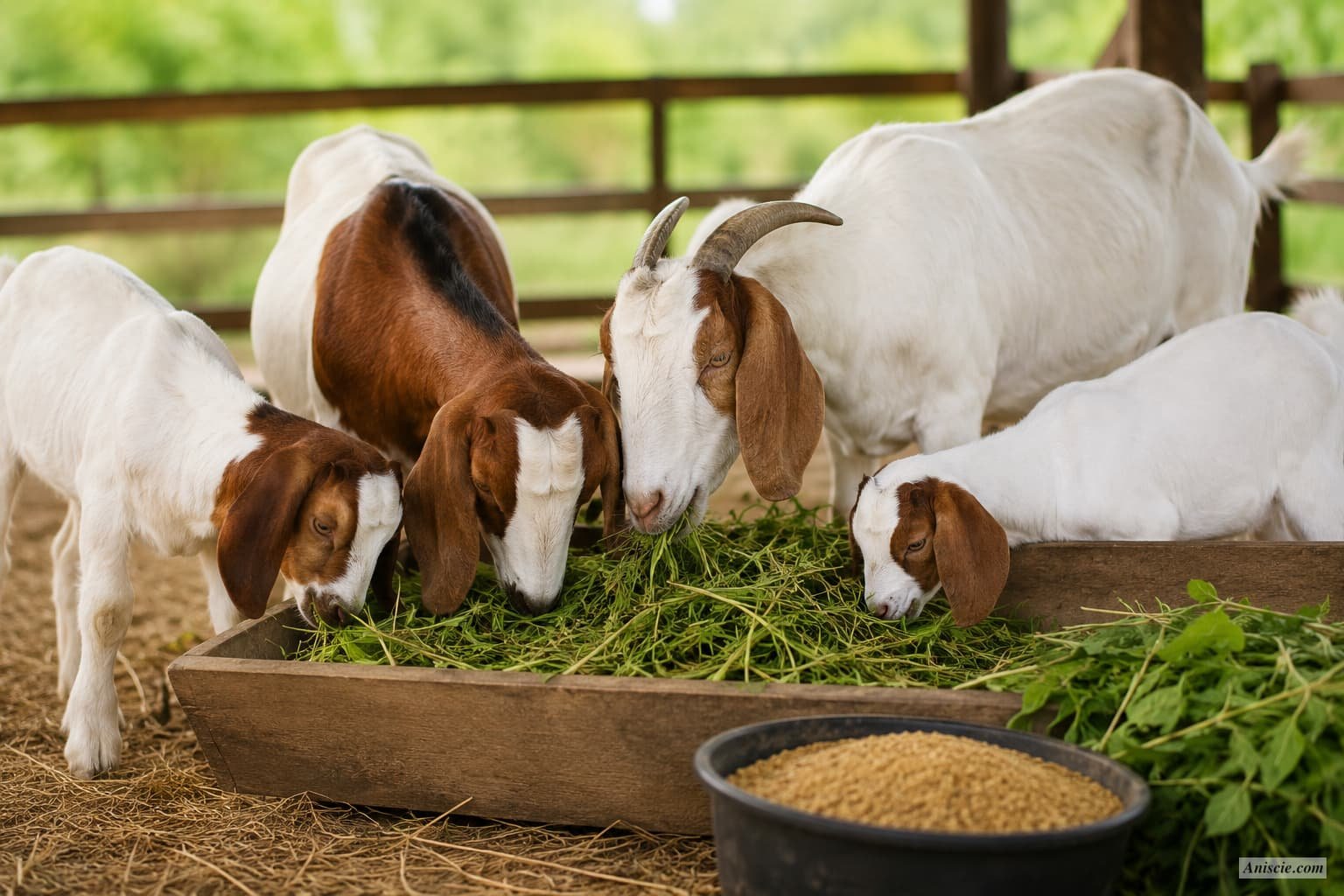
- Goats are sensitive animals with peculiar feeding habits. They are fastidious about cleanliness and prefer frequent changes in feed. Feeds offered must be clean and fresh, as goats refuse to eat feed that is dirty or foul-smelling.
- They dislike wet, stale, or trampled fodder. For this reason, it is advisable to feed them in hayracks or hang the feed in bundles from a peg on a wall or from a tree branch.
- Double-sided portable hayracks are the most suitable.
- They are convenient for stall feeding. It is preferable to offer small quantities at a time; when fed large quantities at once, goats waste a considerable amount by trampling it.
- Goats are ruminants and are very fond of leguminous fodders. They do not readily relish fodders such as sorghum (Sorghum vulgare Pers.) and maize (Zea mays L.), silage, or straw. Goats also do not prefer hay prepared from forest grasses, even when harvested at an early stage, but readily consume hay prepared from leguminous crops.
- Some of the common green roughages preferred by goats include lucerne (Medicago sativa L.), berseem (Trifolium alexandrinum Jusl.), Napier grass (Pennisetum purpureum Schum.), green pigeon pea (Cajanus cajan (L.) Millsp.), cowpea (Vigna sinensis (L.) Savi ex Hassk.), soybean (Glycine max (L.) Merr.), cabbage and cauliflower leaves, shaftal, senji, methi, and various shrubs and weeds.
- Leaves of trees such as babul (Acacia arabica Willd.), neem (Azadirachta indica L.), and peepal (Ficus religiosa L.) are also relished. Common dry fodders preferred by goats include the straws of pigeon pea, black gram (Phaseolus mungo Roxb.), green gram (Phaseolus aureus Roxb.), gram (Cicer arietinum L.), dried tree leaves, and lucerne or berseem hay. The last two are particularly popular and constitute the principal forage crops for dairy goats.
Nutrients Required
The nutrient requirements of goats may be divided into maintenance, production (milk, meat, and fiber production), and pregnancy requirements.
Maintenance Ration
The maintenance requirements are related to body surface area and basal metabolic rate. Goats have a higher basal metabolic rate than cattle; therefore, their maintenance requirements are greater than those of cattle. The requirement is calculated on a body-weight basis, and an additional 25 to 30 percent feed is generally allowed for maintenance.
The maintenance requirement thus calculated is 0.09 kg digestible crude protein (DCP) and 0.09 kg total digestible nutrients (TDN). It is worth noting an interesting aspect of goat nutrition. Relative to their body size, goats can consume substantially more feed than cattle or sheep, ranging from 6.5 to 11 percent of their body weight as dry matter compared with 2.5 to 3 percent in cattle or sheep. This means that goats can satisfy their maintenance requirements and produce milk from forage alone.
Production Ration
The requirement for the production of 1 liter of milk containing 3.0 percent fat is 43 g of DCP and 200 g of starch equivalent (SE), whereas the production of 1 liter of milk containing 4.5 percent fat requires 60 g of DCP and 285 g of SE.
The nutritional requirements of a goat weighing 50 kg and producing 2 liters of milk containing 4 percent fat may be met by feeding 400 g of concentrate mixture and 5 kg of berseem or lucerne. The ration should contain 12 to 15 percent protein, depending on the protein content of the forage and the level of milk production.
The following concentrate mixtures may be used for feeding goats:
- 1 part wheat bran, 2 parts maize grain, and 1 part linseed cake.
- 2 parts maize grain, 1 part barley, 2 parts mustard cake, and 2 parts gram husk.
- 1 part wheat bran, 2 parts barley grain, and 1 part groundnut cake.
- 2 parts gram grain and 1 part wheat bran.
Each of the above mixtures should also contain 2 percent mineral mixture and 2 percent common salt.
Pregnancy Ration
Fetal growth during the last two months of pregnancy is rapid, and the metabolic rate of the doe increases considerably. During this period, the ration should be increased to the level of a production ration. About one week before kidding, the doe should be provided with a greater quantity of succulent feed.
For three to four days after kidding, the level of feeding should be reduced and the diet should contain more fibrous feeds. This helps minimize the stress associated with the sudden onset of lactation and the accompanying metabolic changes. After this period, feeding may be resumed at normal levels.
Feeding of Young Stock
The performance of adult animals largely depends on how they are reared during the growing period. Therefore, it is essential that proper care is taken when feeding young stock. The feeding schedule for kids should be designed to achieve an average weekly weight gain of approximately 0.6 kg.
Kids should receive 56 to 112 g of colostrum four to five times daily, depending on their birth weight, for the first three days of life. From the fourth day onward, they may be fed according to the following ration schedule.
Ration Schedule for Young Stock
| Body weight (kg) | Milk | Concentrate mixture* per day (g) | Green fodder: Lucerne or berseem (kg) | |
|---|---|---|---|---|
| Morning (ml) | Evening (ml) | |||
| 2.5 | 200 | 200 | – | – |
| 3.0 | 250 | 250 | – | – |
| 3.5 | 300 | 300 | – | – |
| 4.0 | 300 | 300 | – | – |
| 5.0 | 300 | 300 | 50 | Ad libitum |
| 6.0 | 350 | 350 | 100 | Ad libitum |
| 7.0 | 350 | 350 | 150 | Ad libitum |
| 8.0 | 300 | 300 | 200 | Ad libitum |
| 9.0 | 250 | 240 | 250 | Ad libitum |
| 10.0 | 150 | 150 | 350 | Ad libitum |
| 15.0 | 100 | 100 | 350 | Ad libitum |
| 20.0 | – | – | 350 | Ad libitum |
| 25.0 | – | – | 350 | 1.5 |
| 30.0 | – | – | 350 | 2.0 |
| 40.0 | – | – | 350 | 2.5 |
| 50.0 | – | – | 350 | 4.0 |
| 60.0 | – | – | 350 | 5.0 |
| 70.0 | – | – | 350 | 5.5 |
The composition of the concentrate mixture (parts by weight) should be: gram, 20; maize, 22; groundnut cake, 35; wheat bran, 20; mineral mixture, 2.5; and common salt, 0.5.
Mineral Mixture
Minerals should form an essential part of the ration, as they contribute to skeletal development, physiological functions, and milk production. Among these, calcium and phosphorus are particularly important. The maintenance requirements of calcium and phosphorus are approximately 6.5 g and 3.5 g, respectively, per 50 kg body weight. Goats require slightly greater quantities of calcium than sheep. Mineral mixture may be included in the concentrate ration at a rate of 0.2 percent.
Common Salt
Lumps of rock salt of adequate size should be suspended in a convenient location where goats can easily access them, or alternatively, they may be placed in the feed trough. The provision of salt licks is important because goats secrete appreciable amounts of sodium and chloride ions in milk.
Salt often helps maintain normal physiological function and may have a limited beneficial effect on controlling internal parasites. Salt may also be incorporated into the daily concentrate ration at a level of up to 2 percent.
Vitamins and Antibiotics
Goats particularly require vitamins A, D, and E. The microorganisms present in the rumen synthesize most of the other vitamins required by the animal. Vitamin A can be supplied through green forage and yellow maize. One kilogram of lush green fodder can provide approximately 1,500 IU of vitamin A.
Vitamin D is obtained primarily through exposure to sunlight. Vitamin E is present in adequate amounts in most conventional rations. Synthetic vitamins A and D may be included in the diets of growing kids when necessary.
Supplementation with antibiotics such as aureomycin or terramycin has historically been reported to increase growth rates in young kids, reduce the incidence of scours and certain infectious diseases, and improve their general appearance.