CONTENT
Hay Making: Principles, Types, Steps, Storage, and Nutrient Losses
Hay making is one of the most important forage conservation practices in livestock production. Properly prepared hay provides a dependable source of nutrients during periods when fresh forage or pasture is unavailable. The quality of hay depends on factors such as crop selection, stage of harvest, drying method, and storage conditions. This guide explains the principles of hay making, types of hay, preparation methods, storage practices, and nutrient losses associated with hay production.
Hay refers to grasses or legumes that are harvested, dried, and stored at 85–90% dry matter. High-quality hay is green in color, leafy, pliable, and free from mustiness. When harvested at the proper physiological stage of growth and well-cured to 15% or less moisture at the time of storage, hay can serve as an excellent feed for dairy cattle, particularly when fresh forage is scarce or pasture availability is limited.
Principles of Hay Making
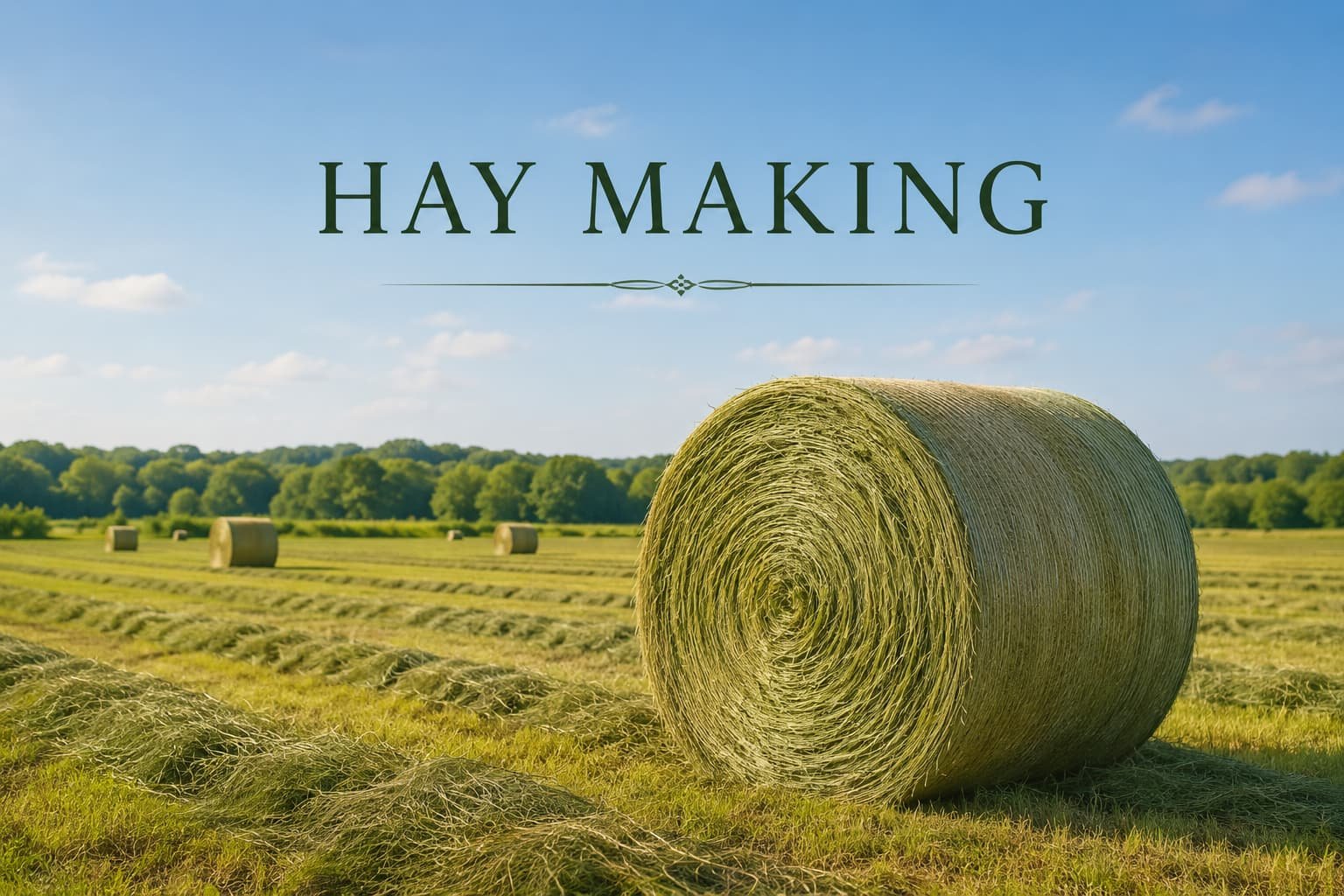
The principle involved in hay making is to reduce the water content of the herbage so that it can be safely stored in bulk without undergoing fermentation or becoming moldy.
Requisites of Good-Quality Hay
- Good hay should be leafy. The leaves are generally rich in proteins, vitamins, and minerals.
- It should be prepared from herbage cut at a stage approaching maturity.
- It should be green in color (an indication of carotene content).
- It should be soft and pliable.
- It should be free from dust and molds.
- It should be free from weeds and stubble.
- It should have the smell and aroma characteristic of the crop from which it is made.
- The moisture content in hay should not exceed 15%.
- Hay of average quality usually contains 25–30% crude fiber.
- Hay is a primary feed for ruminants and horses, while only limited amounts are fed to swine.
Types of Hay
Depending on the method of processing, hay can be divided into the following categories:
- Jungle hay
- Sun-dried hay
- Barn-dried hay
- Dehydrated forage
Jungle hay and sun-dried hay generally involve field curing. A barn is a roofed farm structure used for storing hay. Hay is baled in the field and transported to the barn for storage. Dryers are also used for forage dehydration.
Two types of dryers are available:
- Low-temperature dryers (80–180°C)
- High-temperature dryers (300–600°C)
Advantages of Hay
- Reduce transportation costs to the drying site.
- Reduce drying time.
- Nutrient losses due to rainfall are minimized because the process is performed in a barn.
- Loss of plant parts, especially leaves, is lower than with field curing.
Disadvantages of Hay
- High capital investment is required for establishing a dehydration facility.
- Processing costs are high if sufficient forage is not available.
- Skilled operation is required; improper operation may lead to fire hazards.
Based on the crops used for hay making, hays are classified as follows:
- Legume Hay: Legume hay contains a higher percentage of digestible nutrients. In addition, legume proteins are of superior quality. Well-cured legume hays are rich in vitamins (especially vitamins D and E), calcium, and carotene. Among leguminous forage crops, alfalfa, berseem, cowpea, and soybean are commonly used for hay production.
- Non-Legume Hay: Non-legume hays made from grasses are generally inferior to legume hays. They are usually less palatable and contain lower levels of protein, minerals, and vitamins. However, grass hays often produce higher yields per acre and are easier to grow.
- Mixed Hay: Hay prepared from a mixture of legumes and grasses is known as mixed hay. Its composition depends on the proportion of the different species included in the forage mixture.
Steps in Hay Making
The major steps in hay making are:
- Selection of Crop and Appropriate Harvest Stage
- Selection of a Suitable Drying Method
1. Selection of Crop and Appropriate Harvest Stage
High-quality hay can be prepared from forage crops that have soft and pliable stems. Oats are particularly suitable for hay making because of their soft stem structure. Both annual and perennial grasses are also commonly used.
Legumes are also used for hay production, but leaf shattering must be minimized through careful handling. Alfalfa, berseem, cowpea, and similar legumes can be used for hay making. Crops should be harvested during the day after the dew has evaporated so that the forage can dry uniformly when spread across the field.
Another important consideration is that the field should not be wet; otherwise, uniform drying may not occur.
Forage harvested at an earlier stage generally contains more protein, less crude fiber, higher vitamin content, greater palatability, and reduced leaf loss. The ideal time for cutting forage for hay making is when approximately one-third to one-half of the crop is in bloom.
2. Selection of a Suitable Drying Method
- Quantity of forage available (For small quantities of forage, costly structures and highly skilled operations may not be economical.)
- Duration of forage availability (If forage is available for hay production for at least 300 days per year, investment in dehydration systems may be justified.)
- Relative humidity (Field curing is less suitable under high humidity conditions because mold growth may occur.)
- Rainfall intensity (Rainfall causes nutrient losses through leaching. Frequent rainfall combined with high humidity can create serious challenges for hay making.)
- Atmospheric temperature (The intensity and duration of sunshine influence drying conditions. During hot, dry weather, hay production through sun drying is generally convenient and efficient.)
- Installation costs (The choice between barns and dehydrators depends on economic considerations. Simple field curing during dry seasons remains one of the most economical methods for small-scale livestock producers.)
During curing, it is important to protect the forage from excessive bleaching by sunlight and to preserve leaves from shattering as much as possible. Maximum moisture removal is necessary so the forage can be stored safely without heating and the resulting loss of nutrients.
For reasonably rapid curing and the production of high-quality hay, the forage should be left in the field for several hours until it is well wilted, or approximately one-fourth to one-third cured. It should then be raked into small loose heaps known as windrows. If favorable weather continues, curing can be completed in the windrows. Under slower drying conditions, turning may also be necessary.
In addition to field curing, hay may be cured by hanging forage on tripods or farm fences. In artificial curing systems, the forage is placed in a chamber where it is exposed to heated air under controlled conditions based on the forage type and drying temperature.
Losses of Nutrients in Hay Making
Some nutrient losses always occur during field curing of hay, although these losses are generally minimal under favorable conditions. Drying green forage at ambient temperatures reduces digestibility. However, when forage is dried without excessive fermentation or bleaching, it retains a high proportion of its nutrients.
Nutrient losses in hay making occur due to:
- Late Cutting
- Shattering
- Loss of Vitamins
- Fermentation
- Leaching
1. Due to Late Cutting
Late cutting results in greater lignification and lower carbohydrate and protein digestibility. One disadvantage of early cutting is reduced yield and higher moisture content in forage intended for hay production.
2. By Shattering
Losses due to leaf shattering and breakage of fine plant parts are particularly important in legumes. Leaves are considerably richer in digestible nutrients than stems; therefore, shattering significantly reduces the nutritive value of hay. To minimize these losses, hay should not be overdried or handled during the warmest part of the day.
3. Loss of Vitamins
During drying, much of the green pigment containing carotene may be lost through bleaching. In general, the carotene content of freshly cured hay is proportional to its greenness. Severe bleaching can destroy more than 90% of the carotene content.
4. Losses in Fermentation
During fermentation, organic nutrients such as starches and sugars are oxidized to CO2 and water. If drying is prolonged because of unfavorable weather conditions, bacterial and fungal activity may cause undesirable changes. Moldy hay is not only unpalatable but may also be harmful to animals and people handling the hay due to the presence of mycotoxins. Such hay may also contain actinomycetes, which are associated with the allergic condition known as “Farmer’s Lung.” One method of preventing mold growth is the uniform application of propionic acid to the hay. Uneven drying commonly results in localized patches of mold within hay stacks.
5. By Leaching
If hay is nearly cured and is exposed to prolonged heavy rainfall while still in the field, severe nutrient losses may occur through leaching. Unless rainfall is sufficient to thoroughly soak the forage, leaching losses are generally limited. For this reason, losses are usually lower when hay is stored in adequately sized windrows.
Storage of Hay
Hay is commonly stored in stacks. Care should be taken to ensure that the hay is completely dry before storage. It should be stored in a shaded location where there is minimal risk of fire.
Stacks should be constructed on elevated ground. Machines are also available for baling hay. Baled hay occupies less storage space and is easier to handle and transport.
Brown Hay
Under unfavorable weather conditions, good-quality hay may not be produced through conventional curing methods. In such situations, the forage is allowed to dry until approximately 50% of its moisture has been removed and is then packed into stacks or piles.
Fermentation occurs and the hay may become very hot; however, the temperature should not exceed 80°C. Significant losses in nutritive value occur due to fermentation, typically ranging from 30–40%. Despite these losses, brown hay is often quite palatable.
Wastelage
Wastelage is a material produced by ensiling waste materials (such as animal organ waste) in combination with forage and suitable additives under anaerobic conditions through fermentation by lactic acid-producing bacteria. Apart from the source material, the remaining preparation steps are similar to those used in silage production.