CONTENT
Types of Scarcity Fodders for Livestock: Alternative Feed Resources During Feed Shortages
Feed shortages caused by droughts, floods, seasonal forage deficits, or other adverse conditions can significantly affect livestock productivity and health. During such periods, conventional fodder resources may become scarce or unavailable, making it necessary to utilize alternative feed resources to meet the nutritional requirements of animals. Scarcity fodders include a wide range of agro-industrial by-products, crop residues, tree leaves, root crops, grasses, weeds, and other unconventional feed materials that can help sustain livestock during feed emergencies.
Feed scarcity may result from either floods or droughts. Ruminants, owing to their larger body size, require large quantities of feed dry matter. They need bulky and fibrous feeds, and roughages are the natural feed source for ruminants.
However, roughages are often not available in adequate quantities during periods of feed scarcity. During such situations, it is important to identify roughage substitutes that can help meet the minimum roughage requirements of livestock.
Many regions of the world have significant potential sources of alternative feed resources. If these feed materials are properly collected and utilized, they can at least provide sufficient nutrients for the maintenance of animals. These include a wide variety of tree leaves, shrubs, weeds, straw, and grasses.
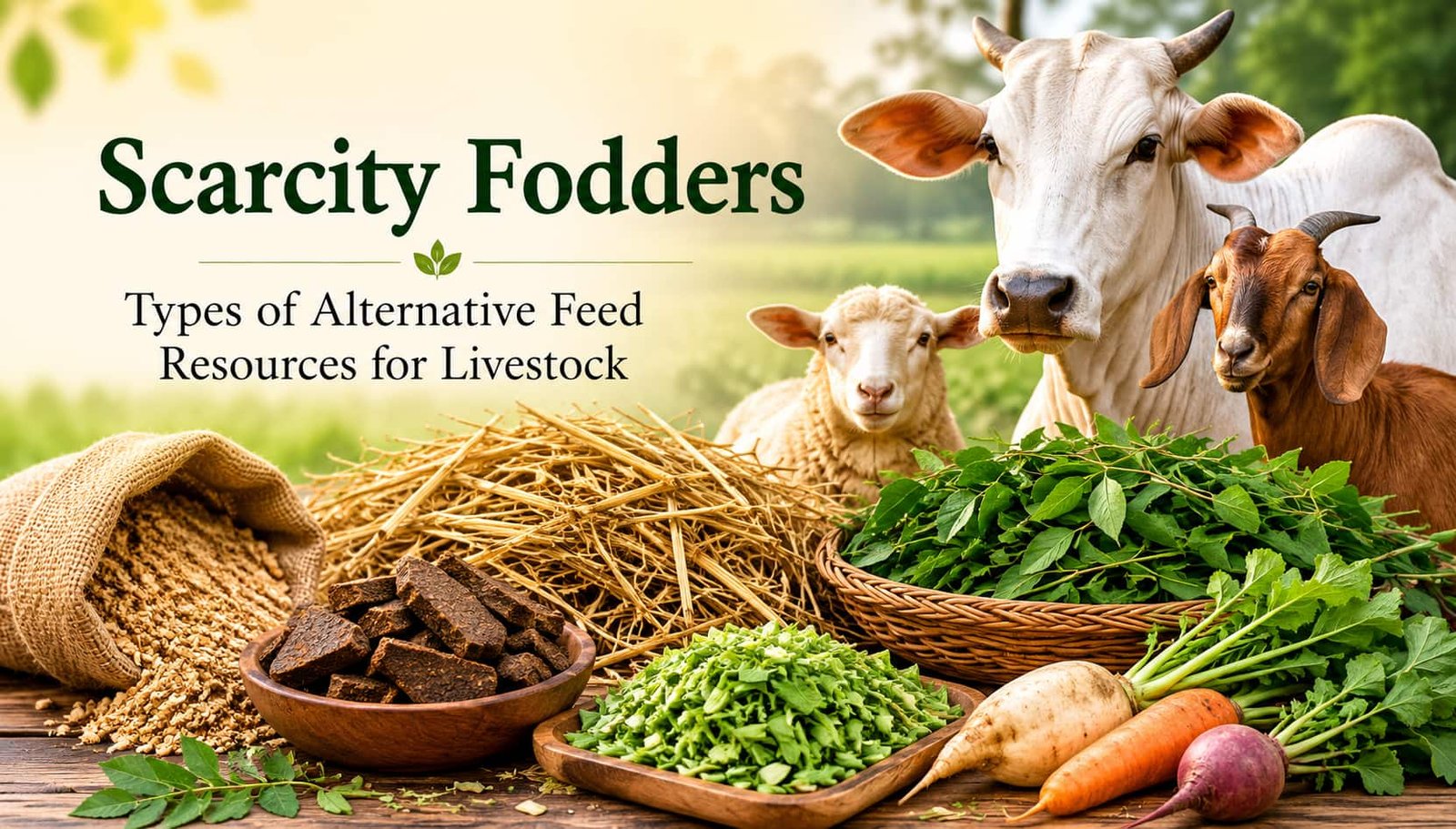
Types of Scarcity Fodders
The main types of scarcity fodders are:
- Agro-industrial by-products
- Sugar industry wastes
- Inferior-quality roughages
- Top feed resources
- Root crops
- Grasses and weeds
1. Agro-Industrial By-Products
The importance of utilizing unconventional feeds to augment existing conventional livestock feed resources was recognized more than 30 years ago. Many countries continue to face shortages of animal feed and fodder nutrients. Moreover, these conditions are often aggravated by natural calamities such as droughts and floods. Studies have indicated that a large number of agricultural by-products and industrial waste materials can be utilized for feeding livestock.
Some unconventional livestock feeds are described below:
Sunflower Meal
Sunflower seed meal, when combined with other protein supplements, is a good feed ingredient for poultry. Good-quality sunflower meal contains about 40–44% high-grade protein and is particularly rich in methionine. Sunflower seed meal is a satisfactory substitute for peanut meal in starter rations and can replace it completely without adverse effects.
Guar Meal
Guar is a drought-resistant legume, and the meal, a by-product of guar gum production, is a potential source of protein. Guar meal is not highly palatable to cattle, and inclusion levels as low as 5% may initially be refused by some animals. However, once adapted, cattle can consume rations containing up to 15% raw guar meal. Higher levels may cause diarrhea, particularly in young calves.
Niger Cake
Niger cake compares favorably with other oilseed cakes in its chemical composition. It contains about 36% crude protein and 5.98% mineral matter but also contains approximately 14–18% crude fiber. It has been suggested that niger cake can completely replace peanut meal on a protein-equivalent basis in growing chick diets.
Karanja Cake
Karanja cake is relatively less palatable. It contains polyphenolic compounds that may have adverse effects on growth and production. Extracted karanja cake can replace sesame cake up to 30% on a protein-equivalent basis in starter and grower poultry diets.
Neem Cake
Neem cake contains approximately 34% protein, while processed neem cake may contain up to 48% protein. The fiber content is only about 4.4%. Its lysine and methionine levels are comparable to those of peanut meal protein. When introduced gradually, neem cake can be included in cattle rations at levels of approximately 15–20%.
Rubber Seed Cake
Rubber seed meal contains cyanogenic compounds. Good-quality rubber seed cake contains about 30% protein. It can be included at up to 20% in concentrate mixtures for lactating cows and up to 10% in poultry diets without adverse effects.
Sunn Hemp Seed
Sunn hemp is cultivated in many tropical and subtropical regions. In most cases, the crop is used as green manure, although in some areas it is also utilized as livestock feed.
Cassia Tora Seed
Boiled cassia tora seeds can safely be included in concentrate rations for dairy cows at levels up to 15%.
Kapok Seed Cake
Kapok seed cake can be used as one of the components in cattle concentrate feeds.
Corn Gluten Meal
Corn gluten meal consists primarily of the dried residue obtained after the removal of most of the starch and bran during the wet-milling process used to manufacture corn starch. It may occasionally contain corn oil meal. Corn gluten meal typically contains 50–60% protein.
Safflower Meal
Safflower meal is produced after the removal of most of the hull and oil from safflower seeds. In decorticated form, it contains approximately 40–45% protein.
2. Sugar Industry Wastes
- Molasses: Molasses helps improve the utilization of non-protein nitrogen sources such as urea in ruminants because it provides a readily available source of energy. Liquid urea-molasses diets can be used as a sole ration under specific feeding systems.
- Bagasse: Sugarcane bagasse can be fed to adult cattle as a maintenance ration. It is often finely chopped, mixed with molasses, and fed to livestock.
- Sugarcane Tops: Sugarcane tops can be preserved as silage and utilized during feed shortages. They are relatively palatable and can be fed for several months.
3. Inferior-Quality Roughages
Rice Straw
Rice straw is used as feed for ruminants and has numerous other applications, including manure production, thatching, paper pulp manufacture, biofuel production, mat making, poultry litter, and mushroom cultivation.
Rice straw is generally poorly palatable, and voluntary intake is often low. However, intake depends on straw characteristics (coarse, fine, long, dwarf, leafy, stemmy, fresh, stored, hard, or soft), animal species and breed, body weight, diet composition, physiological status, and environmental conditions.
Wheat Straw
Wheat straw contains approximately 3–4% crude protein on a dry matter basis. Leaves are generally of higher feeding value than stems, and properly dried straw typically contains 87–93% dry matter, depending on environmental conditions.
Digestibility is generally around 40–43%, and intake ranges from approximately 1.5–1.8 kg per 100 kg body weight in adults and 1.8–2.2 kg per 100 kg body weight in growing heifers, depending on the level of production.
Finger Millet (Ragi) Straw
Finger millet (ragi) straw can also be utilized where it is available.
4. Top Feed Resources
Although tree leaves are commonly fed to sheep and goats, they can also be fed to cattle during periods of feed shortage. Young leaves generally contain higher levels of protein and lower levels of crude fiber. They are typically rich in calcium and relatively low in phosphorus but may contain substantial amounts of tannins.
5. Root Crops
Root crops such as turnips, carrots, and fodder beets can be used during winter. Their main characteristics include high moisture content and relatively low crude fiber levels. These feeds are readily accepted by animals because of their pleasant and sweet taste.
6. Grasses and Weeds
Some weeds and aquatic plants can be used as scarcity fodders, although palatability may be limited because of the presence of alkaloids and polyphenolic compounds. In addition to supplying protein and energy, many are rich sources of carotenoids.
Water hyacinth, water spinach, lotus leaves and stalks (Nelumbo spp.), water chestnut (Trapa natans), hydrilla, pistia, and other aquatic weeds can be fed to ruminants. These resources are often readily available in many regions, even during periods of feed scarcity.