CONTENT
Livestock Waste Management: Converting Animal Manure into Organic Fertilizer and Renewable Energy
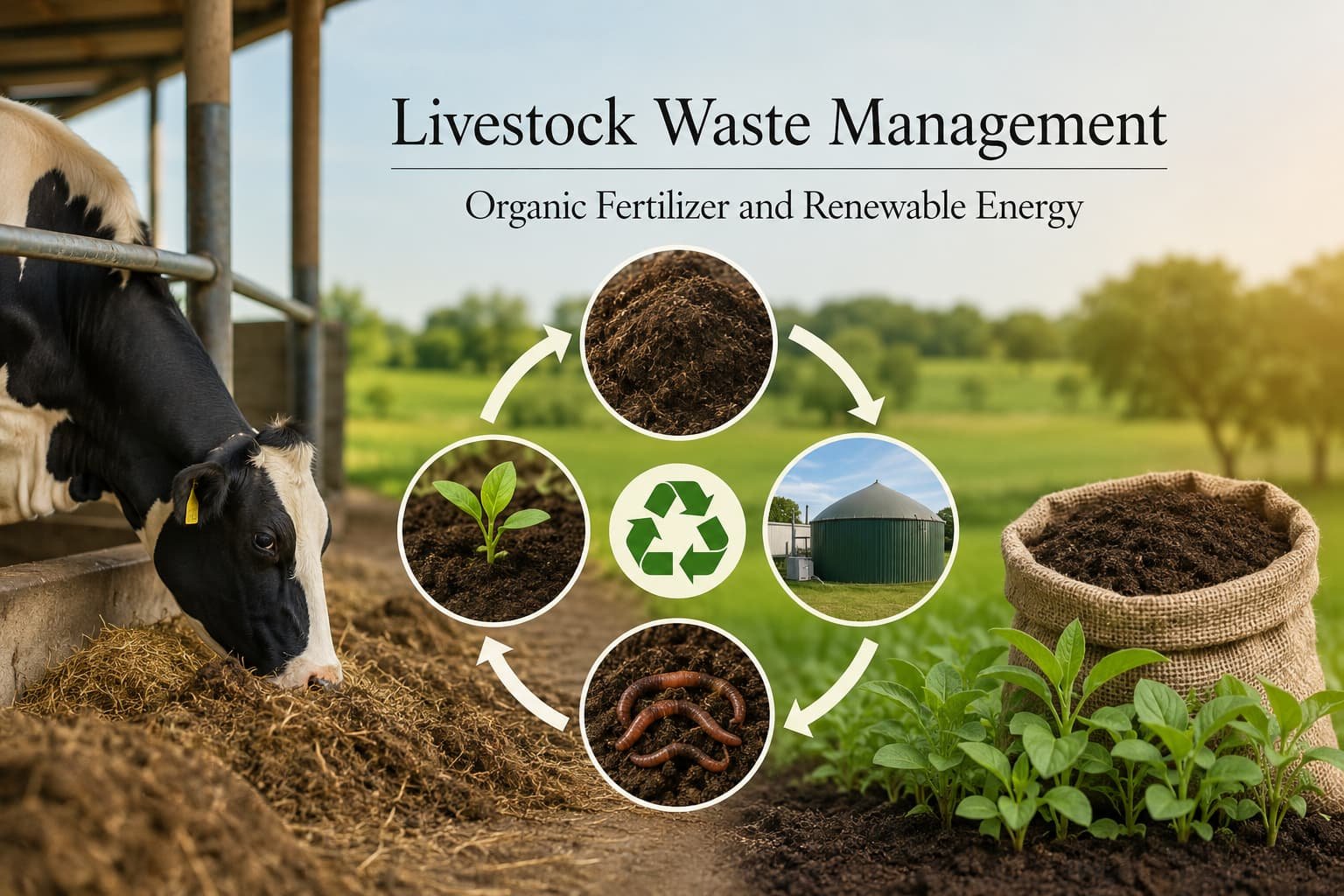
Livestock waste management is an essential component of sustainable agriculture and environmental stewardship. Animal manure, urine, leftover feed, and other farm wastes are valuable resources that can be recycled into organic fertilizers and renewable energy products. Proper utilization of these materials not only improves soil fertility and crop productivity but also reduces environmental pollution and waste disposal challenges. This article explores the major methods of livestock waste recycling, including farmyard manure (FYM), biogas production, Panchakavya, and vermicomposting, along with their benefits for modern farming systems.
Livestock wastes consist primarily of dung and urine. In many production systems, livestock dung and urine are not properly collected or utilized. Although traditional farming practices have long encouraged the use of animal waste as manure for crop production, greater awareness is still needed regarding the benefits of these valuable organic resources.
Biogas production from cattle dung has provided an effective means of utilizing manure as a renewable energy source. Therefore, proper collection and preservation of dung, urine, leftover feed, and other farm wastes are important because these materials can be converted into valuable manure and used for energy production.
In many regions, a significant proportion of cattle dung is still used directly as fuel without recognizing its value as manure. Urine, which is a rich source of potassium (K), nitrogen (N), and sulfur (S), is also often underutilized because of inadequate collection methods.
Farmyard Manure (FYM)
Farmyard Manure (FYM) is a decomposed mixture of dung and urine from farm animals along with leftover feed and bedding materials.
FYM is a bulky organic manure that has long-lasting effects on crop production and soil productivity when properly applied:
- FYM contains all the essential elements required for crop growth.
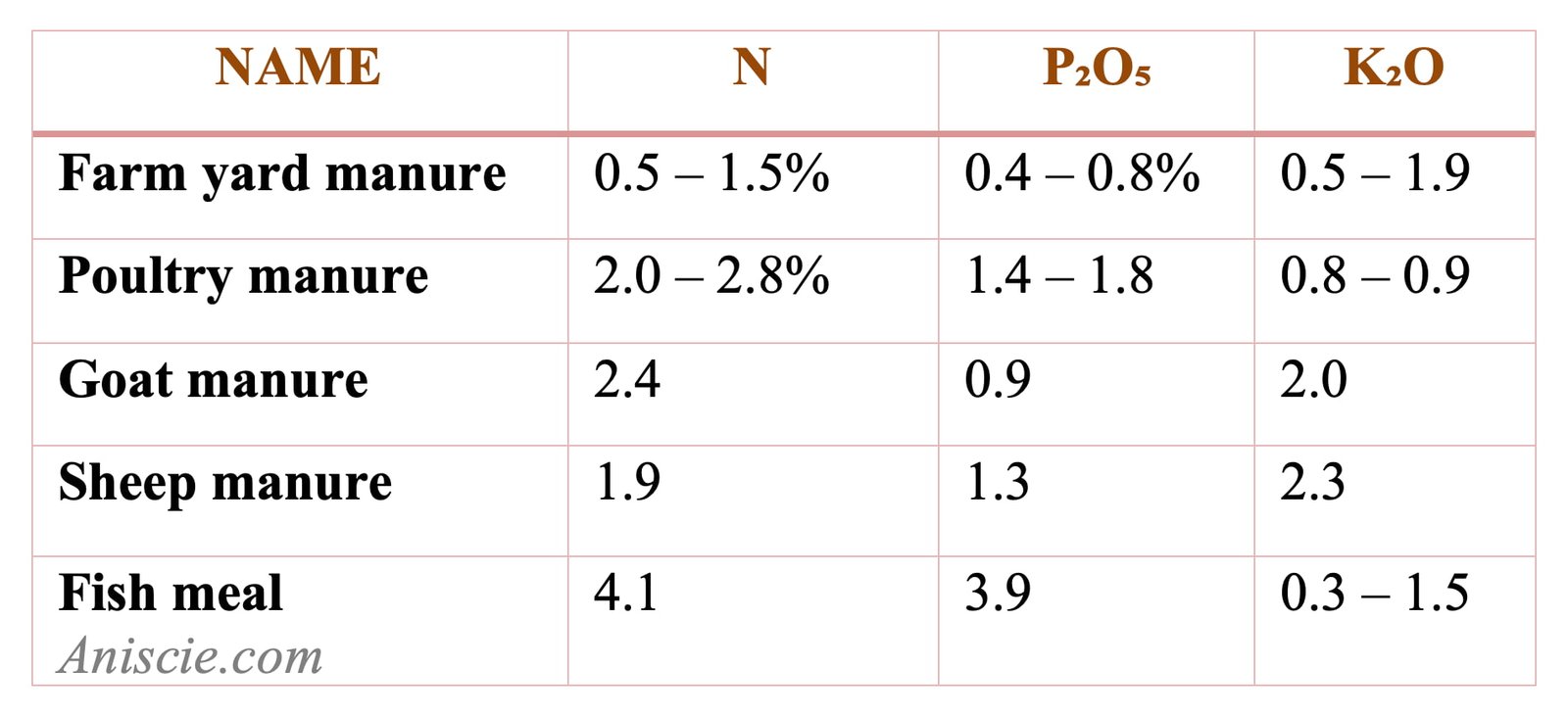
- These nutrients are present in relatively small quantities (average NPK content on a dry-weight basis is approximately 1.0%, 0.5%, and 1.0%, respectively), but they are not easily lost from the soil because they are present in organic form.
- There are no adverse environmental effects associated with the proper use of FYM.
- FYM is generally less expensive than commercial fertilizers and can be prepared locally using readily available resources.
- Application of FYM improves soil physical properties such as structure, pore space, and water-holding capacity.
- It also improves soil chemical properties because organic matter (humus) possesses a high cation exchange capacity (CEC).
- FYM serves as a major food source for beneficial soil microorganisms. Consequently, soil biological activity is enhanced through the application of FYM.
Because of these numerous advantages, animal wastes should be properly collected and converted into manure.
The floor of the livestock housing facility should be designed so that urine is collected efficiently through proper slope and flooring characteristics or absorbed using bedding materials such as rice husks, sawdust, peanut hulls, chopped straw, or similar materials. The dung, urine (with or without bedding material), and leftover feed (mainly roughages) should be collected properly.
There are different methods of storage used to prepare FYM:
- Heap Method
- Pit Method
- Covered Pit Method
1. Heap Method
In this method, manure is heaped on open ground and exposed to sunlight and rainfall. Considerable nutrient loss may occur because of volatilization and leaching. These losses can be reduced by storing the heap under shade and covering it with soil or a polyethylene sheet.
2. Pit Method
This method is superior to the heap method. The bottom and sides of the pit are plastered or lined with non-absorbent materials. Because the manure is not directly exposed to sunlight or rainfall, nutrient losses are minimized.
3. Covered Pit Method
In this method, the pit opening is covered, making it the most effective method for FYM preparation. Cattle and buffalo manure are produced in large quantities worldwide and should be utilized efficiently. Pig manure is also a rich source of nitrogen and phosphorus (3.7% and 3.3%, respectively) and should be used effectively as an organic nutrient source.
Biogas Production
Biogas provides a convenient alternative energy source for agricultural operations and rural households while also producing high-quality manure free of viable weed seeds. Biogas is generated through the anaerobic digestion of organic wastes, primarily cattle dung. Even small livestock operations can efficiently utilize manure for biogas production.
Value Addition
Value addition is the process of converting livestock products, by-products, or farm wastes into products with higher economic value, improved utility, enhanced marketability, or extended shelf life through processing, transformation, or innovative utilization.
Panchakavya
The Sanskrit word Panchakavya means “mixture of five products.” In recent years, Panchakavya has gained prominence in organic farming systems. It is a fermented preparation made by combining five products derived from cows.
The three primary constituents are dung, urine, and milk, while the two derived products are curd and ghee. These ingredients are mixed in specific proportions and allowed to ferment. Panchakavya is traditionally believed to promote growth and enhance immunity in plants and animals. It may improve the shelf life and quality of vegetables, fruits, and grains. In modern organic farming, Panchakavya is primarily used as a growth-promoting and immunity-enhancing input.
The ingredients include 4 kg of biogas slurry, 1 kg of fresh cow dung, 3 liters of cow urine, 2 liters of cow milk, 2 liters of cow curd, 1 kg of cow ghee, 3 liters of sugarcane juice, 12 ripe bananas, 3 liters of tender coconut water, and 2 liters of toddy (if available). This formulation yields approximately 20 liters of Panchakavya.
The mixture is stored in a wide-mouthed earthen pot or concrete tank, covered with a cotton cloth, and placed in an open area. Adequate shade should be provided, and the contents should be stirred twice daily, once in the morning and once in the evening. Stirring releases methane gas generated during fermentation. Under suitable conditions, the Panchakavya is ready for use after approximately seven days. It is typically diluted to a 3% solution before application to crops.
Benefits of Panchakavya in Agriculture:
- Seeds can be soaked, and seedlings can be dipped in a 3% Panchakavya solution for approximately 30 minutes before planting.
- Various cereal crops, including rice and maize, as well as vegetables, cash crops, and plantation crops, have shown positive responses to Panchakavya application.
- Earthworms multiply more rapidly when exposed to this solution.
- Plants treated with Panchakavya often produce larger leaves and develop a denser canopy. Stems develop more lateral shoots and stronger branches capable of supporting heavier yields. Root growth becomes more extensive and penetrates deeper into the soil, improving drought tolerance and nutrient uptake.
Panchakavya has several reported beneficial effects on livestock, poultry, and aquaculture systems:
- When administered to dairy cattle at approximately 200 mL per day, improvements in health status and milk fat content have been reported. Similar observations have been noted in sheep and goats.
- When mixed with poultry feed or drinking water at a rate of approximately 5 mL per bird per day, birds reportedly remained healthier and produced larger eggs over extended periods.
- Improved weight gain has been reported in broiler chickens.
- In fish ponds, Panchakavya application has been associated with increased phytoplankton and zooplankton growth, thereby enhancing natural feed availability.
Vermicompost
Organic waste is decomposed by microorganisms and consumed by earthworms. The castings produced by these worms are commonly known as vermicompost. The primary requirements include space, cow dung, organic wastes, and earthworms. Vermicompost is a valuable organic manure because it improves soil quality, whereas long-term reliance on inorganic fertilizers may contribute to soil degradation.
Sources of Organic Waste for Manure Production:
Organic wastes available in agricultural areas include cattle dung, sheep droppings, biogas slurry, crop residues, husks, corn cobs, weeds, kitchen waste, and other biodegradable materials. All of these materials can be used for vermicompost production.
Requirements for Vermicompost Production
- Housing: Sheltered worm-culturing facilities are recommended to protect earthworms from excessive sunlight and rainfall.
- Containers: Cement tanks or similar structures may be used.
- Bedding and Feeding Materials: Cow dung is commonly used initially. Once sufficient earthworm populations are established, various organic wastes may be utilized.
Process of Vermicompost Production
The bedding and feeding materials are mixed, moistened, and allowed to ferment for approximately two to three weeks in cement tanks. During this period, the material should be turned three or four times to reduce temperature and promote uniform decomposition. Once the material becomes sufficiently soft, it is transferred to culture containers and earthworms are introduced.
A container measuring 1 × 1 × 0.3 meters can hold approximately 30–40 kg of bedding and feeding materials. About 1,000–1,500 worms are required to process the material. The substrate should maintain 40–50% moisture, a pH of 6.3–7.5, and a temperature range of 20–30°C.
Earthworms inhabit the deeper layers of the substrate, actively feeding and depositing granular castings on the surface. The worms should be allowed to continue feeding until the material is converted into a highly granular mass.
Earthworms generally reach adulthood in about seven weeks. From the eighth week onward, they begin producing cocoons. One mature worm can produce approximately two cocoons per week. Each cocoon may yield three to seven young worms after an incubation period of 5–10 days, depending on species, feed quality, and environmental conditions. Worm populations can increase rapidly under favorable conditions.
Harvesting of Vermicompost
Harvesting vermicompost involves manually separating earthworms from the castings. The contents of the container are dumped onto the ground and formed into a mound. After several hours, most worms migrate to the bottom of the mound to avoid light and gather in dense clusters. The vermicompost is then removed, and the worms are collected for use in new culture beds.
The collected vermicompost is dried and passed through a 3-mm sieve to recover cocoons, juvenile worms, and unconsumed organic material. The recovered cocoons and young worms are used to establish new culture beds. Vermicompost is rich in macronutrients and beneficial microorganisms, including actinomycetes and nitrogen-fixing bacteria, making it an excellent organic fertilizer.
Benefits of Vermicompost
- Recycling of organic wastes.
- Production of valuable nutrient-rich resources.
- Reduction of environmental pollution.
- Creation of employment opportunities.
- Improvement of soil pH through buffering effects.
- Improved percolation in clay soils.
- Enhanced water-holding capacity in sandy soils.
- Release of plant-available nutrients.
- Increased oxidizable carbon content and improved cation exchange capacity.
- Improved nitrate and phosphate availability.
- Promotion of plant root development.
One limitation of this technology is that pesticides and heavy metals may accumulate in earthworms raised on contaminated organic wastes. If such worms are used as a protein source in animal feeds, potential health risks may arise.