CONTENT
Housing of Dairy Cattle and Buffaloes: Loose Housing vs. Conventional Barn Systems
Housing of dairy cattle and buffaloes refers to the provision of suitable shelter, feeding facilities, watering systems, ventilation, and space requirements to ensure animal comfort, health, productivity, and efficient farm management.
The two major housing systems used for dairy cattle and buffaloes are loose housing and conventional (stanchion) barns. The choice between these systems depends primarily on climate, management practices, available space, and economic considerations.
A great diversity exists in the design of dairy animal shelters worldwide. Traditional animal shelters have evolved based on the needs, available resources, and ingenuity of farmers. Building design and construction materials greatly influence the thermal comfort within dairy shelters. Efficiently designed sheds can help reduce thermal stress, thereby increasing feed intake, milk production, and reproductive efficiency.
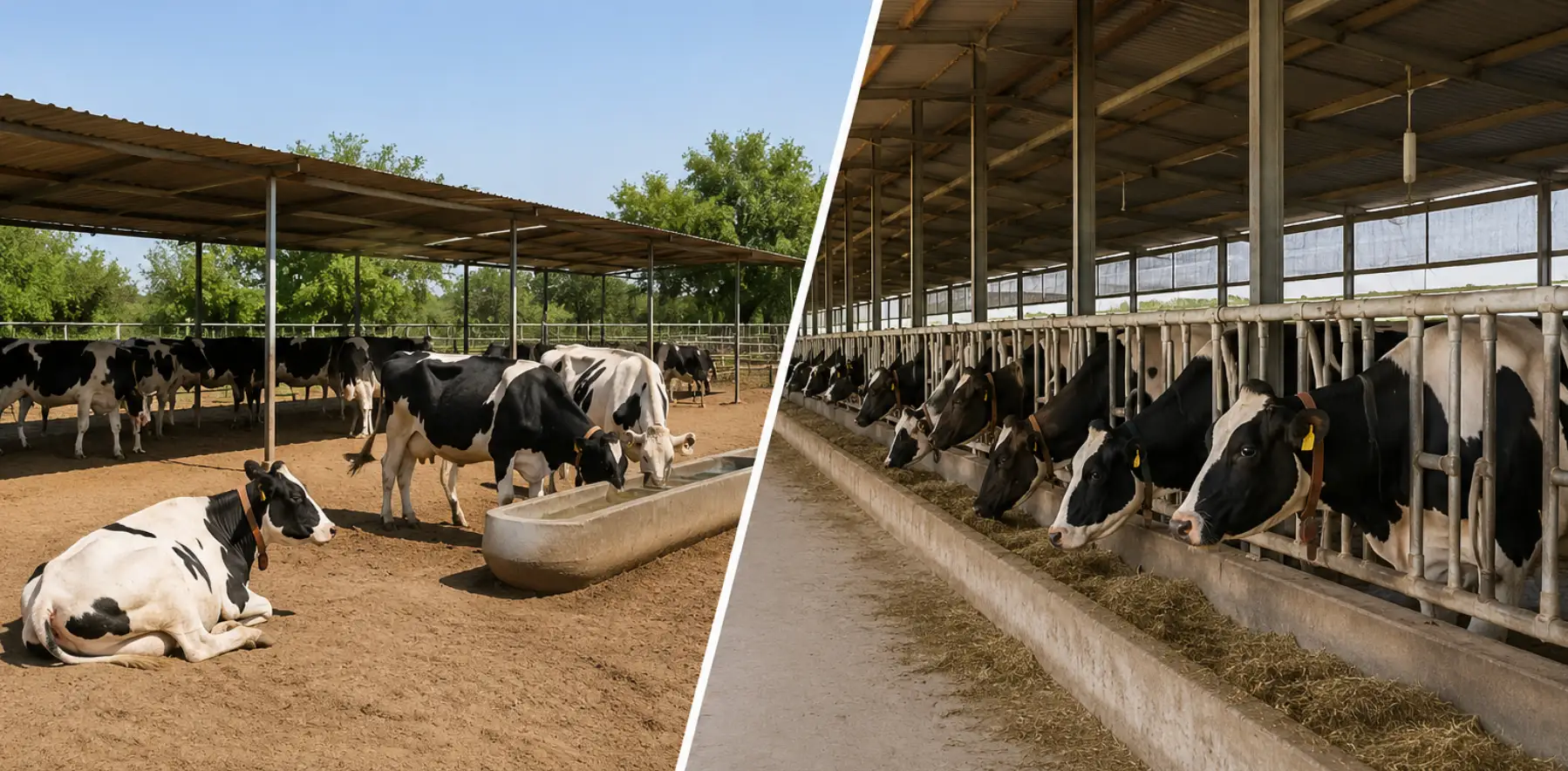
Under varying climatic, geographical, and economic conditions, designing an ideal housing system for dairy animals that is suitable for all regions is impossible. Therefore, in practice, there are two main systems of housing for dairy animals, namely:
- Loose housing
- Conventional barns
Loose housing is generally preferred in tropical and subtropical regions because it provides better ventilation, greater animal comfort, and lower construction costs. Conventional barns are more suitable for temperate regions and areas with prolonged cold weather or heavy rainfall, where greater protection from environmental conditions is required.
1. Loose Housing
Loose housing is a system in which animals are kept loose in an open paddock throughout the day and night, except during milking and treatment. In this system, a shelter is provided along one side of the open paddock, under which animals can take refuge during hot or cold weather or during rainfall.
A common feed manger and water trough are provided, and concentrates are fed during milking. Milking is carried out in a separate milking barn or parlor, where cows are secured and milked. The open paddock is enclosed using half walls or wire fencing of a suitable height.
Advantages
- Construction costs are lower.
- Future expansion is easier.
- Animals can move freely and receive adequate exercise.
- Animals can be maintained in a clean condition.
- Common feeding and watering arrangements can be used.
- Clean milk production is possible because animals are milked in a separate milking barn.
- Estrus detection is easier.
- Approximately 10–15% more animals than the standard capacity can be accommodated for short periods.
Disadvantages
- It is not suitable for regions with severe winters or areas receiving heavy rainfall.
- It requires more floor space.
- Competition for feed may occur.
- Providing individual attention to animals is difficult.
- A separate milking barn is required.
2. Conventional Barns or Stanchion Barns
In this housing system, animals are confined on a platform and secured by stanchions or neck chains. The animals are both fed and milked in the same barn. These barns are completely roofed, and the sidewalls are fitted with windows or ventilators located at suitable positions to provide adequate ventilation and lighting.
This system is particularly suitable for temperate regions and areas with heavy rainfall. With minor modifications, it can also be adapted for tropical regions.
Advantages
- Animals and caretakers are less exposed to harsh environmental conditions.
- Animals can be maintained in a clean condition.
- Disease control is easier.
- Individual animal care can be provided.
- A separate milking barn is not required.
Disadvantages
- Construction costs are higher.
- Future expansion is more difficult.
- It is not well suited to hot and humid climatic conditions.
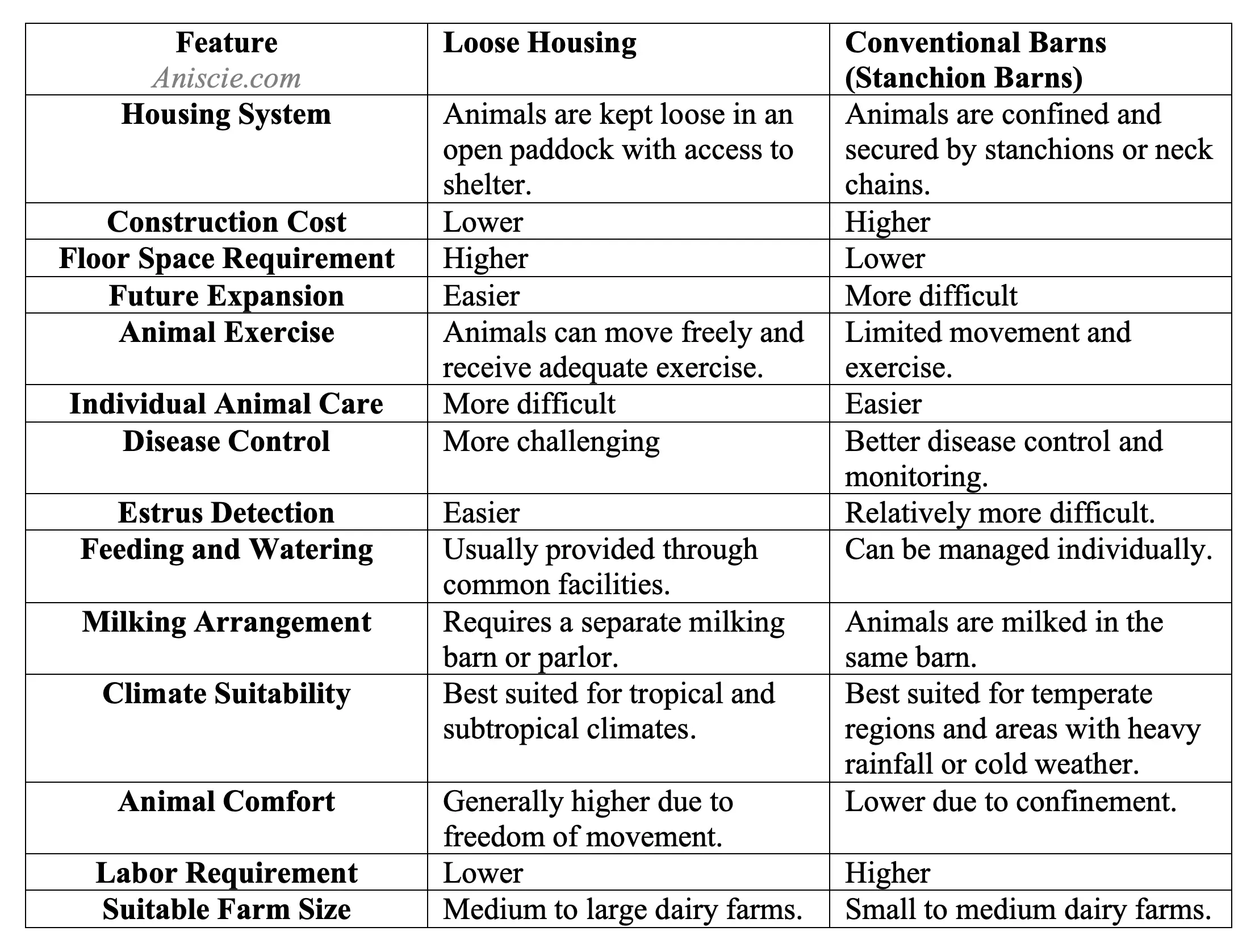
Comparison Between Loose Housing and Conventional Barn (Stanchion Barn) Systems
The following table compares loose housing and conventional barn systems based on construction cost, space requirements, animal comfort, labor requirements, climate suitability, and management considerations.