CONTENT
Essential Buildings Required for Dairy Farming (Cattle and Buffalo): Types, Layout, and Functions of Different Units
Proper planning of dairy farm buildings is essential for efficient management of cattle and buffalo. A well-designed dairy farm should include housing units for different classes of animals, milking facilities, calving pens, isolation and quarantine units, and accessory buildings for feed and milk storage.
Each building serves a specific function in animal housing, feeding, breeding, milking, health management, and farm operations. This article discusses the essential buildings required for dairy farming, their layout, and the functions of different units.
Various Buildings or Units
The buildings required on a dairy farm can be broadly classified into dairy cow buildings, main building units, and accessory buildings. Each unit serves a specific purpose in animal management, feeding, breeding, milking, and disease control:
- Dairy Cow Building
- Main Building Units
- Accessory Buildings
Dairy Cow Building
A dairy cow building must have the following areas:
- Feeding passage
- Manger
- Standing space
- Gutter or drainage channel
- Milking passage
Main Building Units
- Milking barn or parlor
- Down-calver shed or Calving pen
- Calf pen
- Young stock or heifer shed
- Dry animal shed
- Bull shed
- Isolation shed
- Quarantine shed
Accessory Buildings
- Storage room
- Milk room
- Hay or straw shed
Milking Barn
A milking barn is a barn where lactating animals are milked and is fully covered. It should be located at the center of the farm, with all other farm buildings arranged around it. Depending upon the number of lactating animals, there are two types of milking barns, viz.,
- Single-row system.
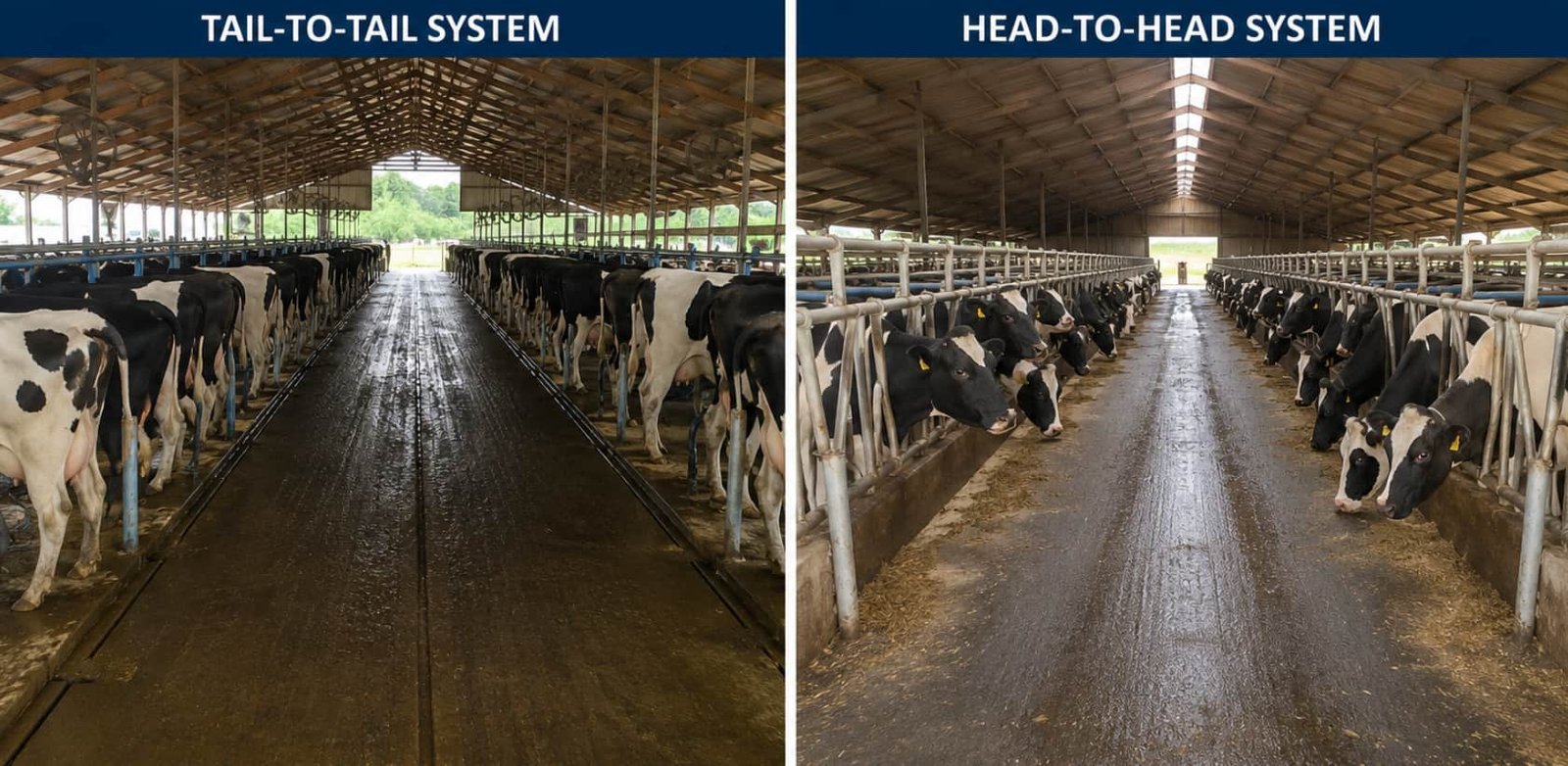
- Double-row system: head-to-head or face-in; tail-to-tail or face-out.
In a single-row system, 12–16 animals can be kept. If the number is greater than 16, then a double-row system is preferable. In a double-row system, up to 50 animals can be maintained in a single shed. The distance between two sheds should be greater than 30 feet, or it should be twice the height of the building.
There shall be an individual standing space in the milking barn, and the number of standing spaces required should be 25% of the total number of lactating animals in the herd. The milking operation should be carried out in batches.
| Length of standing space | 1.5–1.7 m |
| Width of standing space | 1.05–1.2 m (80% of the length of the standing space) |
| Width of central passage | 1.5–1.8 m |
| Width of feed alley | 0.75 m |
| Width of gutter | 0.30 m |
| Overhang | 0.75 m |
Advantages of ‘Tail-to-Tail System’
- Cleaning and milking of animals are easy.
- Supervision of milking is also easy.
- There is less chance of disease transmission from one animal to another.
- Animals can receive more fresh air from outside.
Advantages of ‘Head-to-Head System’
- Moving animals into the shed is easy.
- Feeding animals is also easy.
- Disinfection of the gutter is enhanced due to the direct exposure of the gutter to sunlight.
- Animals are better displayed to visitors.
Disadvantages of ‘Head-to-Head System’
- Milking supervision is difficult.
- The possibility of disease transmission is greater.
Shed for Lactating or Dry Cows
Lactating and dry cows are generally housed separately. The floor in the covered area should preferably be made of cement concrete. On smaller farms, lactating and dry animals can be housed together. Normally, one-third of the animals on a farm will be in the dry or dry-cum-pregnant stage.
Floor Space Requirements
| Type of Animal | Floor Space Requirement (m²) | Maximum Number of Animals per Pen | Height of the Shed (cm) | |
|---|---|---|---|---|
| Covered Area | Open Area | |||
| Bulls | 12.0 | 24.0 | 1 | 175 cm in medium and heavy rainfall areas and 220 cm in dry areas. |
| Cows | 3.5 | 7.0 | 50 | |
| Buffaloes | 4.0 | 8.0 | 50 | |
| Down-Calver | 12.0 | 12.0 | 1 | |
| Young Calves | 1.0 | 2.0 | 30 | |
| Old Calves | 2.0 | 4.0 | 30 | |
Feeding and Watering Space Requirements
| Type of Animal | Space per Animal (cm) | Total Manger Length in a Pen for 100 Animals (cm) | Total Water Tank Length in a Pen for 100 Animals (cm) |
|---|---|---|---|
| Adult Cattle and Buffaloes | 60–75 | 6000–7500 | 600–750 |
| Calves | 40–50 | 4000–5000 | 400–500 |
Dimensions of Feed Manger
| Type of Animal | Width (cm) | Depth (cm) | Height of Inner Wall (cm) |
|---|---|---|---|
| Adult Cattle and Buffaloes | 60 | 40 | 50 |
| Calves | 40 | 15 | 20 |
Calving Pen
Pregnant animals are transferred to a calving pen 2 to 3 weeks before the expected date of calving. A calving pen measuring 3 m × 4 m (12 m2) is essential for keeping animals in the advanced stage of pregnancy. It should be located near the farm manager’s residence for better supervision. The number of calving pens required is 10% of the total number of breedable female stock on the farm.
Isolation Shed
An isolation shed is used to separate sick animals from apparently healthy animals to prevent the transmission of diseases to healthy stock. It should be located at the corner of the farm.
Quarantine Shed
A quarantine shed should be located at the entrance of the farm. Newly purchased animals entering the farm should be kept in the quarantine shed for a minimum period of 30 to 40 days to monitor for any disease occurrence.
Store Room
All four walls should be enclosed, and the store room should be rat-proof. There should be one concrete store room with a feed-mixing unit located at a distant site and a smaller feed store room behind the milking parlor.
Milk Room
A milk room is essential for storing milk and chilling it in larger dairy farms with a production capacity of 400 to 700 liters. Such farms require a room measuring 3.7 m × 5 m, with an additional 0.37 m² for every 40 liters of milk production. For a smaller dairy unit producing less than 100 liters, a room measuring 3.75 m × 3 m is sufficient for storing milk and concentrate feed.
Hay or Straw Shed
An adult animal consumes about 5 to 10 kg of hay or straw per day, while young stock consume about 2 to 5 kg per day. The annual requirement can be calculated, and the corresponding space requirement can then be determined.