CONTENT
Calf Housing: Types, Requirements, Management, and Floor Space Requirements
Calf housing plays a critical role in calf health, welfare, growth, and future productivity. Properly designed housing helps minimize disease transmission, reduce calf mortality, improve feed efficiency, and create a comfortable environment that supports normal growth and development.
The main objective in the planning and design of calf housing is to provide an environment that minimizes the need for veterinary care, reduces calf mortality, and encourages the production of healthy calves. The calf housing should provide a suitable environment for both the calves and the stockman. Factors such as ventilation, bedding, space allowance, housing type, and management practices are important considerations when designing housing systems for calves.
Fundamental Requirements
- Provide dry bedding.
- A well-ventilated environment.
- A specific minimum cubic air capacity per calf.
- A draught-free environment at calf level.
A dry bed is important to reduce heat loss to the floor and minimize the use of straw. Moisture removal from a calf house is usually achieved through a combination of drainage and ventilation. Good ventilation also removes gases such as ammonia, hydrogen sulphide, carbon dioxide, and methane.
The cubic air capacity per calf is important in all calf housing designs because it dilutes the concentration of disease-producing organisms in a building, thus reducing the risk of cross-infection.
The height and space provided in the housing allow air to be introduced into a calf house well above the level of the calves, thus minimizing the risk of draughts at calf level during the winter months.
Management Considerations for Group Housing
- If an all-in, all-out system is practiced, proper cleaning and disinfection between batches should be ensured.
- A minimum period of 3 weeks between batches should be allowed.
- The age range within a group of calves should be narrow.
- Only calves from a similar background should be grouped together wherever practicable.
Types of Housing for Calves
Calf housing is basically of three types. They are:
- Housing for dairy and beef calves reared for replacement or beef production.
- Housing for calves reared for veal production.
- Housing for suckling calves.
Most calves reared fall under the first category. The type of housing used for calf rearing varies from situation to situation. There is considerable diversity of opinion regarding whether calves should be reared in individual pens or in groups.
In many regions, calves are commonly reared in groups in conventional barns or in the same housing facility as adult cattle. Even on organized farms, the situation is often not much different. High calf mortality rates, ranging from 30% to 40% on many farms, may be attributable to this type of housing and calf management.
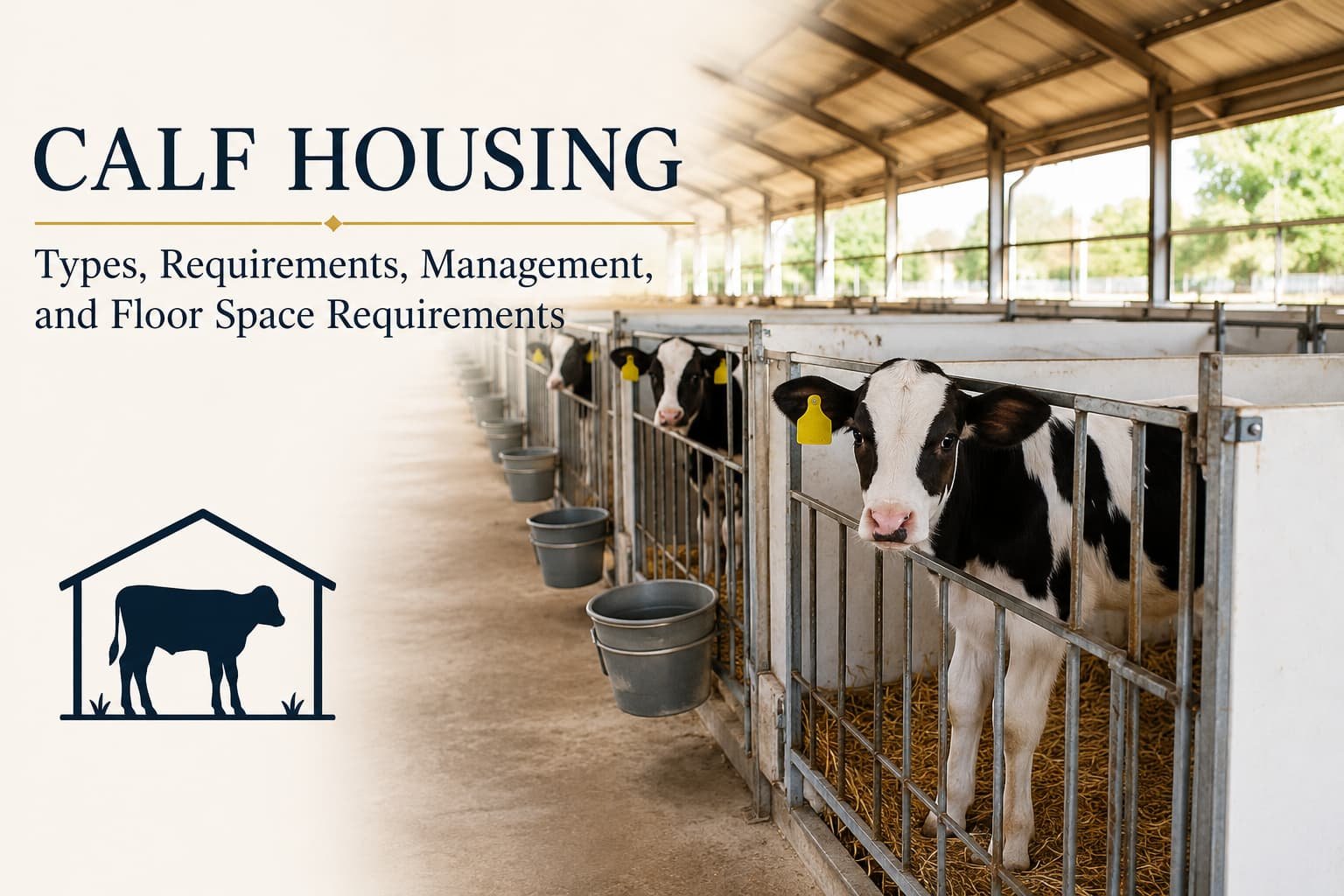
Individual pens should be constructed so that they can be easily cleaned and disinfected. Individual pens provide effective separation for each calf. This prevents navel sucking and reduces the spread of disease through facial or other direct contact.
If railed pen divisions are used, contact is not completely prevented because the calves can still see and interact with one another. In other types of housing, contact may be completely prevented. It is preferable to keep calves in individual pens for at least 1 month and, if possible, up to 3 months. After 3 months, 3 to 5 calves may be housed together in a single pen.
From 6 months of age until breeding age, the animals are generally kept individually. After 6 months of age, male calves are usually sold for breeding or slaughter. For ease of management, the calf shed or calf unit should be located adjacent to the dairy unit.
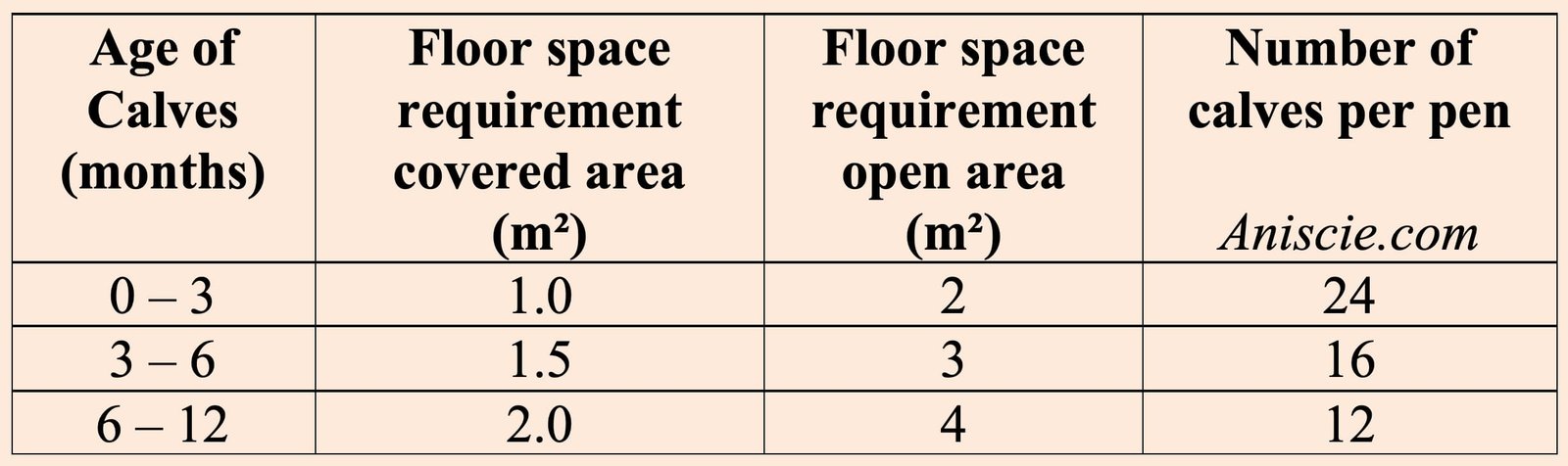
Recommended floor space requirements for different age groups of calves: