CONTENT
Bull Housing: Requirements, Design, Floor Space, and Management
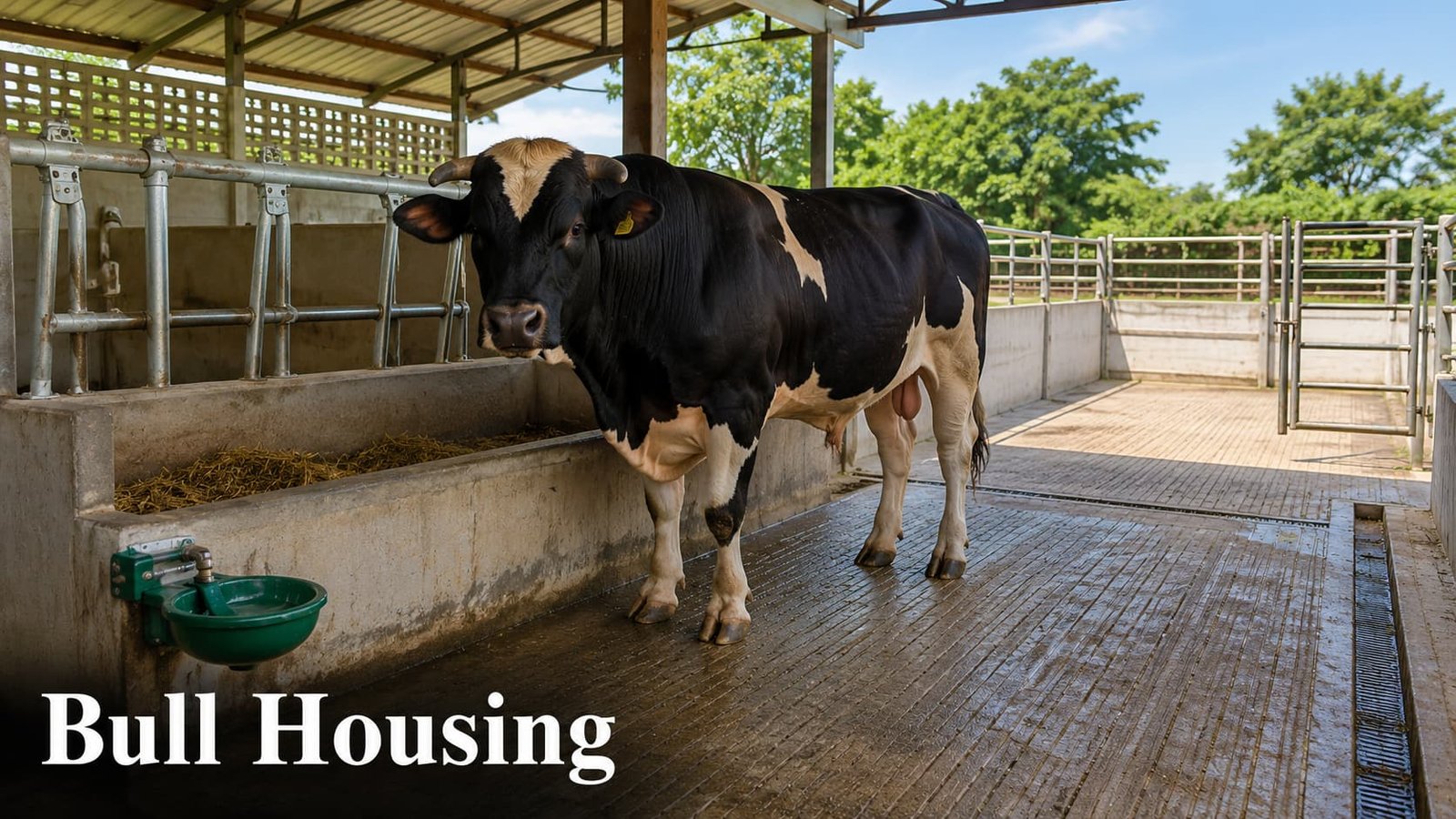
Bull housing is an important component of dairy farm management. Proper housing provides a safe and comfortable environment for breeding bulls, facilitates handling and management, supports reproductive performance, and helps prevent injuries. A well-designed bull housing system should provide adequate space, ventilation, exercise facilities, and protection from adverse environmental conditions.
The statement that the bull is half of the herd is literally true in the sense that the dairy bull contributes half of the herd’s genotype through its offspring. In hot regions, semen production in bulls is affected if they are not properly housed. Therefore, an adequate and well-facilitated bull house is needed to improve breeding efficiency on a dairy farm. Bulls are generally housed using a pen-and-yard system. Bulls must be housed individually and may be accommodated in either a single-row or double-row system.
Purpose of Bull Housing
- To protect bulls from inclement weather and to ensure safety and easy handling.
- To provide opportunities for exercise.
- To improve reproductive efficiency on the dairy farm.
Floor Space Requirement
Adequate floor space is necessary to promote normal movement, reduce stress, minimize injuries, and support reproductive performance in breeding bulls.
- In the covered area, 12 m2 per bull can be provided, and in the open exercise yard, 120 m2 per bull should be provided.
- If an open yard is not provided, a bull exerciser is required.
Construction Principles
The design and construction of bull housing should prioritize animal welfare, durability, worker safety, and ease of maintenance while providing a comfortable environment for the bull throughout the year.
1. Wall
In an enclosed loose box, the solid wall should be constructed to a height of 1.5 m. Above these walls, two or three horizontal tubular rods should be fixed with a gap of 20 to 30 cm between them.
2. Floor
Flooring should be properly laid for bulls because it helps reduce hoof problems. The floor can be constructed using rough cement concrete and should have a gradient slope of 1/40 to 1/60 to allow easy drainage into the drainage channel. In hot regions, the floor should remain cool during summer and provide adequate insulation from heat. Generally, vitrified paving bricks can be used to prevent slippery floors.
3. Roof
A gable or monitor roof with eaves 2.5–3 m high should be provided, and the ridge height should be 3.2–3.5 m. Roofing materials used for bull sheds in hot regions should have good insulating properties and low heat conductivity. Generally, galvanized iron sheets, fiber cement sheets, or other insulated roofing materials are used as roofing materials.
Fittings and Facilities
Appropriate fittings and facilities are essential for feeding, watering, handling, and managing bulls safely and efficiently within the housing system.
1. Manger
A cement concrete manger with dimensions of 60 cm width, 40 cm depth, and 50 cm inner wall height should be provided inside the bull shed. An essential fitting associated with the manger is the provision of a yoke or tubular stanchions installed over the manger.
2. Water Trough
The bull shed should have a water trough measuring about 60 to 75 cm in length. The best method of watering bulls is by using an automatic water bowl.
3. Doorway
Each bull box should have a main entrance of the half-door type, measuring 4 feet in width and 7 feet in height. The upper part of the doorway should have two strong bars across the opening to prevent the bull from jumping over the lower door when the upper half is left open. Provision should also be made at the opposite end of the box for an exit leading either to a feeding passage or to the yard.
4. Yard
A yard is an open area provided for the bull and should measure approximately 120 m2. The yard should be enclosed on all sides by a 0.3 m solid wall and iron tubular rod partitions extending to a height of 1.2 m, with rods placed at 0.25 m intervals. A doorway 1.2 m wide should be provided at the end of the yard. The yard floor should be constructed of cement concrete, properly grooved and roughened, and should have easy access to the drainage system. The bull yard is provided to allow exercise and to enable bulls to view other animals in the herd, thereby reducing the feeling of isolation.
5. Service Crate
The exercise yard should also communicate with a service crate through a swing gate, allowing an attendant to bring the bull to the service crate. The semen collection yard and processing laboratory should be located close to the bull house. One bull is generally required for every 50 breedable cows. If artificial insemination (AI) is widely practiced, maintaining breeding bulls on the farm may not be necessary.
Protection Against Hot Climatic Conditions
Heat stress can adversely affect libido, semen quality, and overall reproductive performance in breeding bulls. Therefore, appropriate environmental modifications are necessary to maintain optimal breeding efficiency during hot weather.
To reduce thermal stress, the following facilities can be provided:
- Bulls should be housed in a cool and well-ventilated shed.
- Showering or splashing with cold water 2–3 times during the hottest part of the day is also effective.
- Bulls can be taken for grazing or exercise during the early morning or late evening, which are the cooler parts of the day.
- Planting fast-growing tall trees around the shed can provide natural shade and good ventilation, while also reducing the effects of solar radiation.
- Spreading straw over the roof may reduce heat inside the animal house.
- The upper surface of the roof may be painted with a white or light-colored material to reflect heat. The underside of the roof may be painted black or another dark color.