CONTENT
Selection of Site for Farm Buildings: Factors to Consider for Livestock and Dairy Farms
Selecting a suitable site is one of the most important steps in farm planning. A well-chosen location ensures proper drainage, adequate water supply, easy transportation, animal comfort, and future farm expansion. Poor site selection can increase construction costs, reduce productivity, and create management difficulties.
Proper housing should be conducive to good health, comfort, and protection from inclement weather and should enable animals to utilize their genetic potential and feed efficiently for optimal production. For the construction of farm buildings, site selection is of utmost importance.
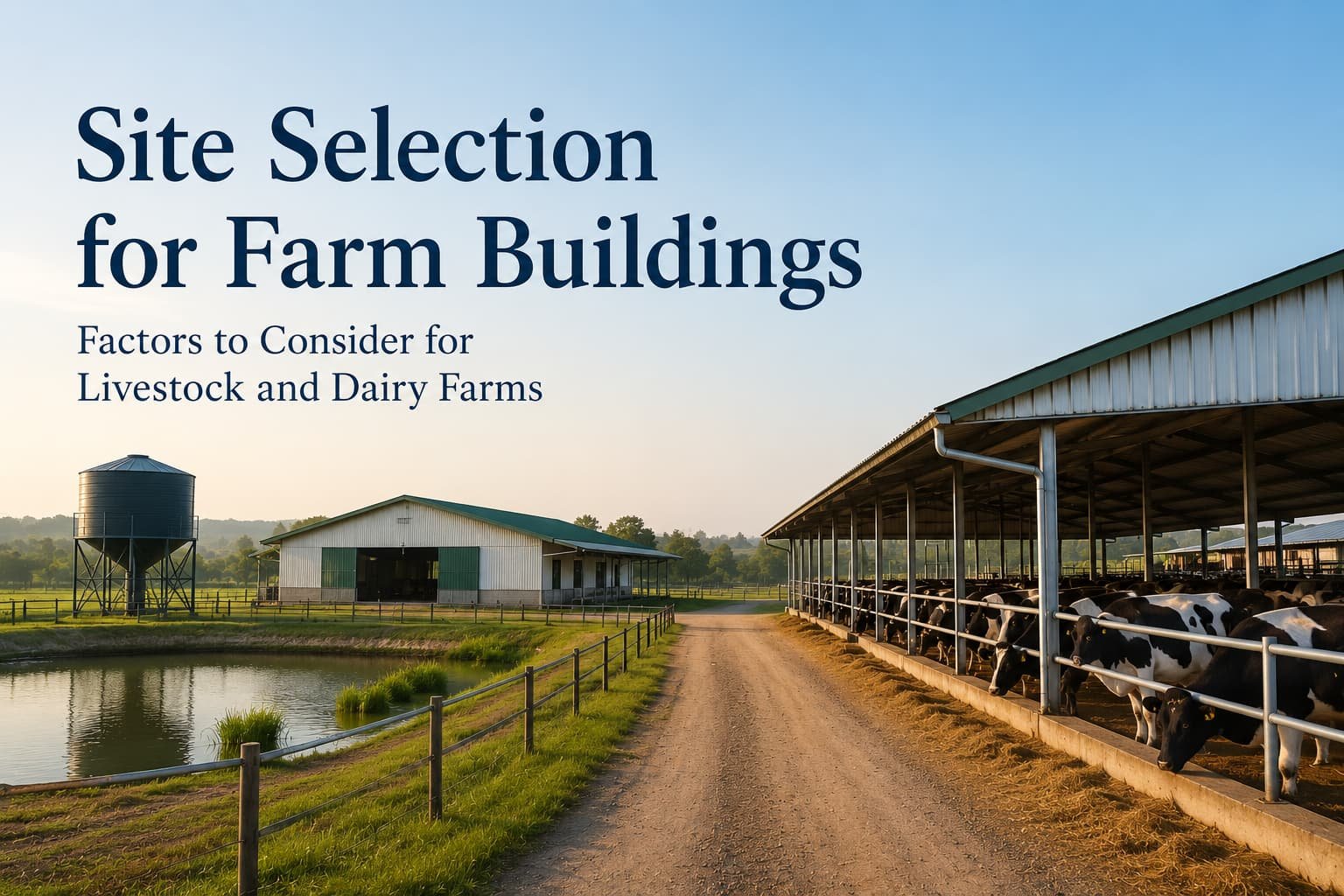
Before selecting a site, the following points should be considered:
- Type of soil
- Availability of land
- Electricity
- Availability of water
- Protection from wind and solar radiation
- Away from noise and other pollution sources
- Availability of market facilities
- Transport facilities
- Drainage system
- Miscellaneous facilities such as telephone service, schools, post offices, and shopping centers
1. Type of Soil
The soil must be suitable for a strong foundation. Different types of soil include marshy, clay, alluvial, sandy, rocky, and gravel soils. Among these, marshy, clay, sandy, and rocky soils are not suitable for animal house construction. Loamy and gravel soils are suitable, with gravel soil being the best for building construction because it provides a strong foundation.
2. Availability of Land
There should be sufficient land to construct all required buildings and allow for future expansion. At least 2–3 acres of land are required for 200 cows. For every 2 cows, 1 acre of land is required for fodder production. Similarly, 1 acre of land is essential for 30–40 sheep or goats.
3. Electricity
Electricity should be available at the site. It is needed for operating various machines on the farm and for providing lighting for the animals.
4. Availability of Water
An adequate supply of potable water is needed for various farm operations such as cleaning, fodder cultivation, milk processing, by-product processing, and animal consumption. Therefore, a reliable and continuous water source is essential.
5. Protection from Wind and Solar Radiation
If farm buildings are located in an open or exposed area, windbreaks in the form of tall, fast-growing trees should be planted near the buildings. This helps reduce wind velocity and minimize exposure to solar radiation.
6. Away from Noise and Other Pollution Sources
The farm site should be located away from noisy industries, chemical plants, and sewage disposal areas. Industrial effluents in the form of gases or liquids may pollute surrounding resources. Noise has also been found to adversely affect animal production. Therefore, the farm should be located away from urban areas.
7. Availability of Market Facilities
The farm site should be located away from urban areas while still being easily accessible to markets so that farm products can be marketed efficiently.
8. Transport Facilities
Farm buildings should have access to good roads and convenient transportation routes to markets. This helps reduce transportation costs and minimizes product spoilage.
9. Drainage Facilities
Proper drainage of rainwater and groundwater should be provided to maintain a healthy environment and protect buildings from dampness.
10. Miscellaneous
Other facilities, such as telephone service, nearby schools for the children of farm workers, post offices, shopping centers, and recreational facilities, should also be considered.