CONTENT
General Principles of Livestock House Planning: Site Plan, Floor Plan, Orientation, and Building Design
Proper livestock house planning is essential for efficient animal management, labor utilization, animal comfort, and long-term farm productivity. Before constructing livestock buildings, careful planning is required to ensure proper site selection, building layout, ventilation, drainage, and orientation.
The following points should be considered before planning and designing animal houses:
- Livestock or animal houses should have an attractive appearance
- They should minimize labor costs
- Operational efficiency should be increased
- They should have resale value
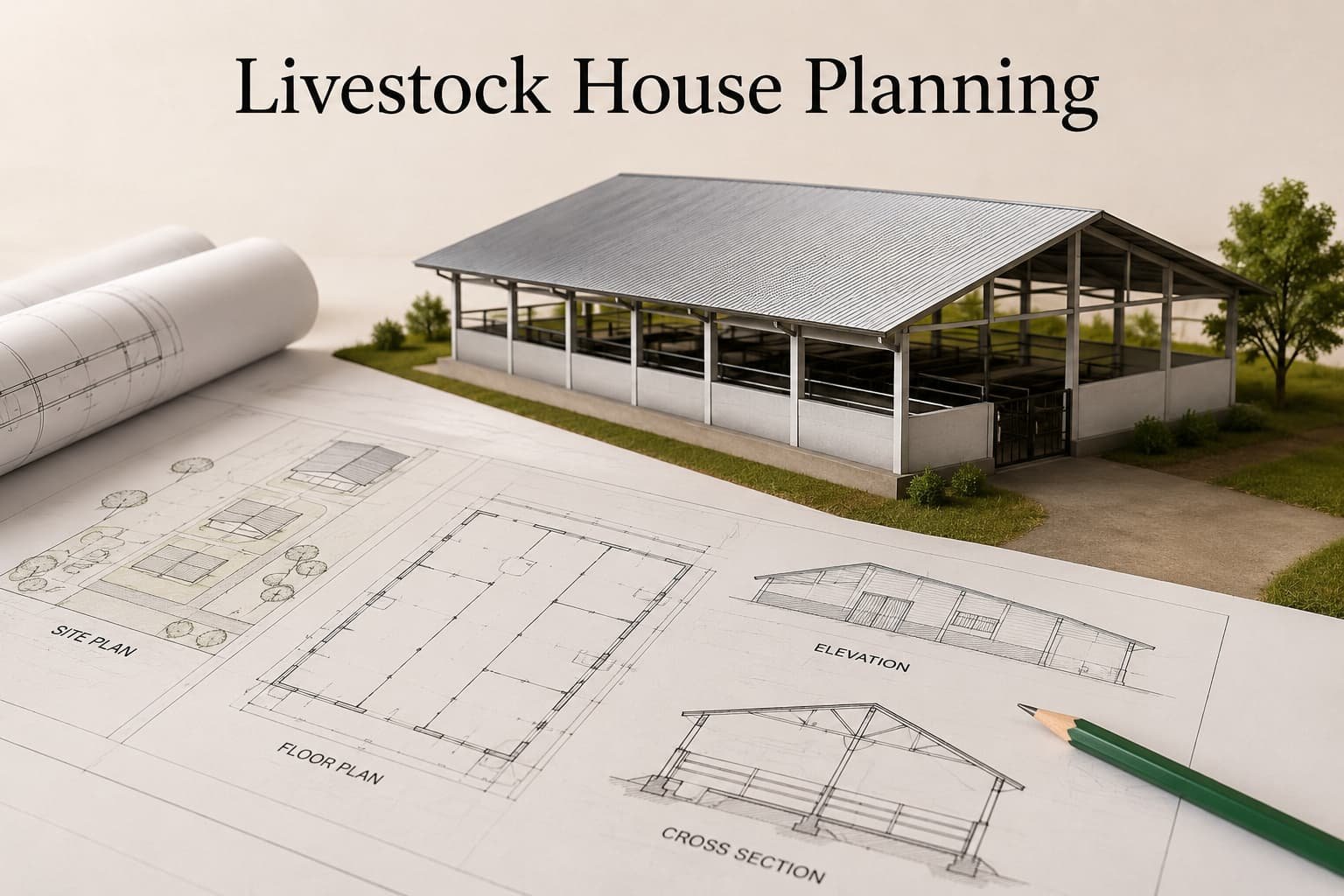
Plan preparation is essential for the construction of animal houses. First, a rough plan consisting of the following should be prepared:
- Site plan
- Floor plan
- Elevation
- Cross section
- Master plan
- Van Dyke prints
- Blueprint
- Orientation
1. Site Plan
It is used to locate the site where the buildings are to be erected. It should contain details of the arrangement of various buildings, road layout, and the spaces between buildings.
2. Floor Plan
It is an aerial view of the different structures to be erected within a farm building. It should contain details such as the dimensions of the building, the location of ventilators, and doorways, which should be marked on the floor plan.
3. Elevation
The appearance and view of the whole building are shown in the elevation.
4. Cross Section
It provides details of the building foundation, type of flooring, walls, and roof of the building. The internal fittings, partitions, feeding equipment, and securing devices should be clearly shown.
5. Master Plan
After the rough plans have been prepared and found satisfactory, a master plan should be developed. Master plans are prepared on semi-transparent paper using black ink and drawn to scale. Multiple copies of the plans can then be produced through subsequent processes such as blueprinting.
6. Van Dyke Prints
These are negatives of the original drawing. Black or blue lines are provided on a white background in the negative.
7. Blueprint
Mass production of plans is achieved from negatives by exposing them to sensitive blueprint paper, which is then developed in water and fixed in potassium dichromate. It is used to estimate costs and carry out construction work.
8. Orientation
Farm housing may be constructed facing the road, while other buildings may be positioned at an angle to the road or reversed to take advantage of prevailing winds and sunlight.
In general, animal sheds are oriented with their long axis running east to west, with the paddock side facing north to receive direct sunlight during winter and to prevent direct sunlight from entering the shed during other seasons.