CONTENT
Types of Silos in Livestock Farming: Complete Guide to Silage Storage
A silo is an airtight to semi-airtight structure designed for the storage and preservation of high-moisture feeds as silage.
Silos play a critical role in modern livestock farming by providing a reliable method for storing and preserving high-moisture forage as silage. Proper silo selection and construction help minimize nutrient losses, maintain feed quality, and ensure a consistent supply of nutritious forage throughout the year.
This guide explains the major types of silos used in livestock production, including tower, pit, trench, bunker, and gastight silos, along with their characteristics, advantages, disadvantages, and practical applications.
Characteristics of Silos
- The size should be determined based on the number and type of animals to be fed daily, the length of the feeding period, and the amount of forage available for ensiling.
- Silos should exclude air from the stored material, including the entry of air around the doors of tower silos.
- The side walls should be straight and smooth to prevent the formation of air pockets that may interfere with normal microbial fermentation.
- Silos should be of adequate depth, allowing for better packing and reducing the surface area exposed relative to the total mass.
- The walls should be strong and rigid to withstand the pressure that develops inside the silo as fermentation takes place. Reinforcement of walls may be desirable.
- Adequate provision should be made for the escape of excess juices, either through a drain or a gravel bottom.
- The silo should be conveniently located and accessible in all weather conditions for both filling and feeding operations.
- Silo pits (excluding tower silos) should preferably be located on elevated ground to avoid water seepage.
Types of Silos
The type of silo and the choice of construction material should be determined primarily by economic considerations.
Silos may be classified as follows:
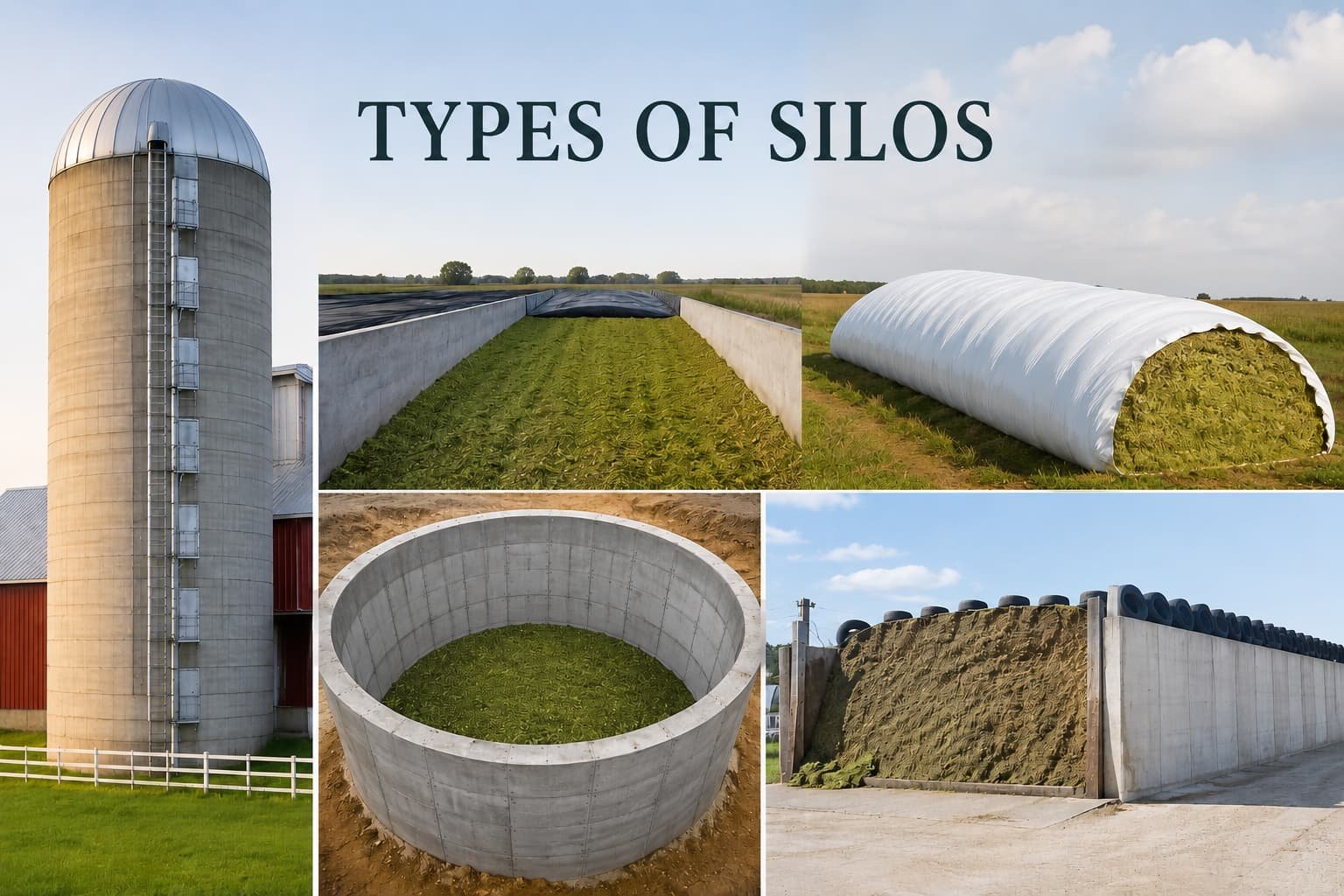
- Conventional Upright (Tower) Silos
- Concrete stave (thin strips of concrete set edge to edge to form the wall)
- Wood stave
- Tile block
- Brick
- Gastight (Oxygen-Limiting) Silos
- Concrete stave
- Brick
- Pit Silos
- Horizontal Silos
- Trench silos (below ground level)
- Bunker silos (above ground level)
- Temporary Silos
- Plastic or polyethylene bag silos
- Modified trench-stack silos
1. Conventional Upright (Tower) Silos
All upright silos are circular in shape and equipped with a series of doors of approximately 2 sq. ft., spaced about every 6 ft. along one side of the silo. These doors are closed as the silo is filled and opened as the silo is emptied.
Recent developments in tower silo construction include bottom unloaders and larger-diameter designs (24–30 ft.). However, typical tower silos range from approximately 12–20 ft. in diameter and 40–80 ft. in height.
2. Gastight or Airtight or Sealed Silos
These silos resemble conventional tower silos but are more expensive because they are constructed to prevent oxygen from entering the structure.
Gastight silos are designed for forages containing as much as 50–75% dry matter or for the storage of high-moisture grain containing 60–75% dry matter.
3. Pit Silos
A pit silo is shaped like a tower silo but is constructed below ground level. It resembles a well. This type of silo can be used only in locations where the water table is sufficiently low to prevent the silo from filling with water.
Compared with tower silos, pit silos offer the following advantages:
- They are not susceptible to storm damage.
- They require less reinforcement.
Disadvantages of pit silos are:
- They can be hazardous because of the frequent presence of suffocating CO2.
- Considerable labor is required to remove the silage.
4. Horizontal Silos
Trench silos (below ground level) and bunker silos (above ground level) are the two main types of horizontal silos.
Trench Silo
This type of silo can be constructed quickly at a relatively low cost. It is most popular in areas with moderate weather conditions and good drainage.
A trench silo should be wider at the top than at the bottom, and the floor should slope toward one end so that excess juices can drain away when high-moisture forage is ensiled.
Advantages: Low initial cost and ease of construction.
Disadvantages: Compared with tower silos, a larger surface area must be sealed.
After filling is completed, the top should be carefully sealed using polyethylene sheeting, plastic covers, wet straw mixed with mud, or sawdust to maintain an airtight environment.
Bunker Silos
As a labor-saving option, above-ground bunker silos (or slightly recessed bunkers), usually with concrete floors, have become increasingly popular among livestock producers.
Size of Silos for Construction:
| No. of Adult Cows | Diameter of Silo (m) | Height of Silo (m) | Tonnes of Silage |
|---|---|---|---|
| 12 | 3.05 | 7.93 | 39.4 |
| 20 | 3.66 | 8.23 | 56.4 |
| 30 | 4.27 | 9.14 | 84.6 |
| 50 | 5.49 | 10.68 | 141.0 |
| 100 | 6.10 | 11.89 | 282.0 |
5. Temporary Silos
Plastic or polyethylene bag silos and modified trench-stack silos are temporary silos commonly used for silage production.