CONTENT
Storage of Feeds and Feed Ingredients: Losses During Storage and Preventive Methods
Proper storage of feeds and feed ingredients is essential to maintain nutritional quality, prevent spoilage, and reduce economic losses. Factors such as moisture, temperature, insects, fungi, rodents, and poor storage design can significantly affect feed quality during storage.
As the population continues to grow, maintaining an adequate food supply has become an urgent priority. One vital and often neglected step toward this goal is reducing food losses that occur between harvest and consumption.
Despite advances in technology, tons of cereals are wasted every year due to various forms of spoilage. Protection of food supplies through sound storage practices is of critical importance.
Efficient storage and marketing practices can make a major contribution in both developing and developed countries where food and feed shortages remain significant. Loss is measured as the reduction in the amount of feed available for consumption.
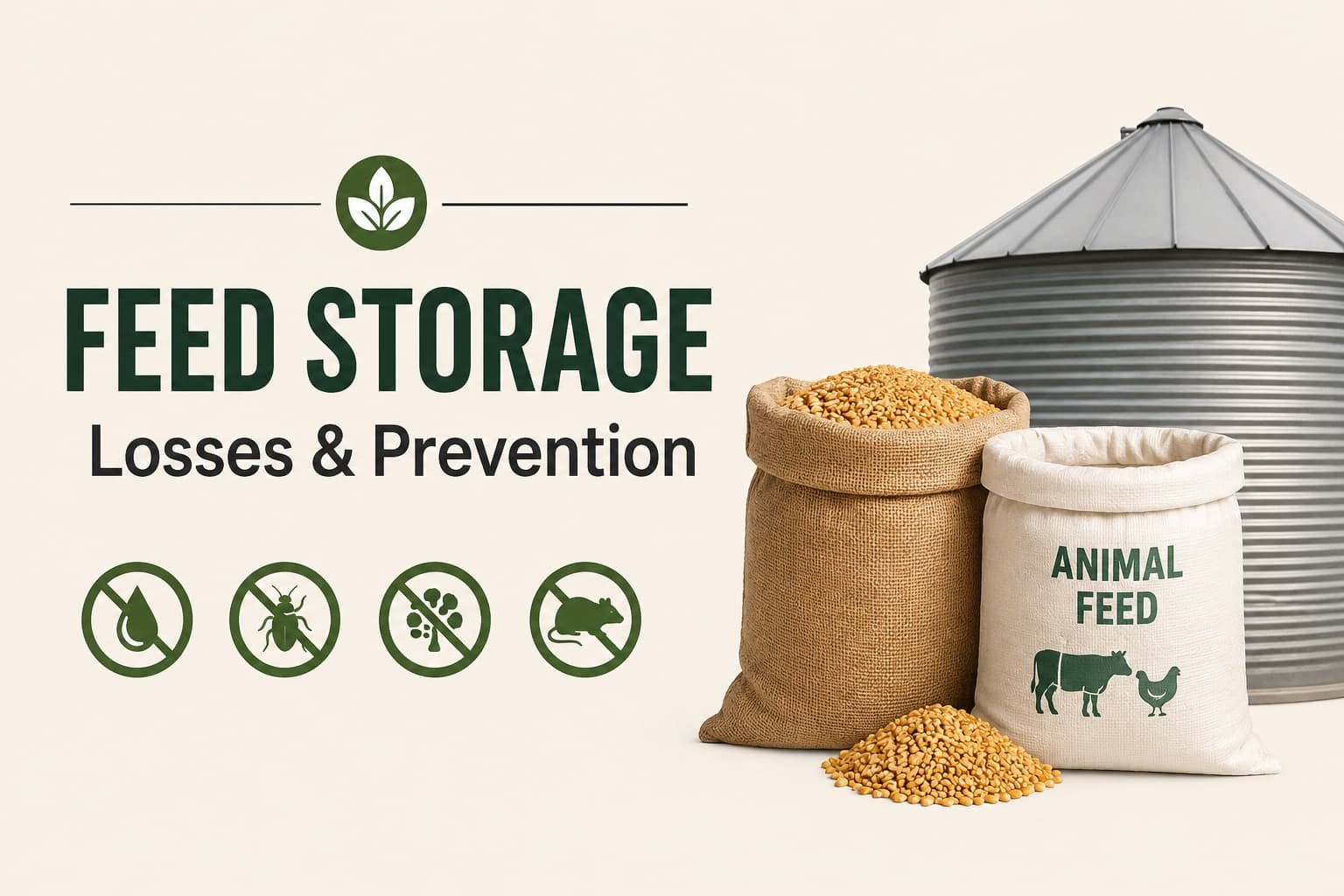
Feed and feed ingredient losses may be:
- Quantitative
- Qualitative
- Economic
- Nutritional
- Germinative
These losses can be prevented or reduced through better management during the pre-harvest stage, harvesting, threshing, shelling, drying, and by applying sound storage practices.
Grains stored under favorable conditions for many years undergo relatively minor changes in composition and can be used as a source of nutritious and palatable food or animal feed. However, under unfavorable conditions, complete spoilage of grain for food or feed purposes may occur within a few days.
Factors affecting feed value and deterioration:
- Physical Factors
- Biological Factors
- Chemical Factors
- Engineering Factors
1. Physical Factors
Moisture content and temperature are the principal factors in safe storage. At low moisture levels and temperatures, destructive insects become inactive. The optimum moisture level for storing feed ingredients is generally less than 10%.
Furthermore, the lower the temperature, the higher the permissible moisture level for storage. High temperatures (21–43°C) accelerate the life processes of microorganisms. Temperatures below 15°C retard insect reproduction.
Control of Physical Deterioration of Feed
Proper drying of grain before storage and storing grains at the lowest possible temperature help minimize physical deterioration.
2. Biological Factors
The principal biological agents causing deterioration during storage are:
- Insects
- Fungi
- Rodents
Insects
At temperatures around 32°C, the rate of multiplication of insect species may increase significantly. The nutritive requirements of insects are similar to those of vertebrates. Crops with high nutritive value are generally more susceptible to insect damage.
Dead and live insects, along with their excreta, make the commodity unpalatable and unacceptable.
Control of insect damage is achieved by maintaining:
- Good hygiene.
- Regular cleaning and inspection of storage containers and stored feed.
- Separation of new dry grain from old grain.
- Storage facilities located away from fields to reduce the risk of infestation.
- Traditional pest control methods such as the use of herbs, mixing ash with grain, and smoking, where appropriate.
- Use of grain storage insecticides such as:
- Contact Poisons: Including dusts, dispersible powders, and emulsions (e.g., BHC, malathion).
- Fumigants: Gases capable of penetrating bulk grain (should only be handled by trained personnel).
Fungi
Fungi produce metabolites such as aflatoxins and zearalenone.
Fungal development in stored feed ingredients occurs due to:
- Inadequate drying,
- High humidity, and
- Wetting of stored materials.
Losses due to fungi can be reduced through proper drying and storage technology.
Rodents
Rodents not only consume feed but also contaminate it with their excretions. In addition, they damage storage containers by gnawing holes, resulting in leakage and wastage of grain.
Rodent control measures include:
- Rodent exclusion during store construction.
- Improved sanitation.
- Fumigation with phosphine and other gases.
- Trapping and hunting.
- Use of cats and dogs.
- Rodent repellents.
- Poison baiting using chlorophacinone, warfarin, coumarin, zinc phosphide, and barium carbonate.
- Acute Cases: Zinc phosphide, calcium cyanide, aluminum phosphide.
- Chronic Cases: Warfarin, coumarin.
3. Chemical Factors
Pesticide residues in the produce may affect feed value, and deterioration may occur during storage. Therefore, care should be taken to apply pesticides at the correct dosage and avoid spraying during the late stages of crop maturity.
4. Engineering Factors
Engineering factors include storage structures (bag or bulk storage) and mechanical operations such as conveying, threshing, and shelling. During these processes, grains may break, resulting in rapid spoilage during storage.
Design of Storage Facilities
Buildings used for the storage of feeds and feed ingredients must be watertight. Roofs, walls, doors, windows, and floors should be leakproof. Floors should not allow water vapor transmission from the soil.
Doors and windows should be sealable to permit ventilation control. Buildings must include measures to prevent the entry of rats, mice, and birds. Gaps between roofs and walls should be sealed using suitable materials such as sheet metal or close netting.
Pipes, shafts, and ducts should be fitted with wide metal guards externally and netting internally.
Essential criteria for safe storage of products:
- Completely weatherproof.
- Gas-tight to enable fumigation of the entire contents.
- Equipped with controllable ventilation.
- Protected against entry of rodents and birds.
- Free from light-transmitting areas in the roof to avoid excessive heat buildup on stored produce.
- Designed to permit installation of fans and floor ducting for specialized storage requirements.
The main factors affecting feed value and deterioration are:
- Moisture: Optimum moisture levels for storing feed ingredients generally range between 10–13%. At moisture levels around 9%, insects become inactive. Moisture content and temperature are the principal factors affecting safe storage. Lower temperatures permit higher moisture levels during storage.
- Temperature: Foods and biological materials are preserved more effectively under refrigeration. Temperatures between 21–43°C accelerate the life processes of microorganisms, while temperatures below 15°C retard insect reproduction.
- Oxygen Supply: Aerobic respiration of grains and associated microorganisms involves oxygen consumption and carbon dioxide liberation. In closed storage facilities, the rate of respiration tends to decrease. An ample oxygen supply may generate enough heat to exceed heat loss, leading to spontaneous heating. Therefore, adequate ventilation should be provided in storage facilities.
Unsound grain usually harbors greater numbers of mold spores and bacteria than sound grain. At a given moisture level, nutrients are more rapidly available from unsound grain to microorganisms.