CONTENT
Moisture Conservation Methods for Fodder Production in Dryland Farming
Moisture conservation plays a vital role in successful fodder production under dryland farming conditions. Efficient soil and water management practices help improve rainwater infiltration, reduce evaporation losses, enhance soil structure, and increase fodder crop productivity. This article explains the major moisture conservation methods used in dryland agriculture for sustainable fodder production.
Since water is the key factor for successful crop production in dryland areas, the role of an efficient farmer begins from the moment rainfall reaches the soil surface.
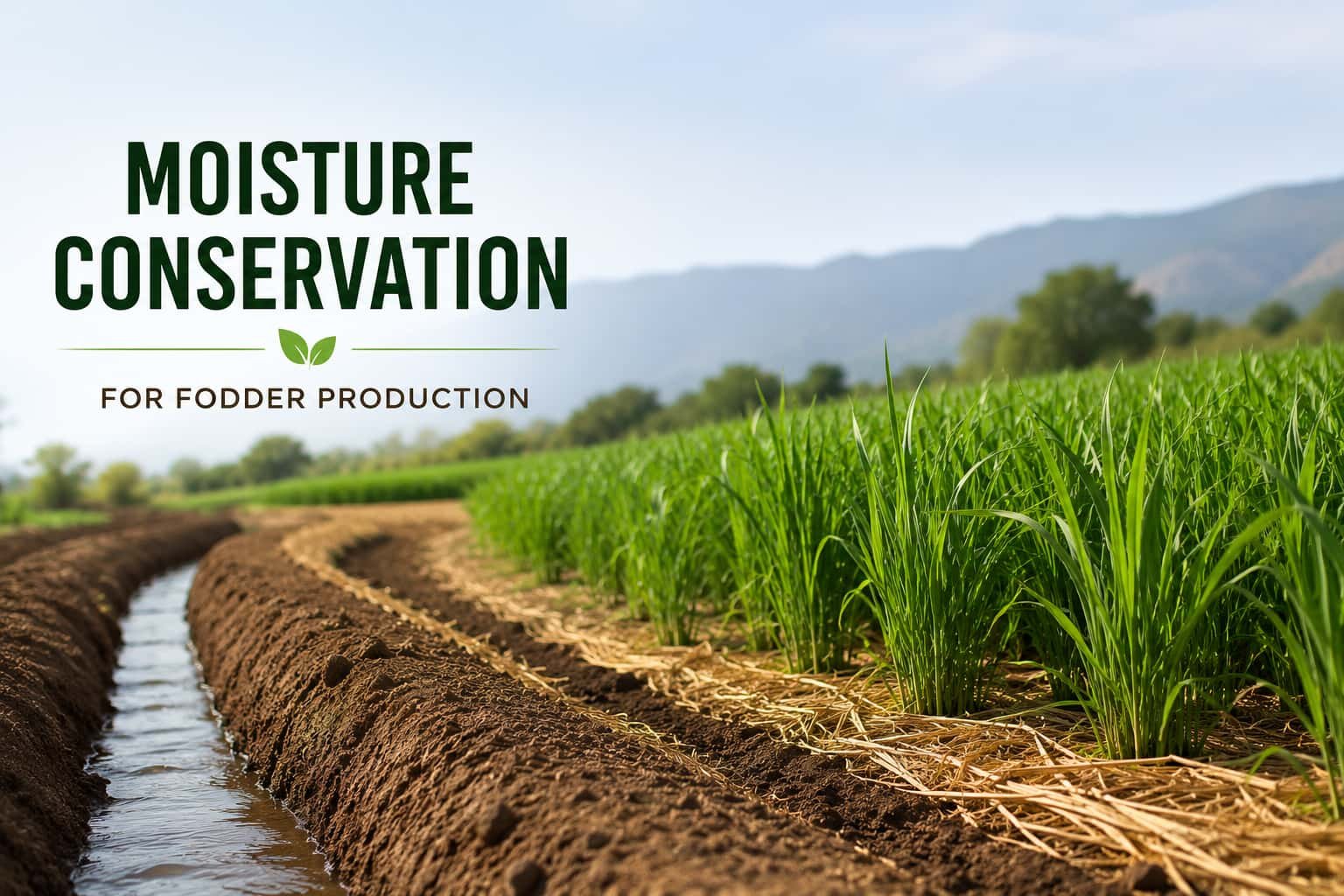
Methods of moisture conservation for fodder production include:
- Arresting the maximum amount of rainfall at the site of occurrence
- Maximizing soil moisture storage
- Reducing soil moisture losses
- Overcoming soil physical constraints
- Use of antitranspirants
1. Arresting Maximum Amount of Rainfall at the Site of Occurrence
Mechanical practices such as leveling, bunding, terracing, contour furrowing, trenching, and ridging help retain rainfall at the site of occurrence and provide more time for rainwater to infiltrate into the soil.
Levelling and Grading
Land leveling and grading is the process of reshaping the land surface to a planned slope or grade, which usually involves cutting high areas and filling low spots to remove surface irregularities and unevenness. This practice helps reduce erosion, control water flow, and improve surface drainage.
Contour Bunding
Contour bunds are constructed to intercept surface runoff. They are usually less than one meter in height and are commonly adopted in low- to medium-rainfall areas with relatively permeable soils. In regions receiving more than 500 mm of rainfall, graded bunds are preferred for the safe removal of excess water.
Bench Terracing
Bench terracing is practiced in areas with steep slopes ranging from 10% to 30%.
2. Maximizing Soil Moisture Storage
Rapid water infiltration and higher soil moisture storage capacity are essential for successful crop production under dryland farming. Improvement in both of these factors can be achieved by making the subsoil more permeable and by improving the structure of the surface soil.
Practices such as hot-weather cultivation, deep ploughing, subsoiling, chiseling, and the cultivation of legumes, grasses, and other deep-rooted crops have been found to make the soil more permeable, enabling it to hold larger quantities of rainwater, which ultimately results in increased crop yields.
Off-Season Tillage
Any tillage operation carried out between two cropping periods is referred to as off-season tillage. Its main objectives are to keep the soil open for greater water infiltration and to control weeds.
Primary Deep Tillage
Primary deep tillage aims to prepare a weed-free seedbed with good water infiltration capacity, thereby providing more time for sowing and ensuring better seed germination.
Chiselling
Chiseling refers to the breaking and loosening of compact soil or subsoil using a chisel plow in order to improve root penetration.
Addition of Organic Matter
Organic matter improves soil structure, resulting in greater water-holding capacity, improved soil fertility, and better physical condition of the soil, which ultimately leads to higher crop yields.
Cultivation of deep-rooted crops, particularly legumes, also helps improve soil permeability and water storage capacity.
3. Reducing Soil Moisture Losses
Surface evaporation and weed growth are the two major causes of soil moisture loss under dryland conditions, and their effective control is of great importance in dryland farming. It has been estimated that surface evaporation accounts for 30–40% of available soil moisture, and if weeds are not adequately controlled, the total moisture loss may increase to 60–80%.
Intercultivation using tools such as a hand hoe, hoe, harrow, or cultivator between crop rows helps remove weeds and reduce evaporation losses by creating a dust mulch on the soil surface.
Application of mulches (organic, chemical, polyethylene, etc.), use of antitranspirants, and chemical weed control are other methods used to reduce unproductive water losses through evaporation, transpiration, and weed growth.
Mulches
Application of mulches such as crop residues, rice straw, sugarcane trash, maize stubbles, dry grasses, and similar materials on the soil surface between crop rows is an effective method for controlling weed growth and reducing soil moisture losses.
In addition, mulching minimizes temperature fluctuations, improves the physico-chemical properties of the soil, enhances soil fertility, and ultimately increases crop yields. Chemical mulches and polyethylene mulching are also used; however, due to their higher cost, their use is generally limited.
4. Overcoming Soil-Physical Constraints
Dryland farmers may encounter one or more of the following soil physical constraints.
Surface Crusting
Surface crusting is commonly observed in light soils, where seedling emergence may be hindered. Incorporation of stubble or crop residues helps minimize crust formation.
Practices such as line sowing and ridge planting also reduce the effects of crusting. In cases where crusting has already occurred, dragging thorny branches over the soil surface can help break the crust.
Soil Cracking
Soil cracking is a serious problem in heavy-textured soils. Practices such as intercultivation, mulching, and the selection of short-duration crop varieties that complete their life cycle before cracks develop can help manage this problem.
Textural Profiles and Hard Pans
Deep ploughing, chiseling, and the cultivation of deep-rooted crops help overcome these problems.
5. Antitranspirants
Antitranspirants are generally used to reduce transpiration in crops; however, because they may also reduce photosynthetic activity, their use is mostly limited to nursery plants and situations involving severe moisture stress.
Antitranspirants are classified into the following types:
- Growth Retardants: These chemicals reduce shoot growth, promote root growth, and may enhance the female flower ratio, thereby increasing productivity and improving drought resistance.
- Stomata-Closing Types: These chemicals reduce water loss by inducing stomatal closure.
- Film-Forming Types: These materials reduce moisture loss by forming a thin film that acts as a physical barrier.
- Reflecting Types: These materials reflect solar radiation, thereby reducing leaf temperature and the vapor pressure gradient between the leaf and the atmosphere, which ultimately reduces transpiration.