CONTENT
Soil Conservation and Soil Erosion: Types, Causes, and Control Measures
Soil conservation plays a vital role in sustainable agriculture by protecting fertile topsoil, improving water retention, and maintaining long-term land productivity. Soil erosion caused by water and wind can reduce crop yields, damage farmland, and negatively impact the environment.
Soil Conservation
Soil conservation is the use and management of land based on its inherent capabilities, involving the application of best management practices to achieve maximum profitable production without degrading the land. This includes the use of suitable soils and crop management practices, as well as the correction of soil acidity, alkalinity, and drainage problems.
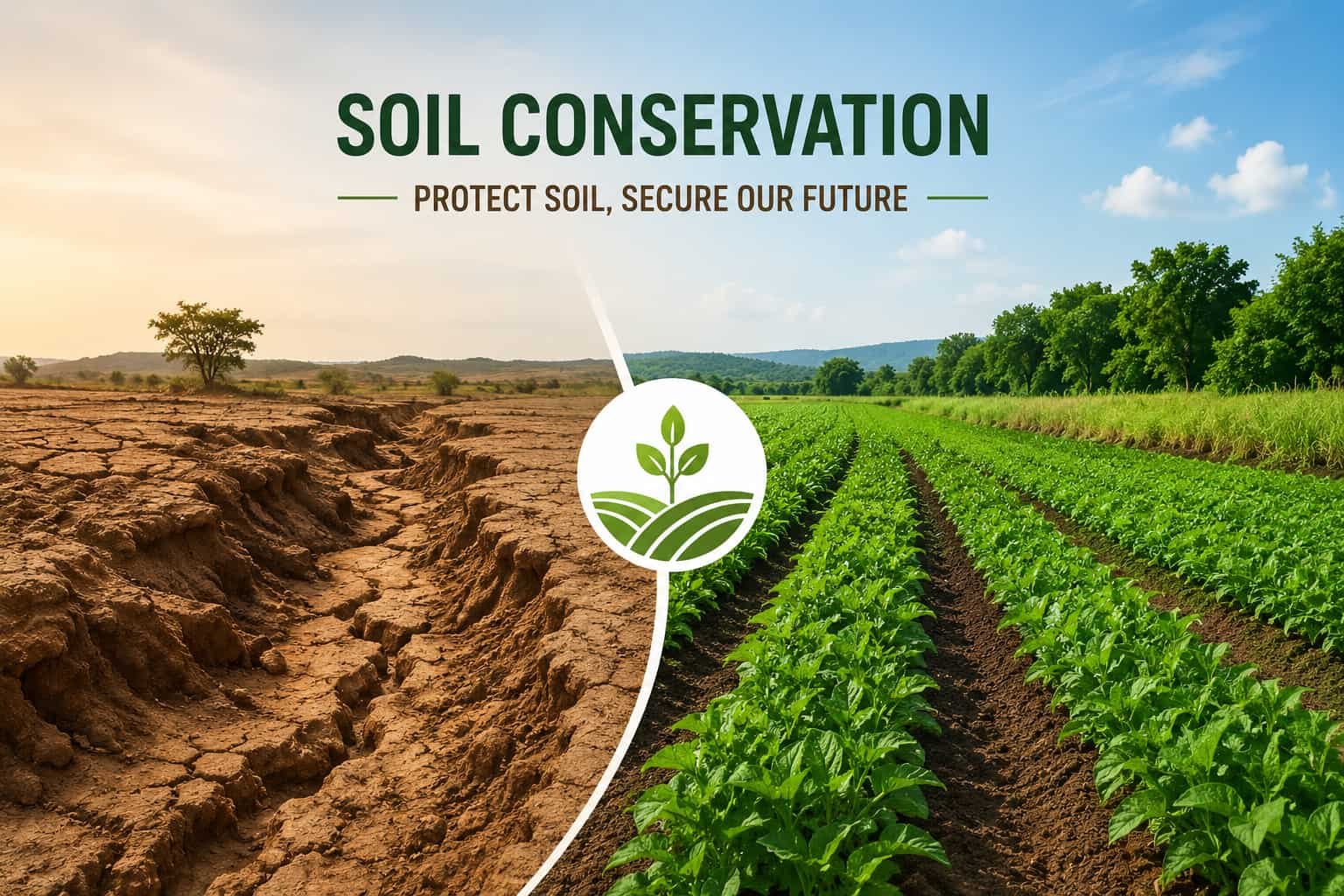
Soil conservation is adopted to prevent soil erosion and maintain long-term soil productivity.
Soil Erosion
Soil erosion is the process of detachment of soil particles from the parent material and the transportation of these detached particles by wind and/or water. The main agents causing erosion are wind and water.
The detaching agents include falling raindrops, channel flow, and wind, while the transporting agents include flowing water, rain splash, and wind. Depending on the agent responsible, erosion is classified as water erosion, wind erosion, or wave erosion.
Water erosion
Water erosion causes several types of damage by gradually removing soil. The rate of erosion depends on rainfall intensity, land slope, soil characteristics, and the type of vegetation cover. Soil erosion caused by rainfall on bare soil may range from 1.9 t/ha to 16.6 t/ha, depending on rainfall intensity, soil type, and other related factors. Water erosion is negligible in soils with adequate plant cover.
Losses due to water erosion:
- Loss of rainwater
- Loss of fertile topsoil
- Nutrient losses
- Silting of reservoirs (reducing the storage depth and capacity of reservoirs)
Wind Erosion
Wind erosion is a serious problem in areas where the land is bare and devoid of vegetation, and it is a common natural phenomenon in arid and semi-arid regions. Factors affecting wind erosion include wind velocity, temperature, rainfall, soil texture, soil structure, cohesiveness, bulk density, organic matter content, moisture content, surface roughness, and the height, density, and type of vegetation cover.
Losses due to wind erosion:
- Loss of fertile topsoil
- Drifting of sand by wind and its deposition on fertile agricultural land
- Damage to crops due to the abrasive action of wind-blown particles
Wave Erosion
Wave erosion is caused by the combined action of wind and water. It mainly occurs along rivers, canals, and other water bodies. Wave erosion in canals is primarily controlled by canal lining.
Measures to Conserve Soil From Water Erosion
Measures to prevent erosion are broadly classified into the following categories:
- Agronomic measures
- Mechanical measures
- Forestry measures
- Agrostological measures
1. Agronomic Measures
Agronomic measures are mainly adopted in dryland areas where the land slope is gentle, usually less than 2%. However, when two or more agronomic measures are combined, soil erosion can be effectively reduced even on slopes greater than 2%.
The following are the commonly adopted agronomic measures:
- Contour cultivation
- Tillage
- Mulching
- Cropping systems
- Strip cropping
- Use of chemicals
- Other agronomic practices
Contour Cultivation
Contour cultivation includes contour ploughing, contour sowing, and other intercultural operations. By ploughing and sowing across the slope, each ridge formed by the plough furrow and each crop row acts as a barrier to surface runoff. This provides more time for water to infiltrate into the soil and helps reduce soil loss.
Tillage
Conservation tillage involves disturbing the soil to the minimum extent necessary while leaving crop residues on the soil surface. The most commonly adopted conservation tillage systems are zero tillage and minimum tillage. These practices can reduce soil loss by up to 50% compared to conventional tillage methods.
Mulching
Mulching with plant materials reduces soil loss by up to 43 times compared to bare soil and by up to 17 times compared to cropped soil without mulch. When crop residues are pressed into narrow, continuous slots measuring 5 to 10 cm in width and 20 to 25 cm in depth, the infiltration capacity of the soil is increased.
Cropping Systems
Pasture land experiences negligible runoff and sediment losses. Growing crops with maximum vegetative cover helps reduce runoff and soil loss.
Strip Cropping
Strip cropping is a system of crop production in which long, narrow strips of erosion-resistant crops (close-growing crops) are alternated with strips of erosion-permitting crops (erect-growing crops) across the slope.
Examples of erosion-resistant crops include groundnut, moth bean, and horse gram, while erosion-permitting crops include sorghum, maize, and millet.
Use of Chemicals
Aggregate stability can be increased by applying chemicals such as polyvinyl alcohol at a rate of 480 kg/ha. Application of bitumen also improves water-stable aggregates and increases the infiltration capacity of the soil.
Other Agronomic Practices
Application of manures and fertilizers promotes early crop cover through rapid plant growth, thereby helping to reduce soil loss.
2. Mechanical Measures
Mechanical measures are generally supplemented with agronomic measures for effective soil and water conservation.
Some of the important mechanical measures include:
- Contour bunding
- Graded bunding
- Broad-base terracing
- Bench terracing
- Trenching
- Vegetative barriers
- Grassed waterways
- Gully control
Contour Bunding
Contour bunds are constructed along contour lines across the slope. This ensures uniform water depth and distribution throughout their length and allows better cultivation compared to other types of bunds. Since the bunds are placed at regular intervals, they intercept surface runoff before it attains erosive velocity, thereby reducing soil erosion.
Contour bunding is commonly adopted in areas receiving less than 1500 mm of annual rainfall and on lands with slopes up to 6%.
Graded Bunding
Graded bunding is recommended in areas where rainwater is not readily absorbed due to high rainfall or low soil infiltration capacity. Graded bunds are designed to safely convey the peak runoff from the inter-bunded area at a velocity that prevents both scouring and silting.
Broad Base Terrace
Broad-base terracing is a combination of ridge and channel constructed across the slope on a controlled grade. It has a wide base and a low ridge height and is suitable for deep black soils.
Bench Terracing
Bench terracing is usually practiced on slopes ranging from 16% to 33%. It involves transforming relatively steep land into a series of level strips or platforms constructed across the slope. This practice reduces slope length and consequently minimizes soil erosion.
Trenching
Contour trenches are constructed on non-agricultural land to provide adequate moisture conditions for establishing tree and grass species. The size of the trench varies depending on the slope, rainfall, and available soil depth. Trenches are generally constructed at intervals of 60 m. They are partially refilled diagonally with the excavated material, while the remaining soil is used to form a spoil bank.
Vegetative Barriers
Vegetative barriers are closely spaced plantations, usually consisting of a few rows of grasses or shrubs grown along contour lines. They act as barriers that reduce the velocity of overland flow and trap silt deposits behind them.
Example: Vetiver grass (Vetiveria zizanioides)
Grassed Waterways
Grassed waterways are drainage channels developed either by shaping existing natural drainage ways or by constructing separate channels in agricultural lands. They are used to safely handle runoff discharge from graded bunds, broad-base terraces, bench terraces, and similar conservation structures.
Suitable perennial grasses with deep-rooted and spreading growth habits, such as Panicum repens, Brachiaria mutica, Cynodon plectostachyus, Cynodon dactylon, and Paspalum notatum, may be established to stabilize the waterways.
Gully Control
Gullies are controlled by diverting runoff through the adoption of agronomic measures and by stabilizing the gully sides and bed through the establishment of vegetation. The gradient of the channel is also reduced to maintain flow velocities below erosive levels using temporary and permanent structures such as check dams, drop spillways, and chutes.
3. Forestry Measures
In forest lands, slopes are generally steep and uneven, the soil is less stable and highly erodible, and precipitation is often high. Vegetation and dried leaves on the forest floor intercept rainfall and reduce the impact of raindrops. Due to overgrazing and deforestation, many hills and hill slopes have become bare and barren. Re-establishment of vegetation is essential to prevent erosion and maintain ecological balance.
Afforestation combined with contour trenching helps reduce soil erosion and increase the infiltration rate of water into the soil.
4. Agrostological Measures
Grasses are used to prevent soil erosion by intercepting rainfall, binding soil particles, and improving soil structure. Suitable grasses should be perennial, drought-resistant, rhizomatous, capable of developing a good canopy, possess a deep root system, have a prostrate growth habit, and be useful for cottage or small-scale industries.
Examples include Chloris gayana, Dicanthium annulatum, and Heteropogon contortus.
Grasses are commonly used to stabilize waterways, contour bunds, bench terraces, and similar conservation structures. In addition, grasses improve soil structure, porosity, and infiltration, while also contributing organic matter to the soil.
Measures to Control Wind Erosion
Measures to control wind erosion should aim at reducing wind velocity and improving soil characteristics.
Reducing Wind Velocity
Adoption of vegetative, tillage, and mechanical measures can help reduce wind velocity and control wind erosion.
- Vegetative Measures: A long barrier consisting of several rows of trees planted across the direction of the wind is known as a shelterbelt. Shelterbelts are useful for soil and moisture conservation because they filter the wind and lift it away from the soil surface.
- Tillage Measures: A rough and cloddy soil surface resists the erosive force of wind. Stubble mulching reduces wind velocity and also traps eroding soil particles.
- Mechanical Measures: Physical obstructions such as fences and terraces, commonly known as windbreaks, help reduce wind velocity.
Altering Soil Factor
The larger the size of the soil aggregates, the lower the effect of wind on soil erosion. Soil aggregate stability can be improved by increasing the organic matter content of the soil.