CONTENT
Agronomical Practices for Leguminous Fodder Production
Leguminous fodder crops play a major role in sustainable livestock production because of their high protein content, soil-enriching properties, and excellent palatability. Crops such as alfalfa, cowpea, desmodium, and stylo improve forage quality when combined with grasses and cereal fodders. This guide covers the major leguminous fodder crops, cultivation methods, nutrient management, irrigation, harvesting practices, and tree fodder production systems commonly used in forage-based livestock farming.
Legumes are one of the most important components of animal fodder because of their high crude protein content (20–25%) compared to fodder cereals (8–12%) and fodder grasses (5–10%). Non-leguminous fodders such as cereals and grasses provide much of the required energy (carbohydrates) for livestock, while legumes improve the overall quality of fodder when mixed with non-leguminous crops due to their high protein content.
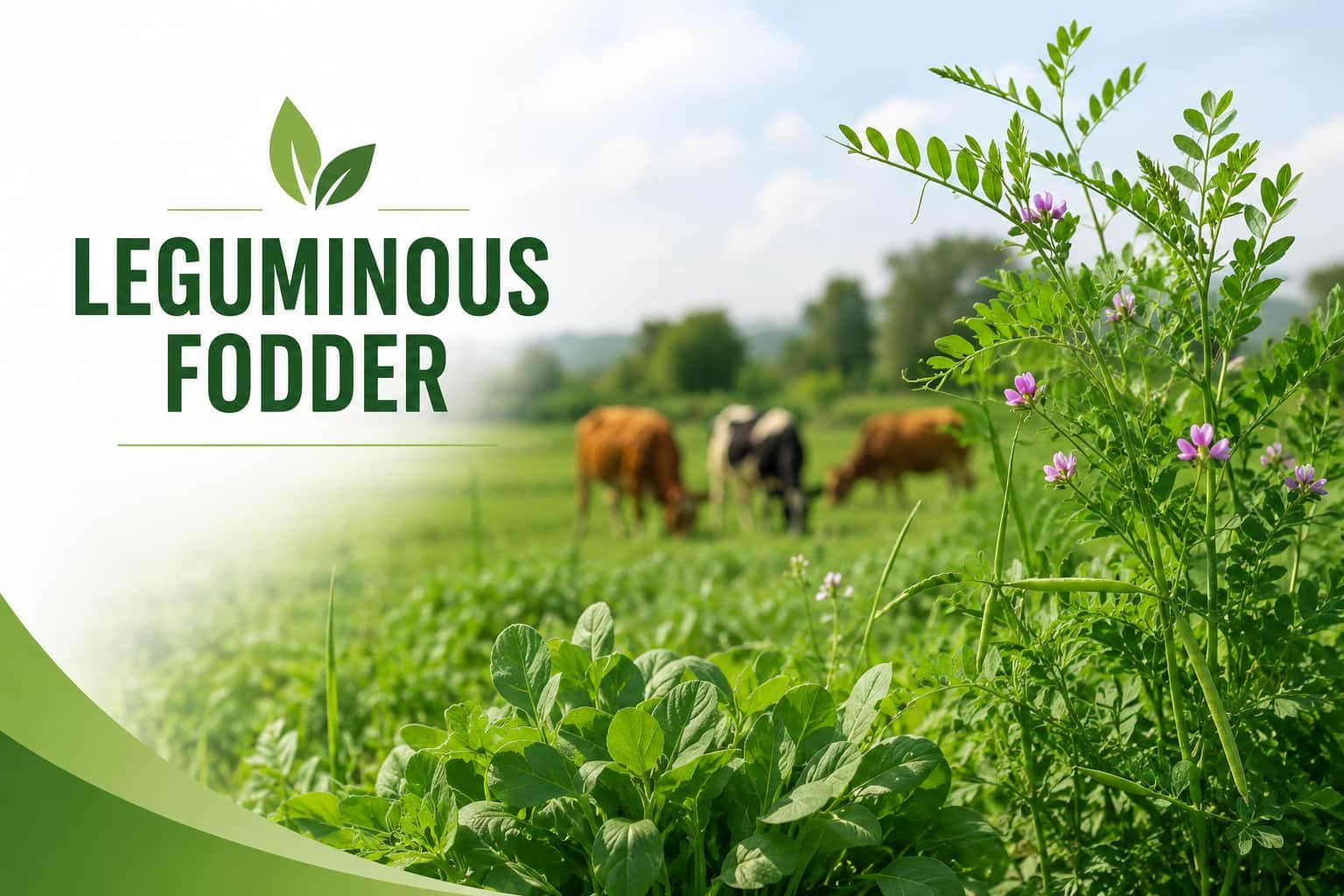
Green fodders from non-legumes are generally fed in bulk quantities (about 10% of the animal’s body weight), whereas legumes are usually fed in smaller quantities (1–2% of body weight). Feeding legumes in excessive amounts may cause digestive problems such as bloat in animals.
The following are some legumes commonly cultivated for fodder production:
- Irrigated Legumes – Perennial:
- Lucerne (Alfalfa): Chetak (S244), Sirsa Type 9 & 8, Co1, GAUL 1 & 2, Anand-3, RL-88
- Desmanthus: Local varieties
- Irrigated Legumes – Annual:
- Cowpea: Co5, UPC 622, 621, 625, EC 4216, GFC 2, 3, CO (FC) 8
- Cluster Bean: Durgajay, Agaita Guara 111, 112, FS277
- Soybean
- Rainfed Legumes – Perennial:
- Desmanthus
- Stylo: S. scabra, S. guianensis, S. humilis, S. hamata
- Desmodium
- Siratro
- Clitoria
- Centro
- Rice Bean: RBL-1, BC 15K1, RBL-6, KRB 4
- Moth Bean
- Rainfed Legumes – Annual:
- Red Gram: Co-1, Co-6
- Horse Gram: CO 1 and Paiyur-1
- Lablab: Co-1, Co-12
- Cowpea: Kohinoor, NP-3, HFC 42-1, UPC 5287
- Cluster Bean: Durgapura Safed, HFG-119, IGFRI-S-212
- Legumes for Temperate Regions:
- Berseem: Pusa Giant, Mescavi, BL1, 2, 10, 22, 180, JB1, Wardan
- Lucerne: Anand-3
- Senji: FOS1, YSL 106, PC5, HFWS 55
Alfalfa or Lucerne (Medicago sativa)
Medicago sativa Linn., commonly known as lucerne or alfalfa, belongs to the family Fabaceae. Lucerne, often referred to as the “Queen of Forages,” is a deep-rooted perennial forage legume adapted to a wide range of environmental conditions, from tropical to alpine regions. It is highly palatable and nutritious, containing 15–20% crude protein on a dry matter basis. Lucerne also adds nitrogen to the soil and improves soil fertility.
It is grown for green fodder, hay, and silage, although it does not tolerate close grazing. Alfalfa is a valuable source of vitamins A and E, and fresh forage is rich in vitamin C. However, a large percentage of vitamins may be lost during drying. The crop can grow in a wide range of soils but performs best in rich, friable, well-drained loamy soils. It does not grow well in acidic soils. Lucerne is hardy and drought resistant and can tolerate high temperatures.
Hedge Lucerne (Desmanthus virgatus)
Hedge lucerne can be grown year-round under irrigation and during June to October under rainfed conditions. It performs well in a wide range of soil types.
Fodder Cowpea or Lobia (Vigna unguiculata)
Cowpea is an annual herb with different growth habits, including bushy, trailing, and climbing forms. The seeds vary in size, shape, and color. This crop is widely grown in tropical, subtropical, and warm temperate regions. It is used as green fodder, for grazing, hay production, and silage, often mixed with sorghum or corn.
Cowpea is a fast-growing leguminous forage crop commonly grown with cereal fodders and grasses to improve the nutritive value of forage. It contains 20–24% crude protein and has digestibility above 70%. Cowpea can also be grown under partially shaded conditions. It serves as an excellent cover crop that suppresses weeds and enriches the soil. The crop thrives in warm climates with moderate humidity.
Grass Leaf Desmodium (Desmodium tortuosum)
Species of Desmodium are highly palatable and nutritious forage plants and are often referred to as the “alfalfa of the tropics.”
Two important tropical fodder species include:
- Grass Leaf Desmodium (Desmodium tortuosum)
- Silver Leaf Desmodium (D. unciniatum)
Desmodium is a shade-tolerant forage legume that grows well under trees such as coconut and eucalyptus. When planted during early summer, it can be harvested multiple times each year. Desmodium fodder contains high crude protein and is considered comparable to alfalfa as a protein supplement in poultry feeding.
A unique characteristic of Desmodium is its self-seeding ability. Mature pods naturally fall to the ground, where the seeds germinate after rainfall or irrigation, allowing dense regrowth. However, once established, the crop can become difficult to remove from fields.
Stylo
Stylo is an erect-growing forage legume native to Brazil. It grows between 0.6 and 1.8 meters tall and is well adapted to tropical climates. Stylo tolerates low fertility soils, drought, acidic soils, and poor drainage. It is considered a promising forage legume for dryland and rainfed farming systems.
Stylos are drought-resistant legumes that perform well in areas receiving annual rainfall between 450–840 mm. The crude protein content generally ranges from 15–18%.
Cultivation Methods
Field Preparation
Deep plowing with a disc or moldboard plow followed by two passes with tillers or harrows is recommended to prepare a fine seedbed. Beds and channels are generally formed for irrigated crops, while ridge-and-furrow systems are preferred in water-scarce areas.
Seeds and Sowing
For small-seeded crops such as lucerne and desmanthus, 15–20 kg/ha seed rate is recommended. For cowpea, cluster bean, lablab, horse gram, and red gram, 20–25 kg/ha is generally used. Soybean typically requires about 75–80 kg/ha.
Before sowing, seed treatment with Trichoderma viride is recommended to reduce root rot and wilt diseases. Under irrigated conditions, line sowing helps maintain adequate plant population and improves resource utilization. Broadcasting is commonly practiced under rainfed conditions.
Manures and Fertilizers
Farmyard Manure (FYM): Irrigated crops – 25 t/ha; rainfed crops – 12.5 t/ha.
Inorganic Fertilizers
- Lucerne: 25:120:40 kg NPK/ha
- Cowpea: 25:40:20 kg NPK/ha
- Desmanthus: 10:60:30 kg NPK/ha
For other rainfed pulses, a basal fertilizer dose of 10:25:0 kg NPK/ha is generally recommended. Biofertilizers such as Azospirillum, Rhizobium, and phosphobacteria may also be used as seed inoculants and soil applications.
Weeding
Both perennial and annual legumes under irrigated and rainfed conditions generally require one or two rounds of weeding and hoeing, typically around the 20th and 40th day after sowing.
Mixed Cropping
To improve pasture quality, legumes such as stylo, clitoria, and siratro may be mixed with grass species such as Cenchrus ciliaris, C. setigerus, and C. glaucus. A common recommendation is one row of legumes for every three rows of grasses. Where line sowing is not feasible, seeds can be mixed and broadcast together.
Plant Protection
Plant protection measures are generally minimal. However, fodder should not be fed to animals within 30 days of fungicide or insecticide application.
Irrigation
Depending on soil and climatic conditions, irrigated legumes generally require irrigation every 7–10 days. Waterlogging for more than 48 hours may cause wilting or root rot in most leguminous fodder crops.
Harvest
- Harvesting is generally done at 50% flowering.
- Cowpea is usually harvested at 70–75 days.
- Lucerne is harvested every 40 days during summer and every 20–30 days during cooler months.
Yield
Desmanthus yields approximately 125 t/ha of green fodder, while lucerne yields around 70–80 t/ha. Cowpea, cluster bean, and soybean typically produce 20–30 t/ha of fodder. Other rainfed legumes generally yield 10–15 t/ha/year of green fodder.
Agronomical Practices for Tree Fodder Production
Tropical and subtropical grasses mainly provide grazing during the rainy and post-rainy seasons. During dry or dormant periods, tree fodders become an important supplemental feed resource for livestock.
The young, leafy, and succulent parts of fodder trees are highly nutritious and rich in crude protein and minerals. They can be fed along with dry grasses and crop residues to improve overall feed quality.
Important fodder trees include Subabul (Leucaena leucocephala) and Sesbania species. These trees can be planted along field boundaries, farm roads, or livestock areas to provide shade, fodder, and additional biomass.
Subabul or Leucaena (Leucaena leucocephala)
Subabul is widely cultivated in tropical and subtropical regions because of its rapid growth, drought tolerance, and high-protein foliage.
Gliricidia
Species: Gliricidia sepium and Gliricidia maculata
Gliricidia sepium is native to Central America and Mexico and is widely cultivated throughout tropical regions because of its adaptability and high productivity. It is commonly used in agroforestry systems, as a fodder tree, and for soil improvement.
The species grows well under moderate rainfall and performs best in deep, well-drained soils, although it can tolerate a wide range of soil conditions, including slightly saline soils.
Sesbania (Sesbania grandiflora)
The leaves of sesbania trees are highly palatable, especially to goats. The crude protein content is approximately 25%.
The practice of growing fodder and fuel trees together with grasses is known as a silvopastoral system. In this system, compatible fodder trees are planted with forage grasses to improve overall forage production and land sustainability.
Silvopastoral systems involve the production of forage grasses and legumes together with multipurpose trees, initially under a cut-and-carry system and later under controlled grazing.
Integrating trees with forage grasses and legumes on the same land is considered an environmentally sustainable and ecologically sound farming approach.
Fodder Crops for Silvopastoral Systems
- Trees: Subabul, Desmanthus, Albizia, Acacia, Hardwickia, Dalbergia sissoo
- Grasses: Cenchrus ciliaris, Cenchrus setigerus, Chrysopogon fulvus, Dicanthium annulatum
- Legumes: Stylosanthes scabra, Stylosanthes hamata, Stylosanthes guianensis, Macroptilium atropurpureum, Lablab, etc.
In silvopastoral systems, trees are generally planted at spacings such as 6 × 5 m, 4 × 3 m, or 3 × 2 m depending on the species and management objectives.
Trees + Grasses Combinations
- Acacia tortilis + Cenchrus ciliaris / C. setigerus
- Acacia arabica + Chrysopogon fulvus
- Albizia lebbeck + Sehima nervosum
- Acacia amara + Pennisetum pedicellatum