CONTENT
Agronomical Practices for Non-Leguminous Fodder Crop Production: Cultivation Practices, Yield, and Management
Non-leguminous fodder crops play a vital role in sustainable livestock production by providing a reliable source of nutritious forage for dairy and meat animals. Major cereal fodders such as maize, sorghum, and pearl millet, along with perennial grasses like Hybrid Napier and Guinea grass, are widely cultivated due to their high biomass yield and adaptability to different climatic conditions.
Proper agronomical practices, including field preparation, irrigation, fertilization, weed management, and timely harvesting, are essential for maximizing fodder quality and productivity. This guide explains the cultivation methods and management practices for important non-leguminous fodder crops.
Cereal Fodder
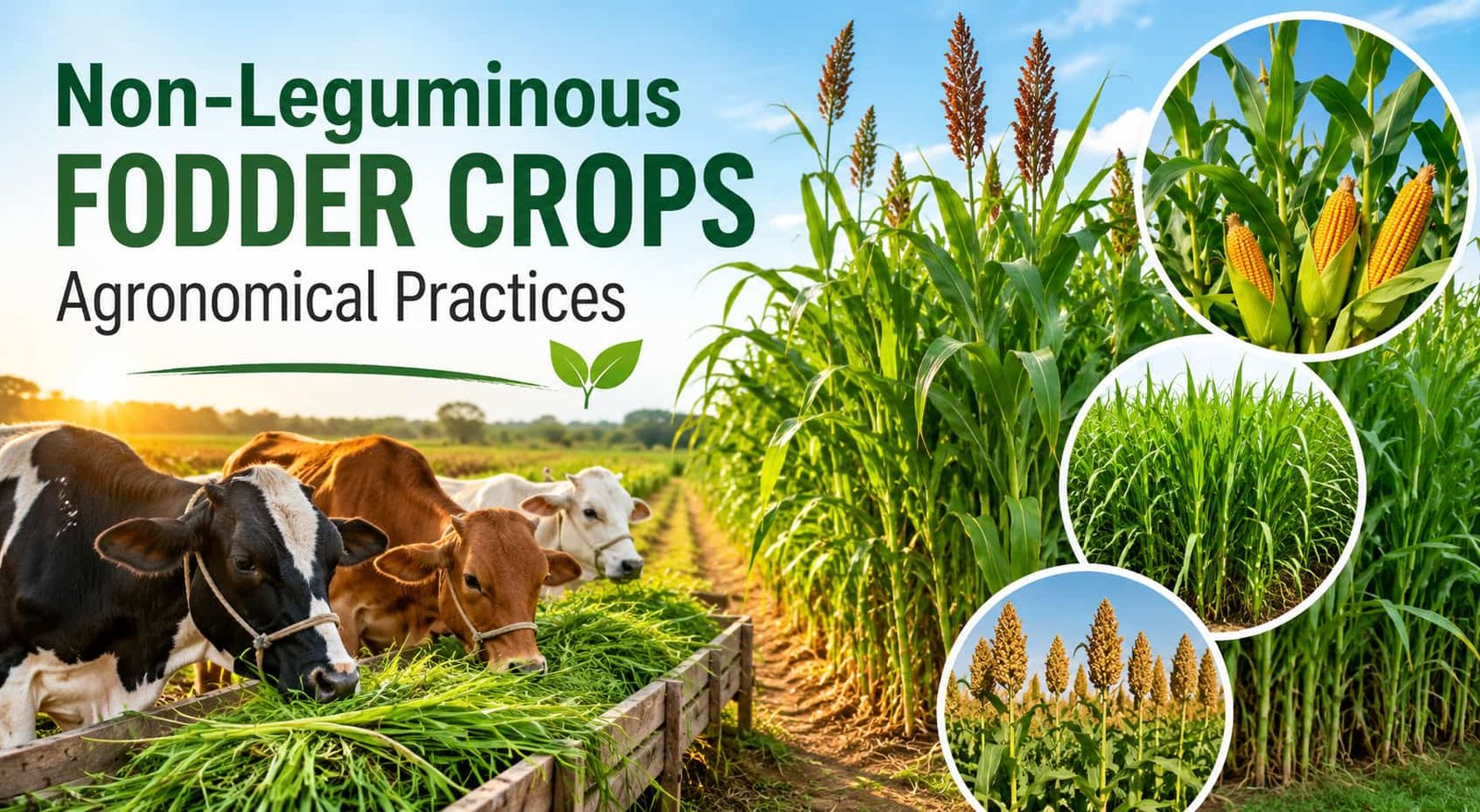
Cereal fodders play an important role in feeding dairy animals. In general, farmers do not grow cereal crops exclusively for fodder purposes. Instead, cereals are mainly cultivated for grain production, and after harvest, the crop residues (straw/stover) are used as cattle feed. However, straw and stover are much lower in nutritive value compared to green fodder. The following are important cereal fodder crops commonly cultivated.
Annual Cereal Fodder Crop Varieties (Summer)
- Sorghum:
- Single Cut: Pusa Chari 1, 2, 6, 23, PC-9, PC-23
- Haryana Chari, SL 44, MP Chari, Jawahar Chari 6, UP Chari 1, Pusa Chari 1
- Double Cut: CO 27, Gujarat Forage Sorghum, Gujarat Forage Sorghum Hybrid
- Multi Cut: Jawahar Chari 69, PCH 106, COFS 29, Pant Chari 5, PCH 109
- Dual Purpose: K-11, CSV-15, SPV 669, JS 29/1
- Maize: African Tall, Vijay Composite, Manjri Composite, Moti Composite, Ganga 5, Jawahar
- Pearl Millet (Bajra): Giant Bajra, Raj Bajra Chari 2, CO 8, TNSC-1, APFB-2, GFB-1, PCB 164, FBC 16, AVKB 19, NDFB 2
- Teosinte
- Finger Millet
- Little Millet
- Proso Millet
Annual Cereal Fodder Crop Varieties (Winter)
- Oats: Kent, OS-6, OS-7, OL-9, OL-125
- Rye: JHO-822, UPO-94, UPO-212
- Barley: DL-36, DL-157, DL-417, DL-454, Azad
Fodder Maize (Zea mays)
Maize is believed to have originated in Mexico. For a long time, it was cultivated primarily for grain production, but over the last century it has also become an important forage crop. Maize grain is widely used in poultry feed formulations. Dent-type maize varieties, characterized by angular grains with a concave top, are commonly grown for forage purposes. The male inflorescence is known as the tassel, while the female inflorescence develops into the cob.
Maize is widely cultivated across tropical and subtropical regions from sea level up to elevations of about 3,300 meters. It performs best under annual rainfall ranging from 600–900 mm during the growing season. Although maize can grow on a wide range of soil types, well-drained fertile soils are ideal. In many regions, maize is grown during the warm season, but with irrigation it can be cultivated throughout the year.
Fodder Sorghum (Sorghum bicolor)
Sorghum is believed to have originated in Africa, although some varieties are also associated with India and China. It is cultivated for both grain and fodder purposes. In the United States, sweet sorghum types with juicy stalks are also grown for syrup production and are commonly used as forage crops because of their palatability.
Sorghum is highly drought tolerant and thrives in tropical and subtropical climates with temperatures ranging from 77–95°F (25–35°C). It is not well suited for elevations above 1,200 meters. The crop can perform under annual rainfall levels as low as 300–350 mm and grows on most soil types except extremely sandy soils. Sorghum is a short-day plant, and a 10-hour photoperiod promotes earlier flowering.
Fodder Pearl Millet (Pennisetum glaucum)
Pearl millet can be grown year-round under irrigated conditions. Under rainfed conditions, it is commonly cultivated during warm and rainy seasons.
Cultivation Methods
Field Preparation
Two plowings using either a traditional plow or tractor-drawn tillers are generally required. For irrigated crops, beds and channels or ridge-and-furrow systems are commonly prepared. Under rainfed conditions, two plowings are usually sufficient, followed by a shallow plowing after sowing to cover the seeds.
Seeds and Sowing
Under irrigated conditions, the seed rate is generally lower because line sowing with proper spacing (30–40 × 10 cm) is practiced. In rainfed systems, seed rates are usually higher because broadcasting methods are commonly used.
Manures
Farmyard manure application recommendations:
- Irrigated crop: 25 t/ha
- Rainfed crop: 12.5 t/ha
Fertilizer
- Irrigated Crop: Basal application (30:40:20 kg NPK/ha) with top dressing of 30 kg N/ha
- Rainfed Crop: Lower basal fertilizer rates with top dressing of 10–20 kg N/ha
Fertilizer application, especially nitrogen, can increase green fodder yield in cereal crops by two to three times.
Biofertilizers such as Azospirillum and Phosphobacterium mixtures may be used as both seed treatment and soil application. Standard recommendations include 600 g for seed treatment and 2,000 g for soil application per hectare.
Weeding
One or two weedings before the 40th day after sowing are generally required to maintain a good stand of cereal fodder. Herbicide use is usually avoided because of concerns regarding possible residual toxicity to livestock.
Irrigation
For irrigated crops, the first irrigation is generally provided on the third day after sowing. Subsequent irrigations are applied every 7–10 days depending on soil type and climatic conditions. Typically, 6–7 irrigations are required during the crop cycle.
Mixed Cropping
To improve fodder quality, legumes are commonly mixed with cereal fodder crops under both irrigated and rainfed conditions.
Plant Protection
Plant protection measures are generally minimal in fodder crops.
However, pests such as shoot fly, stem borers, and aphids may affect sorghum, maize, and pearl millet. Diseases such as downy mildew and leaf spot may also occur. If infestations occur during the early growth stages (before 30 days), appropriate plant protection measures may be necessary. Care should be taken to avoid harvesting fodder within 30 days of pesticide or fungicide application.
Harvest
Harvesting is generally carried out at approximately 50% flowering. Most cereal fodder crops reach this stage within 60–75 days. Small millet species may reach 50% flowering earlier, usually within 50–65 days.
Recommended harvesting stages:
- Sorghum: Immediately after flowering and up to 50% flowering. For multicut varieties, the first cut is taken about two months after sowing, followed by cuts every 35–40 days.
- Maize: Cob formation to milk stage (60–70 days)
- Pearl Millet: Boot leaf stage to early flowering
For multicut varieties, the first harvest is generally performed at the boot leaf stage, followed by subsequent harvests every 35–40 days.
Yield
- The average yield of fodder sorghum and fodder maize is approximately 35–40 t/ha.
- The average yield of pearl millet ranges from 30–35 t/ha.
- The yield of finger millet ranges from 15–20 t/ha.
- Other small millet species generally produce yields between 10–20 t/ha.
Grass Fodder
Hybrid Napier Grass (Napier × Pearl Millet Hybrid)
This triploid hybrid between Napier grass and pearl millet produces more tillers and leaves than Napier grass alone. It is highly vigorous and produces superior fodder yield and quality. Crude protein content generally ranges from 8–11%.
Guinea Grass (Panicum maximum)
Guinea grass is native to tropical Africa. It is a tall, tufted, fast-growing, and highly palatable perennial grass that establishes readily through seed or rooted slips. Crude protein content ranges from 4–14%.
Para Grass (Brachiaria mutica)
Para grass is a perennial species with prostrate shoots that root freely at the nodes, forming a dense cover. It is well suited for humid and seasonally flooded areas and tolerates waterlogging for extended periods. However, it does not perform well in dryland or semi-arid conditions. It is sensitive to cold temperatures and shows limited growth during winter in subtropical regions.
Waterlogged soils are ideal for this crop, although it can also grow on sandy soils if sufficient moisture is available. Because seed production is poor, Para grass is propagated mainly through stem cuttings.
Blue Buffel Grass (Cenchrus glaucus)
Blue Buffel grass is a promising forage grass for dryland cultivation under rainfed conditions. Other commonly grown Cenchrus species include Cenchrus ciliaris and Cenchrus setigerus, although these species are generally lower yielding.
Cultivation Methods
Field Preparation
For both irrigated and rainfed perennial grasses, deep plowing with a disc or moldboard plow is recommended. Deep plowing helps eliminate weeds and improves water infiltration, particularly in rainfed systems.
Seeds and Sowing
Seed collection is difficult in many grass species.
Hybrid Napier grasses are sterile and cannot be propagated by seed. Therefore, they are established vegetatively through rooted slips or stem cuttings.
Guinea grass seed is available, but seed dormancy and poor germination rates make propagation through rooted slips more reliable. Similar conditions apply to buffalo grass and Cenchrus species. Deenanath grass and teosinte can be propagated through seeds. Under rainfed conditions, sowing or planting should coincide with the onset of the rainy season.
Manures and Fertilizers
Most grass species have fibrous root systems concentrated in the upper soil layers, making fertile and well-aerated soils essential. Organic matter application is important regardless of soil type.
Farmyard manure or compost is generally applied at 25 t/ha.
Irrigated grasses such as Hybrid Napier and Guinea grass commonly receive nitrogen top dressing after each harvest. In rainfed systems, nitrogen application rates of 20–40 kg/ha are often recommended.
Biofertilizers such as Azospirillum and Phosphobacterium mixtures can be used for seed treatment and soil application before sowing. These biofertilizers may increase green fodder yield by 1–2 t/ha.
Weeding
Weeding is generally carried out during the early stages of crop growth, usually between 20–40 days after sowing or planting. Depending on weed pressure, one or two weedings may be necessary. Under irrigated conditions, weeding and earthing up are recommended after each harvest.
Irrigation
For irrigated grasses, the first irrigation should be applied on the third day after sowing or planting. Subsequent irrigations are generally provided every 7–10 days depending on soil and weather conditions.
Under rainfed conditions, compartmental bunding may help improve rainwater conservation. Waterlogging for more than three days can negatively affect some grass species.
Plant Protection
Plant protection is generally not required for Hybrid Napier grass, Guinea grass, or buffalo grass.
However, teosinte and Deenanath grass may occasionally be affected by pests such as aphids and shoot fly, along with diseases such as rust and leaf spot. If infestations occur during the early stages of crop growth, appropriate control measures may be necessary.
Harvest
For Hybrid Napier, Guinea grass, and buffalo grass, the first harvest is generally taken 75–90 days after planting. Subsequent harvests are performed at 45-day intervals, producing approximately 7–8 harvests per year.
Deenanath grass and teosinte are usually harvested at 50% flowering, which occurs approximately 60–65 days after sowing. Depending on rainfall conditions, rainfed grasses may provide 2–4 harvests annually.
Recommended harvest stages for grass fodders:
- Hybrid Napier: 6–7 weeks (40–45 days is recommended to reduce oxalate toxicity)
- Guinea Grass: Every 6 weeks
- Para Grass: Every 4–6 weeks
- Deenanath Grass: Mid-flowering stage
- Blue Panic Grass: Every two months
- Rhodes Grass: At flowering
- Cenchrus: At 50% flowering
Yield
- Hybrid Napier: 300–350 t/ha
- Guinea Grass: 200–250 t/ha
- Buffalo Grass: 120–180 t/ha
- Deenanath Grass: 50–60 t/ha
- Teosinte: 30–35 t/ha
- Cenchrus Grass: 20–30 t/ha
- Other rainfed grasses generally yield 10–15 t/ha/year on average.