Nomenclature in Forage Production: Glossary of Forage Production Terms and Definitions
Understanding forage production terminology is essential for students, livestock producers, veterinarians, agronomists, and pasture management professionals. This glossary explains important terms related to grasslands, grazing systems, forage crops, silage production, pasture management, agroforestry, and livestock feeding.
*ADVERTISEMENT*
Contact hello@mkvisuals.org to advertise here
- Agronomy: Agronomy is a branch of agriculture that deals with field crop production and soil management.
- Agroforestry: The deliberate use of woody perennials on the same management unit as arable crops, pasture, and/or animals, either in a mixed spatial arrangement at the same time or in sequence over time.
- Agrisilvipasture: A land-use system in which arable cropping, woody vegetation, and grazing livestock are combined.
- Agrostology: Agrostology is the science concerned with the study of grasses, including their classification, management, and utilization.
- Alley Cropping: A form of agroforestry in which food crops are grown between rows of leguminous trees or shrubs whose roots contain bacteria that “fix” atmospheric nitrogen into a usable fertilizer form.
- Animal Day: One day of grazing on rangeland or pasture by one animal.
- Animal Unit: One mature cow (454 kg) or its equivalent, based on an average daily forage consumption of 12 kg of dry matter per day.
- Animal Unit Month (AUM): The amount of feed or forage required by one animal unit for one month.
- Annual Crops: Crops requiring annual replanting (e.g., maize, pearl millet, and sorghum).
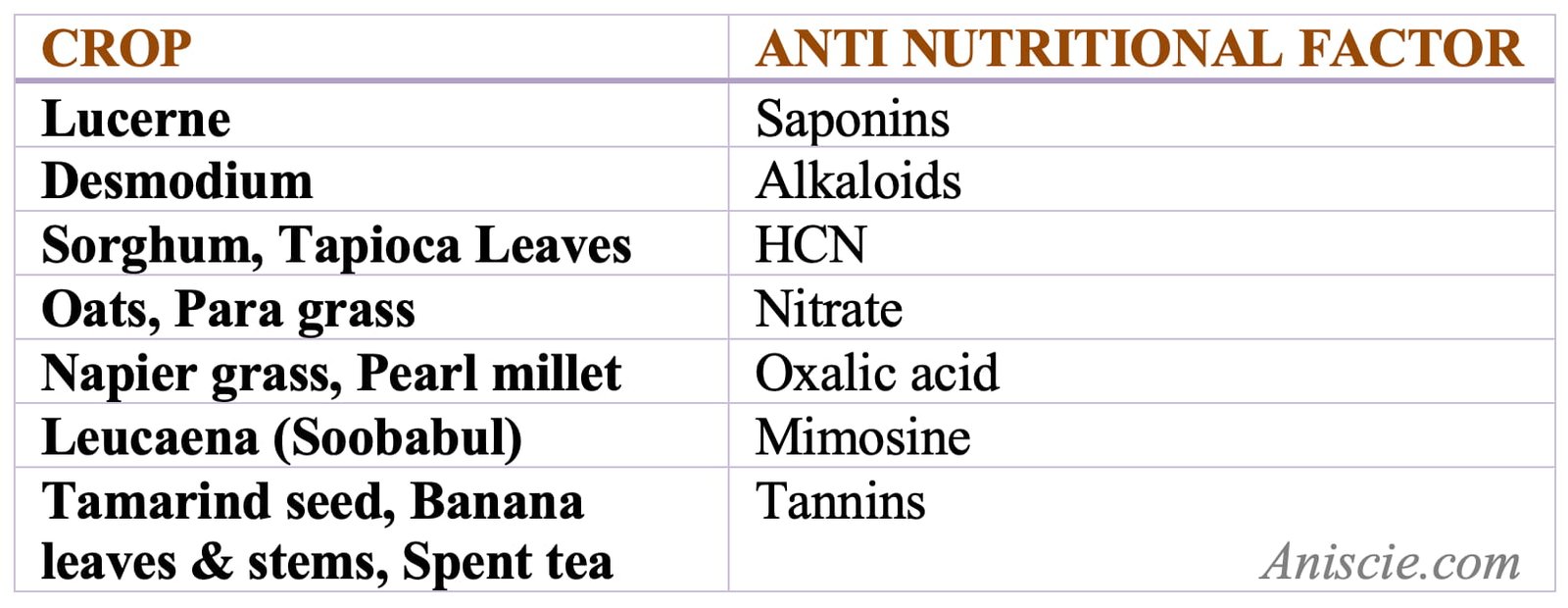
- Anti-Quality Constituents/Anti-Nutritional Factors: Toxic substances present in forage plants that may either cause direct metabolic damage to the animal or interfere with some phase of digestive utilization are referred to as anti-quality constituents or anti-nutritional factors.
- Arboriculture: Arboriculture is the selection, planting, care, and removal of individual trees, shrubs, vines, and other perennial woody plants, as well as the study of their growth and response to cultural practices and environmental conditions.
- Browse: The leaves and twig growth of shrubs, woody vines, and trees available for animal consumption.
- Catch Crop: A crop inserted between two principal crops in a rotation to provide quick livestock feed or improve the soil during a period when the land would otherwise remain idle (e.g., rice bean).
- Cereal Forage: A cereal crop harvested while immature for use as hay, silage, green feed, or pasture.
- Climate: The prevailing condition of the atmosphere over a long period of time in a large geographic area. It represents the aggregate of weather conditions during that period.
- Coppicing: A practice in which tree species are planted at close spacing and pruned to ground level, usually 15–30 cm above the ground, to obtain green fodder periodically.
- Cover Crop: Annual crops sown to create a favorable soil microclimate, reduce evaporation, and protect the soil from erosion.
- Crop Rotation: The practice of growing different crops season after season or year after year on the same land.
- Cropping Intensity (CI): The ratio of the total cropped area in a year to the area available for cultivation, expressed as a percentage.
- Cropping Pattern: The yearly sequence and spatial arrangement of crops followed on a given area of land.
- Cropping System: The cropping patterns used on a farm and their interaction with farm resources, other farm enterprises, and available technology, which together determine the system structure.
- Cropping Scheme: An annual plan indicating the crops and varieties to be grown, the season in which each crop is cultivated, and the area allotted to each crop and variety during different seasons of the year.
- Crude Fibre: A term that includes all insoluble forms of carbohydrates found in feedstuffs. It consists mainly of cellulose, lignin, and some pentosans, and represents the tough fibrous portion of plants.
- Crude Protein: All nitrogenous substances present in feedstuffs, including true proteins and non-protein nitrogen (NPN) compounds such as amides.
- Dairy Husbandry: The care, breeding, feeding, and milking of dairy cattle, along with the production and marketing of milk.
- Farming System: An appropriate combination of farm enterprises such as cropping systems, livestock, fisheries, forestry, and poultry, together with the available resources used to manage them profitably.
- Farmyard Manure: The decomposed mixture of dung and urine from farm animals, along with litter and leftover roughage or fodder materials fed to livestock.
- Fodder: Maize, sorghum, or other coarse grasses harvested with seeds and leaves and cured for animal feeding.
- Fodder Crops: Cultivated plant species used as livestock feed in the form of silage, soilage, or hay.
- Forage Crops: Crops grown primarily for livestock feed, either harvested as hay, silage, or green feed, or directly grazed by animals.
- Forage Forestry: The use of the same land, simultaneously or sequentially, for the production of fodder, food, and fuel.
- Grass: Any plant belonging to the family Poaceae (Gramineae). In livestock feeding and grassland agriculture, the term also includes associated leguminous species.
- Grassland: Land on which graminaceous species are the dominant vegetation.
- Grassland Ecosystem: The ecosystem associated with grasslands and pastures.
- Grassland Farming: A farming system emphasizing the importance of grasses and legumes in livestock and land management, in which legumes are the keystone species and grasses form the foundation of the system.
- Grazing: The consumption or partial defoliation of standing vegetation by domestic livestock or other animals.
- Grazing Capacity: The number of animals a given pasture can support for a specific period of time.
- Grazing Intensity: The number of animals per unit area of grazing land.
- Grazing Pressure: The number of animals per unit area of available forage.
- Grazing Value: The value of a plant or plant cover for livestock, determined by its palatability and nutritional quality, and rated as excellent, good, fair, or poor.
- Selective Grazing: The preferential and sometimes excessive grazing of certain plant species in mixed pastures.
- Hay: Feed produced by dehydrating green forage to a moisture content of 15% or less so that biological activity and heat buildup do not occur rapidly.
- Haylage: A product obtained by ensiling forage with 35–50% moisture under anaerobic conditions. Compared with hay, it reduces field-curing time and associated field risks.
- Integrated Farming System: The integrated cultivation of crops along with other enterprises, where the by-products or waste materials of one enterprise are used as inputs for another, with the objective of increasing profitability.
- Intercropping: The practice of growing two or more crops simultaneously on the same piece of land, either for the entire life cycle or for part of the life cycle of the crops.
- Ley Farming: The alternation of food crops and pasture on the same piece of land. After several years of cultivation, pasture plants are established and used for grazing for several years before the land is returned to crop production.
- Lopping: A practice in which tree species are allowed to attain normal growth, after which the lower and side branches are pruned for fodder.
- Meadow: An area covered with grasses and/or succulent forage legumes grown primarily for hay production.
- Mixed Cropping: A system in which seeds of two or more crops are mixed and sown together by broadcasting without distinct row spacing.
- Monoculture: The practice of growing the same crop season after season or year after year on the same land.
- Native Pasture: A pasture covered with native plant species or naturalized exotic species.
- Overstocking: Stocking animals beyond the safe grazing capacity of the pasture.
- Palatability: Plant characteristics that influence an animal’s preference between two or more forages or parts of the same forage, depending on animal and environmental factors that stimulate selective intake.
- Pasture: A grazed plant community usually composed of several species, often of diverse botanical types.
- Pasture Land: An area of land covered with grasses or other herbaceous forage plants used for grazing animals.
- Pasture Renovation: Improvement of pasture through tillage, seeding, fertilization, and sometimes liming.
- Pasture Succession: A sequence of forage crops grown for grazing purposes.
- Permanent Pasture: A pasture consisting of perennial or self-seeding annual plants maintained for several years for grazing.
- Perennial Crops: Crops that do not require annual replanting, such as Bajra × Napier hybrids, lucerne, stylo, siratro, and hedge lucerne.
- Pollarding: A practice in which tree species are allowed to grow for a certain period before the trunk is pruned to a height of 1–2 m above ground level.
- Quartering: A management practice in which large forage clumps are divided into four sections when they become oversized. Usually, one clump forms a large stool within two years, after which it is divided into four quarters and three are removed.
- Range (Pasture): An extensive area of natural pastureland; if unfenced, it is referred to as open range.
- Range Management: The management of rangeland to produce maximum forage on a sustained basis without damaging other land resources or uses.
- Rangeland Rejuvenation: The creation of favorable conditions for forage plants through soil–plant–animal management practices.
- Relay Cropping: A system in which seeds of one crop, usually a legume, are sown into a standing crop, usually rice, before harvest so that part of their life cycles overlap.
- Rotational Grazing: A grazing system in which a large pasture is divided into smaller paddocks, and livestock are allowed to graze each paddock periodically.
- Rotational Pasture: A pasture used for grazing for a few seasons and then plowed for cultivation of other crops.
- Roughage: Plant materials or feedstuffs that are relatively high in crude fibre and low in digestible nutrients, such as straw and stover.
- Row Intercropping: A system in which two or more crops are sown in distinct rows with narrow row ratios such as 1:1, 1:2, or 2:2.
- Savanna: Grassland with scattered trees occurring individually or in clumps, often representing a transitional type between true grassland and forest.
- Sequential Cropping: The practice of growing two or more crops in sequence, one after another, on the same piece of land.
- Silage: Animal feed produced by storing and fermenting green or moist crops under anaerobic conditions.
- Silage Additive: A material added to forage during ensiling to improve preservation or feeding value.
- Silage Crop: Crops preserved in a succulent condition through partial fermentation.
- Silage Preservative: A material added during ensiling to promote favorable fermentation.
- Silo: A semi-airtight structure designed for the production and storage of silage.
- Silvipasture: An agroforestry system in which livestock browse or consume forage produced by trees and shrubs while also grazing shorter vegetation such as grasses and herbs.
- Soilage: Green forage cut and fed fresh to livestock; such crops are known as soiling crops.
- Steppe: A vast semi-arid grass-covered plain, usually lightly wooded.
- Stover: Mature, cured stalks of crops such as maize, sorghum, or millets from which the grains have been removed; a type of roughage.
- Strip Grazing: A grazing system in which animals are confined to a limited area of forage intended for short-term consumption, usually one day. It is also known as ration grazing. In this system, a movable fence is used to control access to portions of a paddock, and a back fence may also be used to prevent regrazing.
- Strip Intercropping: A system in which two or more crops are sown in alternate strips with wider row ratios such as 10:10.
- Supplemental Pasture: Additional pasture used during adverse weather conditions, usually consisting of annual forage crops for dry periods or winter feeding.
- Tame Pasture: A pasture established with cultivated plant species and used for grazing.
- Temporary Pasture: A pasture grazed for a short period, usually not exceeding one crop season.
- Weather: The condition of the atmosphere at a particular place and time.
*ADVERTISEMENT*
Contact hello@mkvisuals.org to advertise here