CONTENT
Roofing Materials for Animal Housing: Types, Properties, Advantages, and Disadvantages
The roof is one of the most important components of an animal building, as it protects animals from adverse weather conditions and helps maintain a comfortable indoor environment. The choice of roofing material influences heat transfer, ventilation, durability, maintenance requirements, and construction costs. Therefore, selecting an appropriate roofing system is essential for ensuring animal comfort and efficient livestock management.
Different materials are used as roof coverings. Careful selection of roofing material is essential in tropical buildings to reduce the effects of solar radiation. It is preferable to use materials with low thermal conductivity.
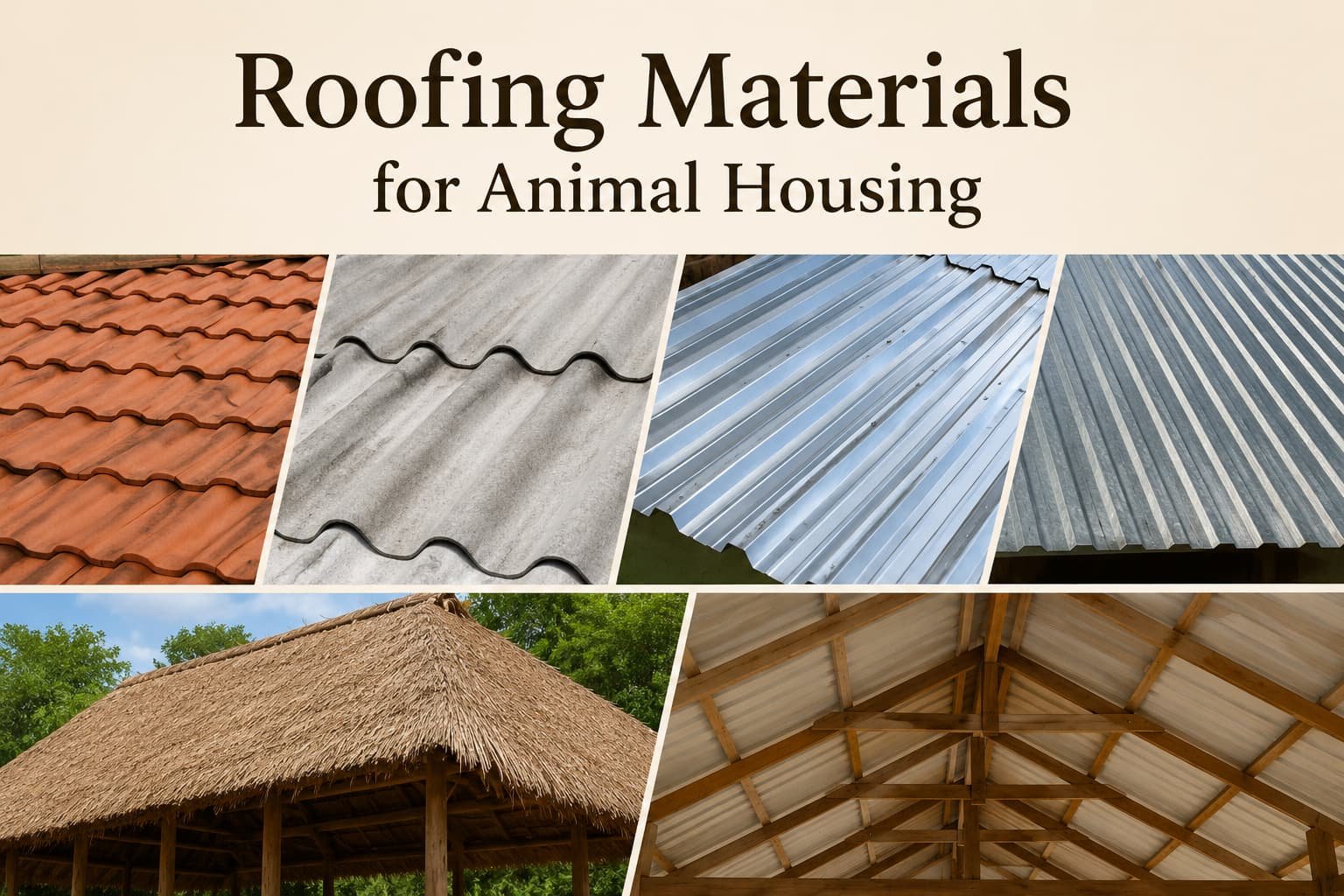
The commonly used roofing materials are:
- Tiles
- Asbestos sheets
- Aluminum sheets
- Galvanized iron sheets
- Thatched roofs
1. Tiles
Tiles are inexpensive and readily available in most areas. They conduct heat rapidly; therefore, they are suitable for hot climates. They can be easily damaged by wind or accidents and must be replaced periodically.
There are two types of tiles:
- Pan Tiles or Mangalore Tiles: These are rectangular tiles with grooves on the outer surface and two nibs on the inner surface. They are laid side by side to cover the roof.
- Country Tiles: These are semi-circular tiles of different shapes and dimensions. They are arranged in overlapping layers, forming numerous air pockets that reduce heat conduction.
2. Asbestos Sheets
Asbestos sheets are commonly used in animal buildings. They are prepared by mixing cement with varying quantities of vegetable fibers. They are available in different dimensions with corrugated surfaces. These sheets are easily fixed to roof trusses and are more durable than tiles. However, buildings with this type of roofing tend to become hotter during summer.
3. Aluminum Sheets
Corrugated aluminum sheets of different thicknesses and dimensions are available as roofing materials. They are generally 2½ feet wide and available in lengths ranging from 8 to 12 feet. They are lightweight and can be easily installed. The bright, polished surface of new sheets provides reflective insulation and helps keep animal housing cooler during summer. Although expensive, they have a higher resale value. They are rust-proof and therefore more durable.
4. Galvanized Iron Sheets
Galvanized iron sheets are iron sheets coated with a galvanized layer and provided with corrugations. They are available in standard dimensions of 6 feet × 3 feet. Galvanized sheets are commonly used in animal housing; however, they tend to make the building very hot during summer.
It is recommended that the sheets be painted white on the outer surface to reduce heat absorption. They are strong but may rust after prolonged use.
5. Thatched Roof
Thatched roofs are made from coconut or palmyra leaves. Hay and straw may also be used as roofing materials. They are inexpensive and poor conductors of heat, helping to keep buildings cool during summer. However, they are not durable and must be replaced annually or every two years. They are also highly susceptible to fire.
Other Roofing Considerations
In addition to the choice of roofing material, factors such as roof weight, structural requirements, and insulation can significantly influence the comfort and durability of animal buildings. Some important roofing considerations are discussed below.
Light Roofing
Light roofing materials are also poor conductors of heat. However, they require closely spaced truss work; otherwise, displacement of the roofing material may occur, allowing rainwater to enter the building.
Roof Lining
Wooden boards and synthetic fiber boards can be used as roof lining for tiled roofs and roofs covered with galvanized iron sheets to provide better insulation.