CONTENT
Construction of Animal House Floors: Materials, Types, Design, and Flooring Requirements
Proper flooring is an essential component of animal housing because it directly influences animal comfort, hygiene, health, and overall productivity. A well-designed floor should provide adequate strength, durability, drainage, and slip resistance while facilitating easy cleaning and waste removal. Different flooring materials and designs are used in livestock production systems depending on the species, management practices, climatic conditions, and economic considerations. This article discusses the construction requirements of animal house floors, various flooring materials, and the different floor designs commonly used in animal housing.
The floor is an important part of the building. It is frequently used by animals for various purposes such as resting, movement, feeding, and milking. Therefore, the floor must possess all the qualities required to meet these purposes. It must be strong and durable enough to withstand the weight of the roof structure and the movement of the animals’ hard hooves. Durability is also important from an economic point of view.
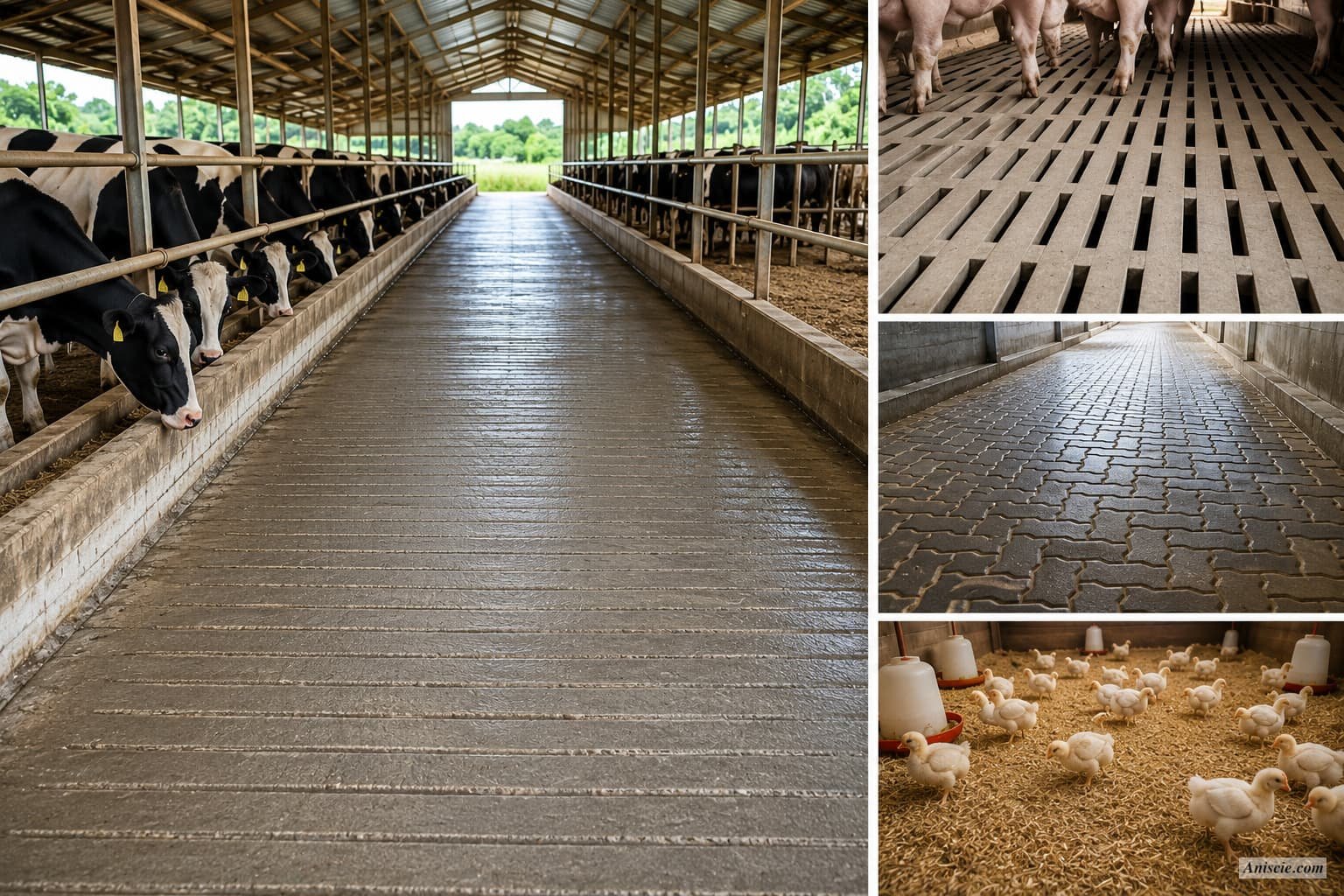
Flooring must facilitate hygienic feeding and effective removal of both liquid and solid waste products. The floor should be laid on a solid and compact foundation. It should have a gradient of 1/60 from the manger to the rear dung channel. A non-slip surface is necessary to prevent accidents, especially in the case of large animals. Grooves and a roughened surface should be provided.
Construction Details
For any type of animal housing floor, the primary requirement is the provision of a good bottom layer. It is as important as the foundation wall. The bottom layer is sometimes called the hard core of the floor.
Floor Materials
Different materials are used for animal housing floors. The choice depends on availability, cost, and other qualities required for the animal housing system.
1. Cement Concrete Floor
This is a common material used in animal housing. It provides a durable and economical floor when properly constructed. In tropical conditions, it provides the cool environment required by animals. Grooves and a rough surface should be provided to prevent accidents.
2. Vitrified Paving Bricks
These are hard, impervious bricks with grooves on the surface. They are ideal flooring materials for animals because of their durability and damp-proof properties. The bricks are laid over the bottom layer with a cushion of sand. The joints are sealed with cement mortar.
3. Stones
Granite stones are used in areas where they are readily available. They are cut into blocks and laid over a cushion of sand. The floor surface is roughened to prevent slipping. This type of flooring is durable, strong, and economical.
4. Wood
Wooden floors are sometimes used in animal housing. They keep the floor warm and comfortable in cold conditions. In mountainous regions where timber is inexpensive, wooden flooring is preferable. The planks may be used as either solid flooring or slatted flooring.
Slatted floors are preferable because they improve hygiene by reducing animal contact with excreta.
In tropical buildings, slatted floors also provide desirable floor-level ventilation, which facilitates maximum cooling of animals in hot conditions. Slatted flooring is commonly used in poultry and rabbit housing.
5. Building Bricks
Building bricks are sometimes used as a flooring material. However, they are not considered ideal because they absorb water and wear out easily. They are laid on edge and packed closely with good-quality cement mortar.
6. Gravel
Fine-quality gravel can be used as an inexpensive flooring material. However, it absorbs water and wears out quickly. Periodic repair and maintenance are required. During disease outbreaks, disinfection is difficult with this type of flooring. Lime dressing and smearing with a cow dung mixture can help maintain the floor properly. This type of flooring is suitable for sheep and goats.
Synthetic Flooring
1. Composition Brick
Composition brick provides a warm, non-conductive floor surface, which is necessary for housing young animals in cold climates. It is a good flooring material for pig and calf housing. It provides a soft and comfortable surface that is beneficial for young animals.
2. Rubber Floor
Rubber flooring is used either as blocks set on a concrete base or as thick mats with grooves and ridges on the surface. It is expensive and difficult to install. In Western countries, rubber flooring is commonly used in dairy facilities and calving pens to provide a clean, soft, and comfortable surface.
Design of Floor
1. Solid Floor
It is a common type of flooring with a solid surface made from materials such as cement concrete, vitrified paving bricks, building bricks, stones, and gravel. Such floors should be laid properly to ensure good drainage. A slope of 1/40 to 1/60 toward the dung channel is desirable. An even, impervious surface is necessary to prevent water stagnation. Proper cleaning and disinfection are essential for disease control.
2. Slatted Floor
Floors constructed with wooden or reinforced concrete slats provide the required gaps between them and are used in intensive animal production systems. They offer a significant advantage in disease control by reducing contact between animals and excreta. Both liquid and solid excreta pass through the gaps immediately after being voided.
The excreta collected beneath the floor are disposed of by suitable mechanical means. Slatted flooring is ideal for raising animals under hygienic conditions. The distance between two planks (slats) is known as the slot and should be 1 to 1.5 cm. The plank width should be 7.5 to 10 cm, and the thickness should be 2.5 to 4 cm. Slatted floors should be raised 1 meter above ground level.
3. Wire Floor
Animal housing floors are now manufactured in the form of heavy-gauge wire mesh. These can be fixed within frames and used as flooring. The wire mesh should be of welded construction with a good galvanized coating. It offers the same advantages as slatted flooring and is easy to install in poultry houses, rabbit housing, and calf housing.
4. Deep Litter Floor
Deep litter flooring consists of bedding materials such as straw, rice husks, sawdust, groundnut hulls, and dried leaves. These materials are spread on the floor and used as litter. The litter may be applied in layers 4–6 inches thick and allowed to accumulate over a period ranging from one month to one year. The litter becomes mixed with excreta and undergoes decomposition.
The dry litter materials absorb moisture, thereby reducing excessive bacterial activity. The decomposed litter mixed with excreta may provide B-complex vitamins to birds. B-complex vitamins, especially vitamin B12, can improve hatchability. Excessive bacterial activity within the deep litter is controlled by the addition of lime.