CONTENT
Arrangement of Farm Buildings: Categories, Farmstead Planning, and Layout Systems
The arrangement of farm buildings is an important aspect of farmstead planning that directly affects the efficiency, productivity, and profitability of a farming enterprise. Properly planned farm buildings facilitate the smooth movement of animals, workers, machinery, feed, and farm products while reducing labor requirements and operating costs.
A well-designed farm layout should provide adequate space for various farm activities, ensure proper sanitation and drainage, facilitate supervision, and allow for future expansion. Factors such as prevailing wind direction, road access, water supply, topography, and biosecurity measures should be considered when arranging farm buildings.
Farm buildings are generally classified into different categories based on their functions, and their arrangement may vary depending on the type and size of the farming enterprise. Common systems of farm building arrangement include the central courtyard system and the parallel road system, each having its own advantages and applications.
Principles of Farmstead Planning
Farmstead planning involves the proper location and arrangement of buildings, roads, utilities, and other facilities to ensure efficient farm operation. A well-planned farmstead reduces labor requirements, improves supervision, enhances animal health, and facilitates future development. The following principles should be considered while planning a farmstead:
- Site selection: Buildings should be located on elevated ground with good drainage to prevent waterlogging and maintain sanitary conditions.
- Wind direction: Residential buildings should be situated on the windward side, while livestock housing and manure storage areas should be located on the leeward side to minimize odors, flies, and dust.
- Road accessibility: The farmstead should have convenient access to public roads to facilitate the movement of inputs, livestock, machinery, and farm products.
- Water supply: An adequate and reliable water supply should be available for livestock, sanitation, and other farm operations.
- Efficient grouping of enterprises: Related farm activities and buildings should be grouped together to reduce unnecessary movement of labor, animals, and equipment.
- Provision for future expansion: Sufficient space should be reserved for the addition of new buildings or expansion of existing enterprises.
- Biosecurity considerations: Quarantine and isolation facilities should be located appropriately to reduce the risk of disease introduction and spread.
- Availability of utilities: Buildings should be planned to allow economical installation and maintenance of electricity, water lines, and drainage systems.
Categories of Farm Buildings
Proper planning, design, and arrangement of various buildings on a farm are necessary for a successful enterprise. Farm buildings can be grouped into three categories.
- Farmhouse (or) homestead
- Farm buildings (or) farmstead
- Farm store
1. Farmhouse (or) Homestead
A farmhouse is a residential building meant for people working on the farm. The farmhouse should never be placed on the leeward side of the farm buildings and should be located on the windward side. Attention to this point helps prevent flies and odors from the manure heap from being blown toward the dwelling house.
2. Farm Buildings (or) Farmstead
These are meant for housing livestock. Farm buildings should be kept well away from the farmhouse and workers’ cottages. However, consideration must be given to ensuring that the distances are not too great; otherwise, stockpersons or other animal attendants may be reluctant to attend animals at night or during bad weather when care is required.
3. Farm Store
A farm store is meant for the storage of feed materials as well as other farm products. The farmhouse should always be located on the windward side.
The farm office should be located in a prominent place, preferably at the center of the farm. The farm manager’s house should be located at the entrance to the farm.
This arrangement allows efficient supervision. All buildings on the farm should be grouped together for efficient operation. Related enterprises should also be grouped together.
The major enterprise that requires more attention should be located nearer to the farm office. In mixed farming systems, the piggery unit can be located away from the dairy unit.
Location of Quarantine and Isolation Sheds
Quarantine Shed
The quarantine shed should be located at the entrance of the farm so that newly purchased animals can be housed there. If they are found to be free from disease, they can then be introduced into the farm.
Isolation Shed
The isolation shed should be located away from the housing areas of healthy animals.
Types of Arrangement of Farm Buildings
Two types of farm building arrangements are:
- Central courtyard system.
- Parallel arrangement with the road.
1. Central Courtyard System
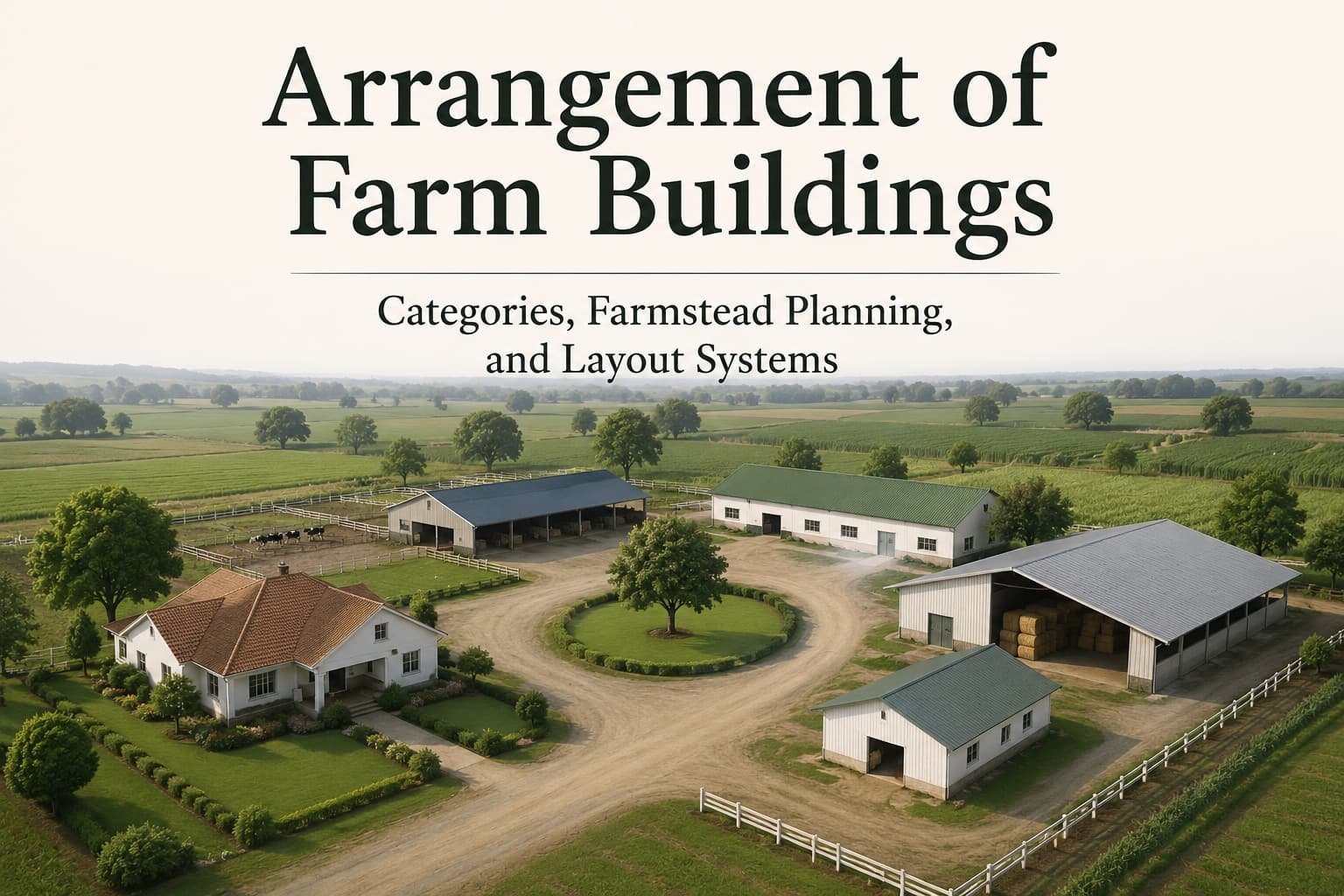
There is a wide driveway at the entrance of the farm leading to a spacious courtyard. The driveway should be 20–25 feet wide. The farmhouse should be located at the entrance of the driveway, allowing good control of farm-building activities and efficient supervision.
The different farm buildings are located around the courtyard at varying distances from it. The major enterprises are usually located closer to the farmhouse than other enterprises.
2. Parallel Arrangement with the Road
The entrance driveway leads to a number of farm roads with sufficient space between them. Different farm buildings are located on either side of the roads in a parallel arrangement.
Different rows can be designated for different types of buildings, such as one for the dairy unit, another for feed storage, and another for storing farm implements. This type of farm arrangement facilitates easy and efficient transportation.
It is mostly followed on commercial farms where resources are obtained from outside markets and products are sold externally. This arrangement is ideal for large farms with different enterprises.
For smaller farms with a single enterprise or limited activities, buildings may be arranged in the shape of the English letters ‘L’, ‘U’, ‘T’, ‘E’, and ‘M’.
Comparison of Farm Building Arrangement Systems
| Feature | Central Courtyard System | Parallel Arrangement with the Road |
|---|---|---|
| Layout Pattern | Buildings are arranged around a central courtyard. | Buildings are arranged in parallel rows along farm roads. |
| Supervision | Easier supervision due to the centralized location of buildings. | Supervision may require more movement between rows. |
| Labor Efficiency | Reduces walking distance and labor requirements. | May involve longer travel distances between enterprises. |
| Transportation | Moderate transportation efficiency. | Provides easy and efficient transportation of inputs and products. |
| Suitability | Suitable for small to medium-sized farms. | Suitable for large commercial farms with multiple enterprises. |
| Future Expansion | Expansion may be more difficult because of the centralized layout. | Expansion is generally easier due to the linear arrangement. |
| Land Requirement | Requires comparatively less land. | Generally requires more land area. |
| Management Convenience | Provides convenient management and close coordination of activities. | Facilitates organized operation of different farm enterprises. |