CONTENT
Animal Housing Design: Environmental Control, Disease Prevention, and Roof Types
Animal housing plays a vital role in livestock production by providing a comfortable and healthy environment for animals. Properly designed animal buildings help improve productivity, product quality, labor efficiency, and disease control while protecting animals from adverse environmental conditions. This article discusses the key principles of animal housing design, including environmental control, disease prevention, and the common roof types used in animal buildings.
Animal housing is designed to facilitate efficient livestock production while maintaining product quality.
Environmentally Controlled Housing
The recent trend in animal housing is to minimize the adverse effects of environmental factors and provide comfortable conditions for animals. In tropical buildings, appropriate building materials and construction methods should be employed to prevent heat radiation from the sun from entering the building through the roof, walls, and surrounding ground.
Non-conducting materials with sufficient insulation will prevent various forms of heat transfer. Comfortable air velocity and optimum humidity should be maintained within the building. All these factors affect the growth, reproduction, and health status of livestock.
Quality of Products
High-quality milk and eggs can be produced only in certain types of housing that are specifically designed for this purpose. For example, certified high-quality eggs are produced only in cages with a rollaway floor arrangement or in slatted-floor systems. Certified high-quality milk with low bacterial counts can be produced only through the parlor milking system.
Labor Control
One of the major expenses on a farm is labor cost. Labor costs can be reduced by properly designing animal housing, and labor efficiency can be improved through the double-row arrangement of animals and housing facilities that facilitate circular movement and two-way operations.
Construction of alleys and passages, such as feed alleys, milk alleys, egg collection alleys, and animal weighing yards, is intended to reduce labor costs.
Disease Control
Animal housing should be properly designed to aid disease control. Provision of washable and well-drained floors, along with washable walls, helps control the spread of diseases. Designing a suitable drainage system for the rapid and hygienic disposal of waste is essential for disease prevention.
External loose-box accommodation is necessary for the isolation of sick animals. Dampness-resistant surfaces help reduce high humidity, which is a predisposing factor for respiratory diseases in pigs and young animals.
Roof
A roof is the structure that covers the entire building and protects the interior from the outside environment. Locally available materials such as thatch, tiles, wood, and agricultural by-products are commonly used as roofing materials. Improved materials such as asbestos sheets or concrete are also used.
The roof structures are as follows:
- Eaves: The lower edges of the roof that rest on the supporting wall.
- Gable: The triangular upper part of a wall formed at the end of a roof.
- Purlins: Wooden members placed horizontally on principal rafters to support the common rafters.
- Rafters: Pieces of timber that extend from the eaves to the ridge.
- Ridge: The highest part of the building where the two slopes of the roof join.
- Span: The horizontal distance between the internal faces of walls or supports.
- Pitch of a Roof: It is the degree of slope of the roof. Steeper pitches are necessary for thatched and tiled roofs. A lower pitch is suitable for aluminum, asbestos, and other metal sheets. It can be calculated using the following formula (Pitch = Rise / (2 × Run))
- Rise is the vertical height from the eave to the ridge.
- Run is half of the span.
- A pitch of 1/8 to 1/10 is sufficient for roofs with metal sheets, whereas a pitch of 1/4 is required for thatched and tiled roofs.
Roof Pattern
Different roof patterns are used for animal buildings to suit climatic conditions and ventilation requirements.
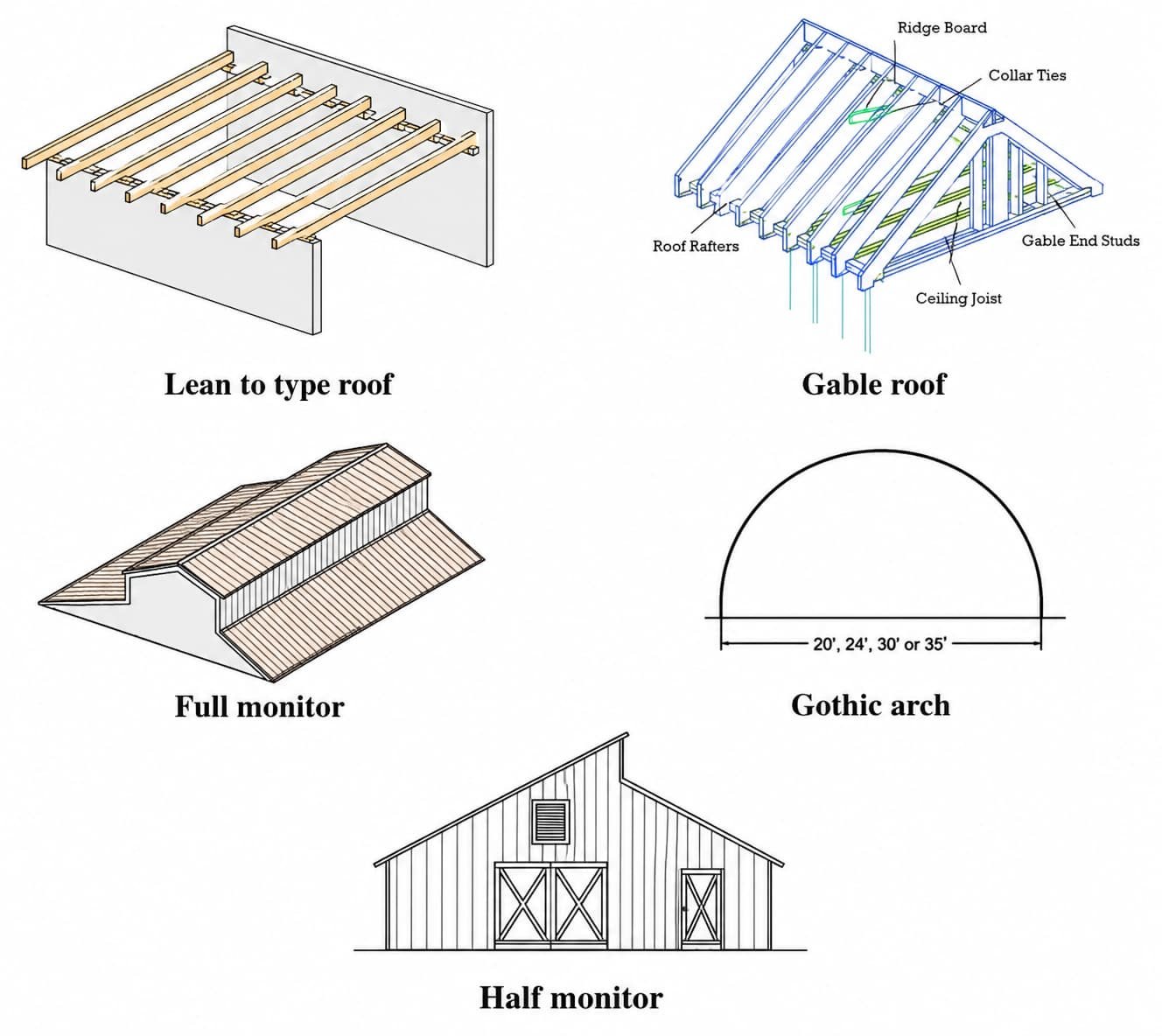
- Lean-to Roof: This is a simple roof with a single slope, commonly adopted for shed-type buildings. Roof ventilation cannot be provided in this pattern. In this type of roof, one wall is higher than the other to provide the necessary slope. It is suitable for a maximum span of 2–4 meters.
- Gable Roof: This is a coupled roof with two slopes. Roof ventilation can be provided in this pattern in the form of a continuous ridge opening protected by louver boards.
- Monitor Roof: This roof has two slopes, but one overlaps the other at the ridge, creating a ventilation gap of about 1 foot. Ventilation can be provided between the two slopes. This design is suitable for tropical buildings and serves the dual purpose of ventilation and lighting. Poultry sheds are commonly constructed using this pattern.
- Semi-Monitor Roof: This roof has two slopes, but one overlaps the other at the ridge, creating a ventilation gap of approximately 1 foot.
- Gothic Arch: This is an arched roof that provides greater roof space and is commonly used for storage buildings. It is used for feed storage and pig housing.