CONTENT
Integration in Poultry Production: Types and Advantages
Modern poultry production involves several interconnected activities, from breeding and hatching to feeding, growing, processing, and marketing. Coordinating these activities within an organized production system can improve operational efficiency, facilitate the movement of inputs and products, and help manage production costs. Such coordinated systems form the basis of integration in the poultry industry.
Integration is the association, coordination, or amalgamation of companies engaged in various stages of production of a particular product or related products, so that there will be a smooth flow of inputs and outputs from one unit to another, leading to an overall reduction in the cost of production of the final product.
In all developed countries, poultry production at present is an integrated operation from the primary breeder to the consumer. Each stage or unit is associated with the other stages. An integrator coordinates all these activities. Usually, an integrator is the owner of the processing plant, hatchery, and feed mill and pays a commission to others for the services rendered by them.
There are only a few integrators in each developed country who control the entire poultry production in these countries. Poultry farmers act only as contract growers, receiving a commission for the eggs, broilers, and turkeys produced by them. The farmers are not the owners of the birds; rather, the integrators are the actual owners.
In India, integration was introduced in the broiler sector about a decade ago, but it is not a complete integration. Broiler production, from principal breeder farms to commercial grower farms, is integrated. Therefore, our integrators can pursue forward integration with processing plants, marketing channels, rendering plants, etc., to obtain a fair price for eggs and broilers and to prevent exploitation by middlemen.
Integration has not yet been well developed in India in the layer sector, except for the supply of feed and the collection of eggs from farmers by the integrator, while layer farmers continue to be the owners of the birds.
Broiler Integration
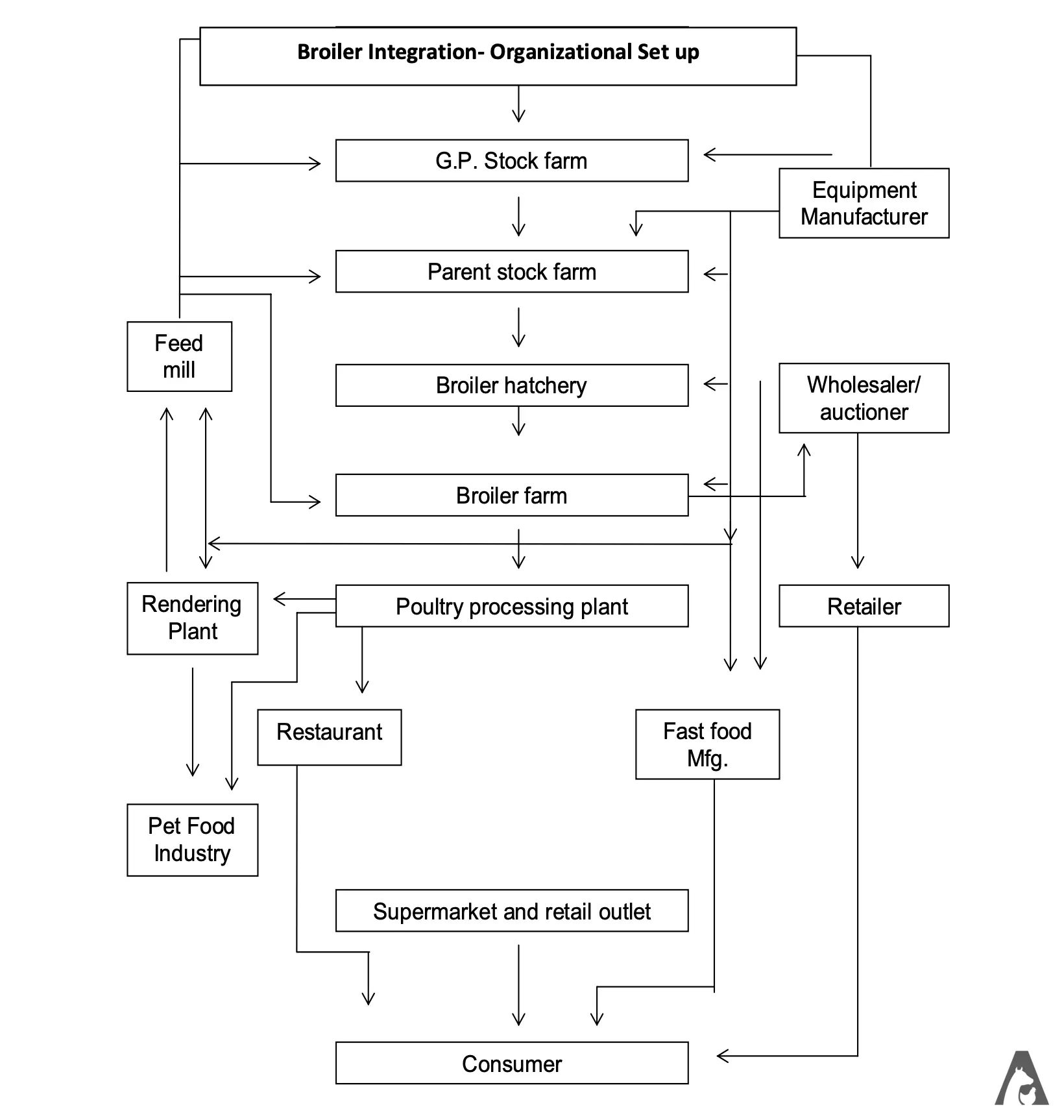
In the broiler industry, the integrator may own breeding farms, parent stock, grower farms, a hatchery, a feed mill, a rendering plant, and a poultry processing plant. The integrator will work with a few contract parent stock farms that supply hatching eggs on a commission basis. The integrator is the owner of the parent stock and will supply ready-to-lay parent stock and feed to the contract breeder farms.
Similarly, the integrator will supply day-old broiler chicks and feed to the contract broiler growers and take back grown broilers after paying a growing commission to them. The integrator will process all the birds in the processing and further-processing plants and later supply them to supermarkets and restaurants for sale. Hatchery waste and offal are processed in the rendering plant, and the meat meal and chicken fat are used in the feed.
Layer Integration
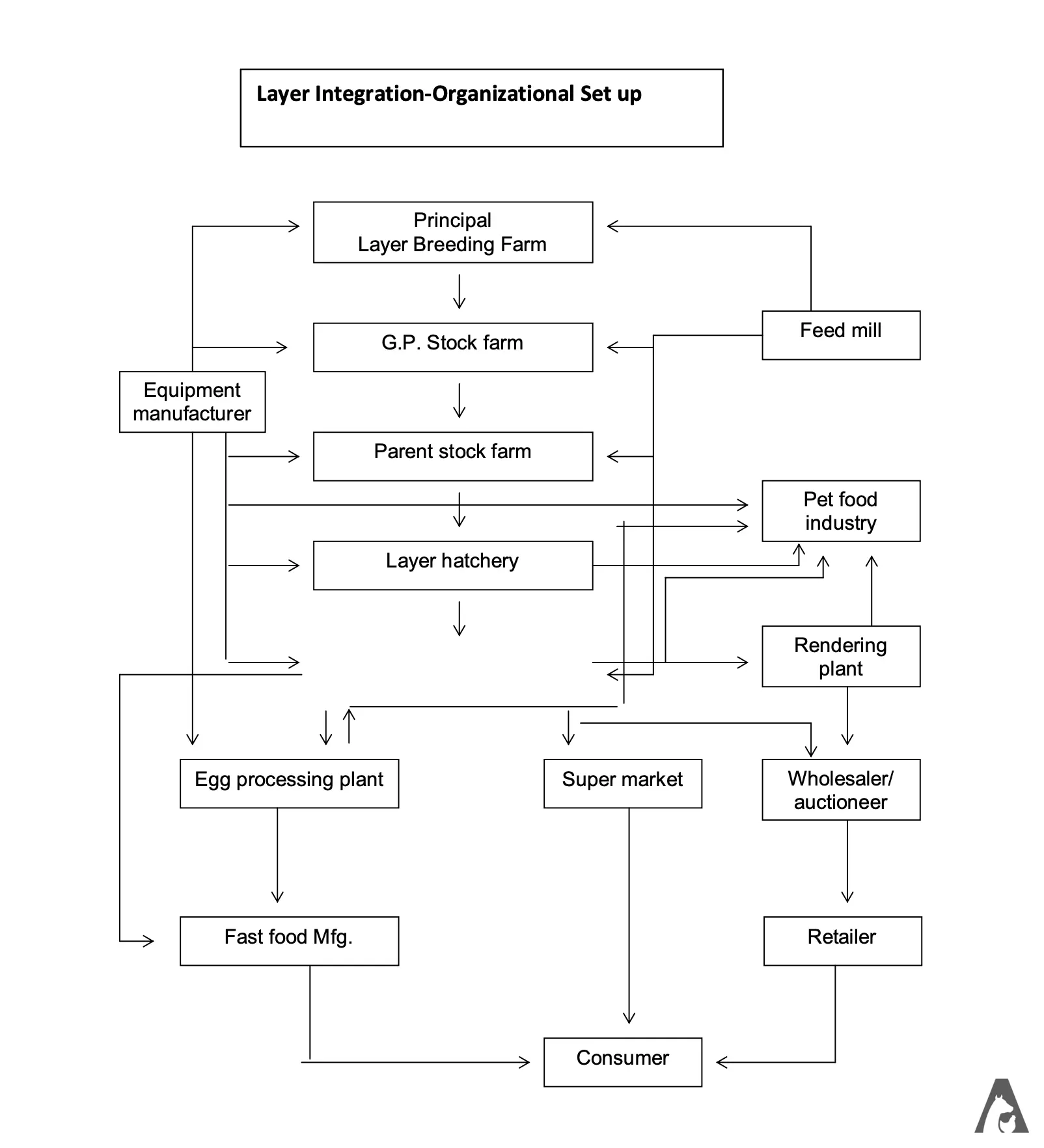
Layer integration is also more or less similar to that of broilers. The layer and parent stock farmers will receive 20-week-old pullets/parent stock and feed from the integrator and supply table/hatching eggs to the integrator on a commission basis.
The integrator will clean, apply egg-coating oil, grade, pack, and distribute the table eggs through various marketing channels. The hatching eggs are utilized to produce pullet chicks for the next cycle.
Since culled hens are not used for human consumption in developed countries, they are mainly utilized for pet food manufacturing, and the offal is recycled into poultry feed after being converted into meat meal, feather meal, and chicken fat.
Types of integration:
- Vertical
- Horizontal
- Parallel
Vertical Integration
Vertical integration is the association between different stages of production, namely breeding, hatchery, commercial farming, processing, and marketing, in order to utilize the output of one unit as the input of another unit. This will ultimately reduce the cost of production of the final products, namely eggs and meat, without affecting the profit margin of the integrator.
Horizontal Integration
Horizontal integration is the association, amalgamation, or merging of companies and units engaged in the same type of production, such as the merging of two or more hatcheries, commercial farms, processing plants, etc., resulting in an increase in the volume of operations and expansion of production.
The integrator can pursue diversified fast foods and advertising in mass media for sales promotion. Sometimes, it may also lead to either unhealthy competition among integrators or even a monopoly. Both are not good for the industry.
Parallel Integration
Parallel integration is another type of integration, also called diversification. Here, the integrator may start allied industries. For example, a broiler farmer or breeder may start a feed mill to reduce feed costs as well as to sell feed. Similarly, a hatchery operator may manufacture incubators for use in the hatchery as well as for sale.
This type of integration not only reduces the cost of production but also generates additional revenue by selling diversified products.
Forward Integration
Here, in order to obtain a better price for the output/product, the integrator will start a processing plant or marketing center.
Backward Integration
In Backward integration, the farmer or integrator, in order to obtain inputs at a lower cost, such as chicks, will start a hatchery and/or breeding farm.
Advantages of Integration
- Mushrooming growth of independent small farms and other production units can be avoided.
- The cost of production of the final product will decrease, ultimately benefiting the consumer.
- It will be possible to develop diversified products and newer fast foods.
- Due to the large volume of operations, the integrator can advertise to promote the products.
- All main products and by-products will be utilized and recycled without wastage. This will not only prevent environmental pollution but also reduce the cost of production of the main product.
- It will stabilize prices by balancing supply and demand.