CONTENT
Poultry Hatchery Rooms and Their Functions
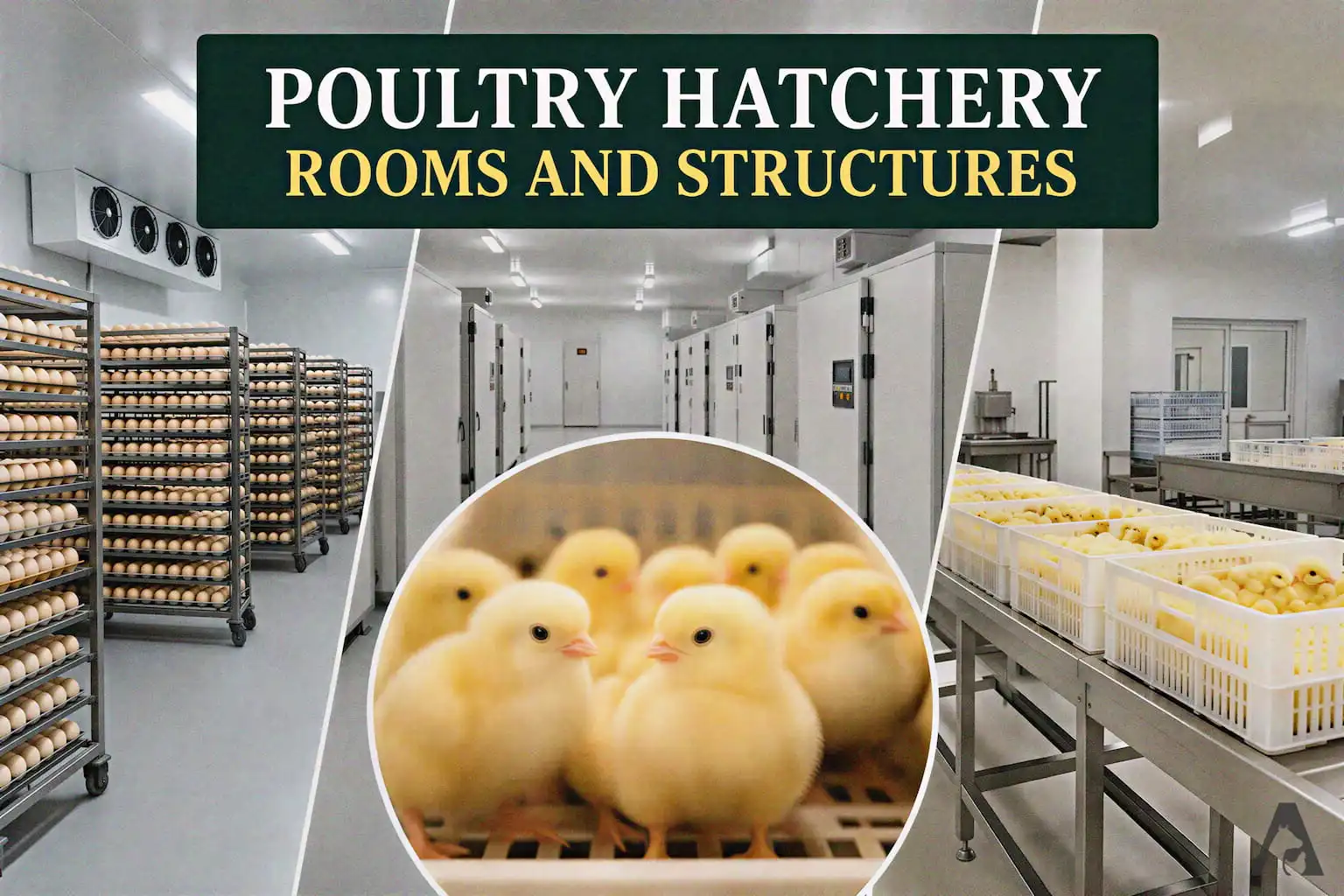
A well-designed poultry hatchery requires specialized rooms and structures to support the systematic movement of hatching eggs and chicks while maintaining appropriate environmental conditions and biosecurity. Proper planning of these areas helps facilitate incubation, hatching, chick processing, sanitation, and other routine hatchery operations.
Hatchery rooms must be adequate in size. Usually, medium-sized hatcheries will hatch chicks twice a week, but large hatcheries will have more than two hatches per week. Consequently, hatching schedules will affect the size of some rooms in the hatchery.
Shower Room
To maintain biosecurity, it is essential that all persons entering the premises shower and change into clean clothing in an adjoining room. It is the only entrance and exit, and the hatchery becomes an isolated unit as far as human entry is concerned.
Hatching Eggs Receiving Counter
Employees delivering hatching eggs to the hatchery must not enter the hatchery in the course of their duties. Eggs should be delivered to the hatchery through a designated door.
Fumigation Room
The fumigation room should be as small as possible in order to reduce the amount of fumigant used. A fan should be used to circulate the air and exhaust the fumigant.
Egg Holding (Egg-cooler) Room
The egg holding room should be about 8 ft high, insulated, slowly ventilated, with complete air movement, cooled, and humidified. The room must be refrigerated to maintain a temperature of 65oF. A forced-air type of refrigeration unit is required in order to maintain a uniform temperature throughout the room.
Pre-incubation Warming Room
Here, eggs are kept for the purpose of drying the “sweat” on the eggs. This can be achieved by providing a sufficient number of ceiling fans in this room.
Setter Room
Setters (incubators) are kept in this room. The size of the setter room will depend on the make of the equipment used. The incubating equipment takes relatively little floor space. The exact room size depends on the aisle and working area necessary to move the eggs and chicks in and out of the machines. A minimum space of 3 ft should be allotted between the sides of adjacent setters and between the wall and the sides or back of the setters. Similarly, a minimum of 10 ft should be allotted in front of two setters when they are arranged face-to-face.
Egg Candling (Dark) Room
This room is usually constructed between the setter and hatcher rooms for candling eggs. Candling is usually practiced when eggs are transferred from the setter to the hatcher. Provisions should be made to darken the room to facilitate easy candling.
Hatcher Room
Hatchers are kept in this room. Here, sufficient space should be allowed around the hatchers, similar to that in the setter room. Since this room is prone to contamination with fluff and debris at the time of hatching, the door toward the setter room should be tightly closed unless necessary, such as at the time of egg transfer.
Chick-holding Room
The chick-holding room is located next to the hatcher room. A relative humidity of 65% is maintained to prevent excessive chick dehydration. Here, the chicks are separated by sex, graded, vaccinated, and placed in chick boxes.
Wash Room
After the chicks are boxed, the trays are washed in a tray washer in the washroom. Necessary pipelines with high-pressure pumps are installed in this room.
Clean Room
After the trays are washed, they are placed on their trolleys and moved to the adjacent clean room.