
CONTENT
Principles of Incubation in Poultry: Temperature, Humidity, Ventilation, Egg Position and Turning
Successful incubation of poultry eggs depends on maintaining optimal environmental conditions throughout embryonic development. Temperature, humidity, ventilation, egg position, and turning are the major factors that influence normal embryo development and hatchability.
Proper management of these factors in setters and hatchers is essential to minimize embryonic mortality and achieve successful hatching. Understanding the principles of incubation is therefore important for efficient hatchery management and poultry production.
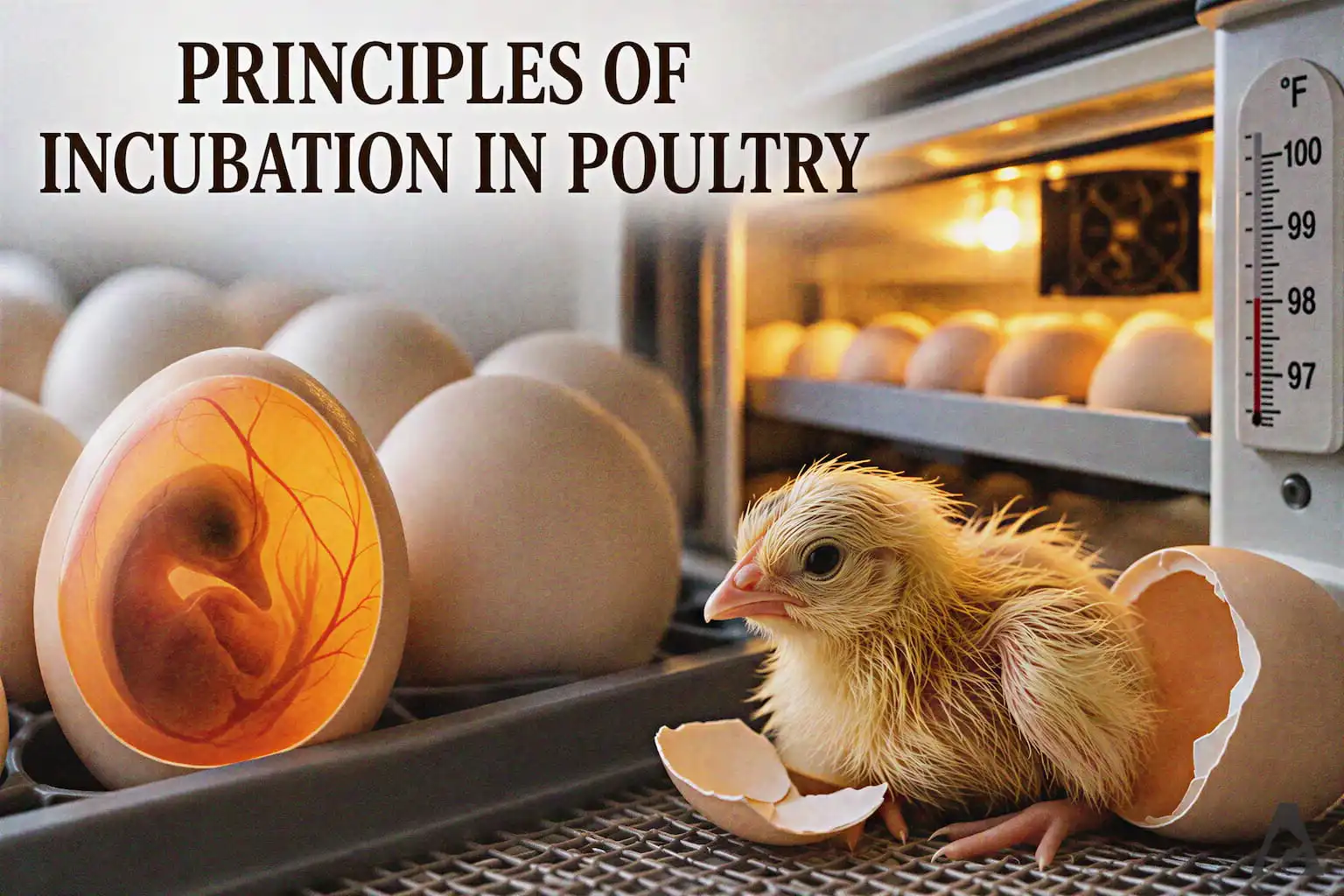
Five major functions are involved in the incubation and hatching of poultry eggs. They are:
- Temperature
- Humidity
- Ventilation (oxygen and carbon dioxide levels and air velocity)
- Position of eggs
- Turning of eggs
1. Temperature
Temperature is the most critical environmental concern during incubation because the developing embryo can only withstand small fluctuations during this period. The embryo starts developing when the temperature exceeds the physiological zero.
Physiological zero is the temperature below which embryonic growth is arrested and above which it is reinitiated. The physiological zero for chicken eggs is about 75°F (24°C).
The optimum temperature for chicken eggs in the setter (for the first 18 days) ranges from 99.50 to 99.75°F, and in the hatcher (for the last 3 days), it is 98.5°F.
2. Humidity
Incubation humidity determines the rate of moisture loss from eggs during incubation. In general, humidity is recorded as relative humidity by comparing the temperatures recorded by wet-bulb and dry-bulb thermometers.
The recommended relative humidity during incubation ranges between 55 and 60% for the first 18 days (in the setter) and between 65 and 75% for the last 3 days. Higher humidity during the hatching period is maintained to avoid dehydration of chicks.
3. Ventilation
Ventilation is important in incubators and hatchers because fresh, oxygenated air is needed for the respiration (oxygen intake and carbon dioxide release) of developing embryos from egg setting until chick removal from the incubator.
Oxygen requirements are low during the first few days compared with the later stages of development. The oxygen content of air at sea level is about 21%. Generally, the oxygen content of the air in the setter remains at about 21%. For every 1% drop in oxygen, there is a 5% reduction in hatchability.
Carbon dioxide is a natural by-product of metabolic processes during embryonic development and is released through the shell. The tolerance level of CO₂ for the first 4 days in the setter is 0.3%. CO₂ levels above 0.5% in the setter reduce hatchability and are completely lethal at 5.0%.
Since the normal oxygen and CO₂ concentrations present in air seem to represent an optimum gaseous environment for incubating eggs, no special provision to control these gases is necessary other than maintaining adequate circulation of fresh air at the proper temperature and humidity.
4. Position of Eggs
Artificially incubated eggs should be held with their large ends up. It is natural for the head of the chick to develop in the large end of the egg near the air cell and for the developing embryo to orient itself so that the head is uppermost.
When eggs are incubated with the small end up, about 60% of the embryos will develop with the head near the small end. Thus, when the chick is ready to hatch, its beak cannot break into the air cell to initiate pulmonary respiration.
Eggs positioned horizontally will incubate and hatch normally as long as they are turned frequently. Under normal circumstances, eggs are set with the large end up for the first 18 days (in the setter) and in a horizontal position for the last 3 days (in the hatcher).
5. Turning of Eggs
Birds, including chickens and quail, turn their eggs during nest incubation. Nature provides nesting birds with the instinct to turn their eggs during incubation. Similarly, eggs should be turned at least 8 times a day. Turning eggs during incubation prevents the developing embryo from adhering to the extra-embryonic membranes and reduces the possibility of embryonic mortality.
In large commercial incubators, the eggs are turned automatically each hour, i.e., 24 times a day. Most eggs are turned to a position of 45° from vertical and then reversed in the opposite direction to 45° from vertical. Rotations of less than 45° are not adequate to achieve high hatchability.