CONTENT
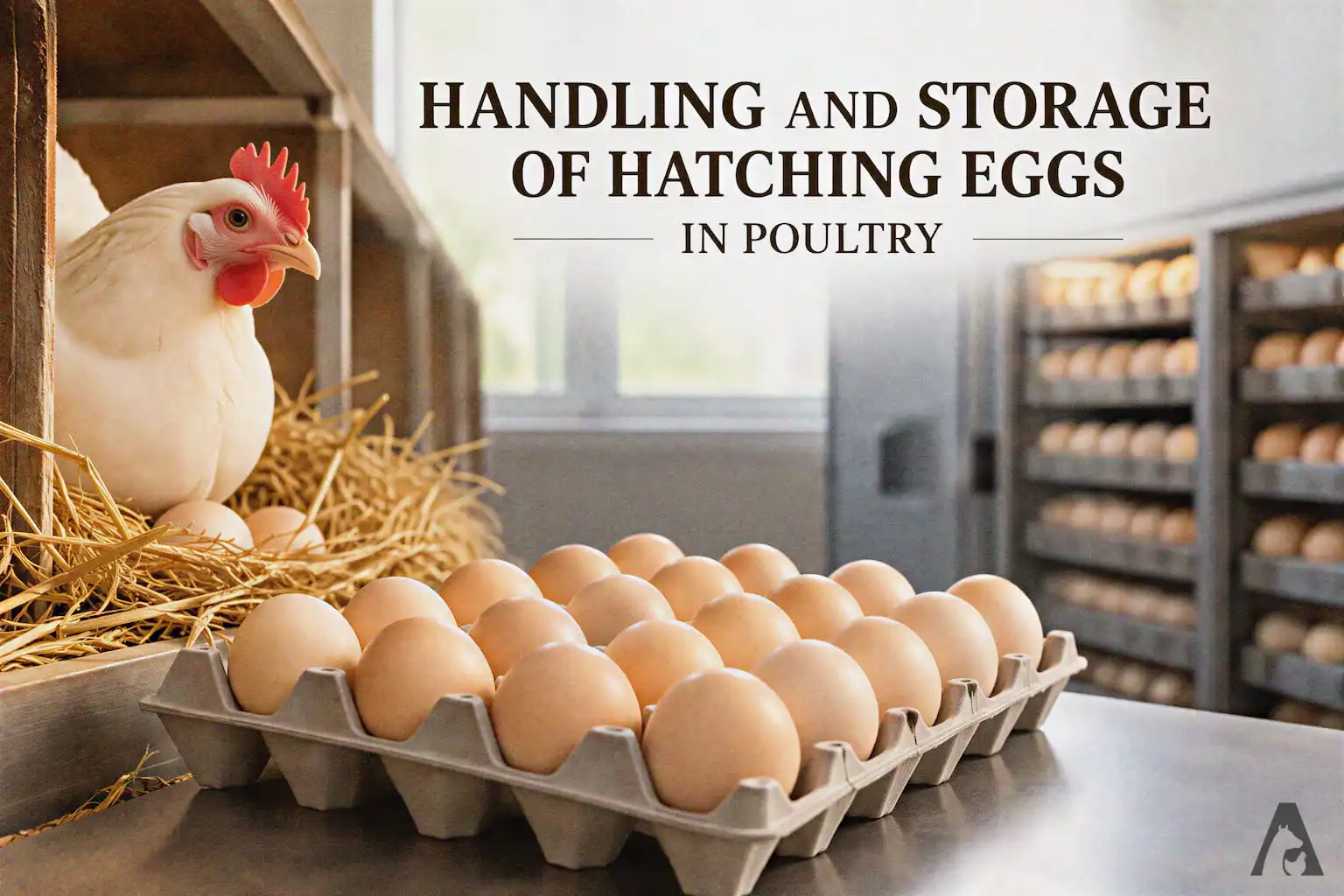
Handling and Storage of Hatching Eggs in Poultry
Proper management of hatching eggs between oviposition and incubation plays an important role in achieving optimal hatchability and producing high-quality chicks. Appropriate handling practices help preserve the biological integrity of the egg and minimize factors that may adversely affect embryonic development before incubation.
The quality of a hatching egg cannot be improved after laying, but the loss in hatching egg quality can be reduced by adopting some standard procedures.
Maintaining Egg Quality in the Breeder House
The hen will lay her eggs over nesting material. The use of sufficient clean, dry, and mold-free nesting material can help avoid cracked and dirty eggs. Similarly, hens should be trained to use nests to lay eggs instead of laying on floors by providing a sufficient number of nest boxes well in advance of the start of laying.
The frequency of hatching egg collection is very important for maintaining quality. Hatching eggs should be collected at least 4 times a day. Hatching eggs are susceptible to contamination, and every effort must be made to reduce the microbial load.
Therefore, it is imperative that people wash and sanitize their hands before collecting eggs from the nests or egg belts. The flats on which eggs are placed must also be sanitized and free of organic material.
Selection of Hatching Eggs
Not all eggs laid by a breeding flock are set. Eggs that are cracked, dirty, or misshapen are usually not used for hatching. Very small or very large eggs do not hatch as well as eggs in the middle size range. Eggs with thin or very porous shells are not likely to hatch well because of excessive water loss during incubation.
Reducing Contamination of Hatching Eggs
Poor hatching egg sanitation can be a major cause of lower hatchability and poor chick quality. There is no such thing as a sterile eggshell. More bacteria are picked up on the shell when the egg passes through the cloaca, through which urine and intestinal contents also pass.
The bacterial load found on an eggshell at the time of laying ranges from 300 to 500 organisms. After oviposition, every surface the egg comes into contact with can further inoculate the shell surface. After an egg is laid, it begins to cool.
During the cooling process, the egg contents begin to shrink, producing negative pressure. This is one of the more opportune times for bacteria on the shell surface to penetrate the eggshell. The egg has many natural defense mechanisms to reduce bacterial penetration. The shell itself provides some protection.
The cuticle on the surface of the eggshell is the best natural barrier to penetration. The inner and outer shell membranes provide additional barriers. The albumen provides somewhat effective control over contamination. The albumen has a high pH in which most bacteria cannot survive.
The chalazae contain an enzyme, lysozyme, which has antibacterial properties. Many breeder personnel use various methods to reduce the microbial load on the eggshell. Sanding, buffing, and wiping hatching eggs are not good methods of sanitation.
Sanding and buffing will remove at least part of the cuticle, resulting in eggs that are more susceptible to penetration. Fumigation with formaldehyde gas is an effective method of sanitizing hatching eggs. Solutions containing quaternary ammonium compounds, formalin, hydrogen peroxide, or phenols may be moderately effective in reducing the microbial load on hatching eggs.
Do not wash eggs unless necessary. If it is necessary to wash eggs, always use a damp cloth with water warmer than the egg. This causes the egg to sweat the dirt out of the pores. Never use water cooler than the egg. Also, do not soak the eggs in water.
Storage of Hatching Eggs
In normal hatchery operations, eggs cannot be set immediately after they are laid. Many hatcheries set eggs once or twice a week. If hatching eggs are stored for up to 1 week, they should be kept in an egg holding room at a temperature of 65°F and a relative humidity of 75%.
When storing eggs for less than 10 days, store them with the large end up. If eggs are held for 10 days or more, hatchability will be improved if they are stored with the small end up.