CONTENT
Rabbit Feeding Management: Nutrient Requirements, Feeding Schedule & Cecotrophy
Rabbit feeding management plays an important role in maintaining health, growth, reproduction, and productivity. A balanced diet for rabbits should provide adequate energy, protein, fiber, minerals, vitamins, and water according to their age and physiological status.
Proper feeding practices should also consider the unique digestive physiology of rabbits, particularly cecotrophy, which allows them to efficiently utilize nutrients from fibrous feeds.
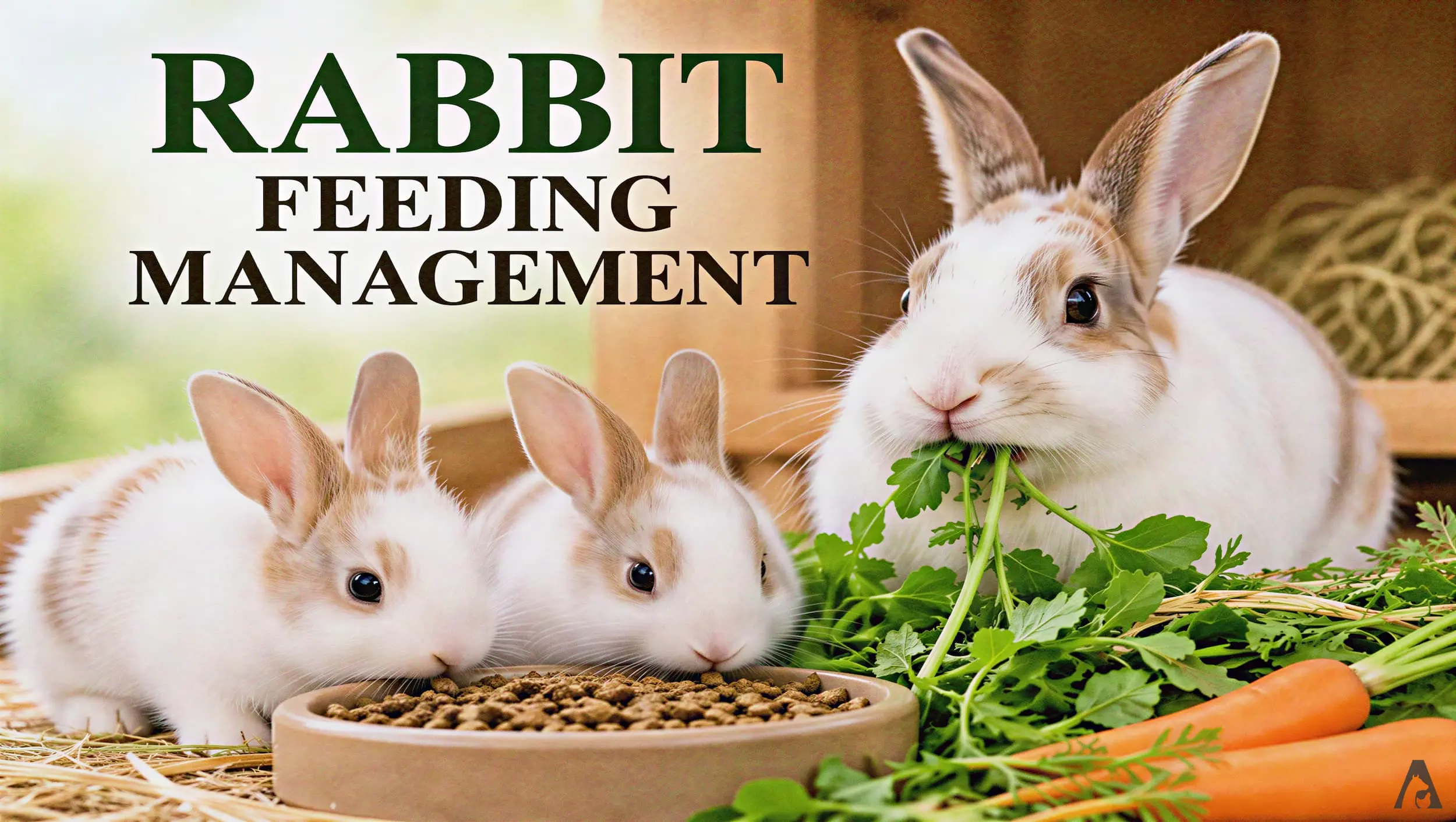
- Rabbits are primarily monogastric herbivorous animals and consume common type of grains and pulses (Sorghum, Bengal gram, wheat etc.) and legumes (alfalfa, berseam, etc.) as greens or as hay and even kitchen wastes and garden vegetables (cabbage, carrot, etc.) or their leaves.
- The dam imposes feeding pattern. A doe feeds her young only once in 24 hours.
- From the 3rd week of life, the young rabbit begin to move about, taking few grams of mother’s milk. Within few days they also start feeding grains and forages.
- Normally rabbit feed and drink water throughout the day but feeding nocturnally is the common phenomena. Lactating doe need the richest and most concentrated feed.
- In organized farm feeding of concentrate in palletized form is the most common practice. The diameter of the pellet should be 3-4 mm with 10-15 mm length. Feeding of rabbit in pellet form is more desirable than mash or ground form.
- Concentrate feed requirement and nutrient requirement is given below.
Feeding Schedule for Different Categories of Rabbits
| Item | Approximate Body Weight | Quantity to Be Fed per Day | |
|---|---|---|---|
| Concentrates | Green Grass | ||
| Bucks | 4–5 kg | 150 g | 600 g |
| Does | 4–5 kg | 150 g | 600 g |
| Lactating does | – | 200 g | 700 g |
| Weaner (6 weeks) | 600–700 g | 50 g | 200 g |
Rabbit consumes to dry matter 6-8 % of their bodyweight out of which roughage can contribute up to 60 %. The dietary crude protein content should be 12 to 15 % for dry non lactating does and 16 to 20 % for growers and lactating does with litter respectively.
| Type of Nutrient | Fattening or Growing Stock | Lactating Doe | Does in Kindle | Animal on Maintenance |
|---|---|---|---|---|
| Digestible Energy (MJ/kg) | 10.4 | 10.9 | 10.4 | 9.2 |
| Fat (%) | 3 | 4 | 3 | 3 |
| Crude Protein (%) | 14 | 18 | 14 | 15–16 |
| Crude Fiber (%) | 15.5 | 18 | 16 | 13 |
- Along with concentrated pellet, green forage including cabbage, lucerne, hedge lucerne, Berseem, Para grass, Sesbania leaves are best suited. The green should be fed ad libitum.
- The rabbit should not feel stress in feeding so the regular routine should be followed properly. Concentrate should be fed in the morning and roughages should be fed in the evening.
- Supply of clean and cold water is very much essential, an adult rabbit requires about one litter of water a day. The water intake of rabbits in a temperate climate is 1.5-2.5 times that of dry matter consumed.
- In warm climate the ratio may raise to 4:1. Water can be provided in pot, by a nipple attached to either a pipeline or a bottle. In lactating and pregnant does water should be provided round the clock.
- Fiber is essential for proper functioning of rabbit digestive system. Lack enough fiber in the rabbit diets will lead to diarrhea and constipation. Rabbit ration must contain 10-14% fiber.
Leaves of Murungai, Agathi and cultivated fodder grasses like guinea, napier and paragrass are palatable to rabbits apart from the leguminous fodder Such as cowpea, lucerne, stylosanthes etc.
Coprophagy/Caecotrophy
Digestion in rabbit is of typical one. The functioning of the rabbit’s digestive tract is virtually the same as that of other mono-gastric animals.
Its uniqueness lies in the dual function of the proximal colon. When the caecum content enters to colon in the early morning, the colon will secrete a mucous which envelops the pellet to form soft pellet or night pellet (more scientifically caecotrophs) and the rabbit directly eat the soft pellet in the morning from the anus.
The soft pellet contains high value protein and soluble vitamins particularly B complex vitamin. The second expulsion is the hard pellet. This action is called caecotrophy or coprophagy. To encourage caecotrophy the feed should contain adequate quantity of roughages.