CONTENT
Breeding Systems of Laboratory Animals
Successful laboratory animal breeding depends on appropriate mating strategies, careful selection of breeding stock, and proper reproductive management. The choice of breeding method varies among species and is influenced by genetic objectives, colony size, available facilities, and the need to maintain reliable pedigree records.
From the standpoint of genetics and maintenance of good records, monogamous mating provides the best system, as in this way a check can be kept on the parentage of stock. Frequently, however, polygamous systems are used with one male and two to six females. This effectively reduces the stock of breeding males and thus cuts costs.
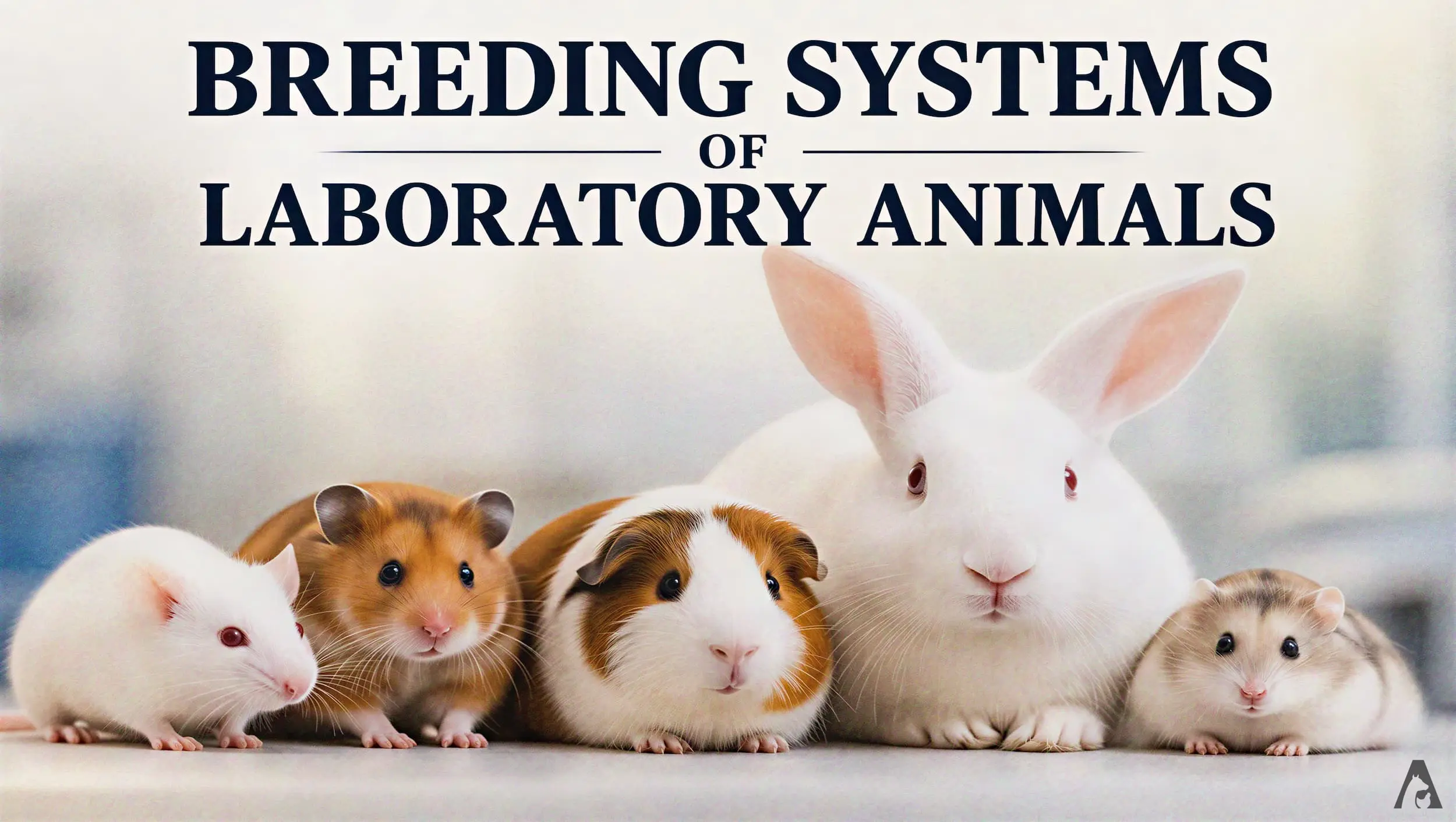
The outbred colony stock may be divided into blocks where males and females are rotated so that breeding between close relatives is avoided.
| Species | Permanently Mated | Temporarily Mated | ||
|---|---|---|---|---|
| Monogamy | Polygamy | Harem | Hand Mated | |
| Mouse | + | + | − | − |
| Chinese hamster | + | + | − | + |
| Syrian hamster | + | − | + | + |
| Guinea pig | − | + | + | − |
| Rabbit | − | − | − | + |
| Ferret | − | − | + | − |
| Cat | − | − | + | + |
| Dog | − | − | − | + |
| Rhesus macaque | − | − | − | + |
| Baboon | − | − | − | + |
| Chicken | − | − | + | − |
Breeding System for Mice
Breeding systems include random mating, i.e., mating in which a female mouse has an equal probability of mating with any one of the available male mice. Random breeding is impractical because of the time required. Inbred strains are usually maintained by brother-to-sister mating or younger-parent-to-offspring mating.
Breeding System for Guinea Pigs
The most common breeding system, and the one that probably gives the highest output per unit area, is to mate the animals in polygamous groups of one boar and 4-20 sows. Once the groups have been set up, they are left together for the whole of their economic breeding life, which is usually about 18 months. Group size depends largely on the available facilities, but the optimum is probably about 12 sows to 1 boar.
Breeding System for Hamsters
Monogamous
Monogamous pairing is the most satisfactory method of breeding Syrian hamsters. If paired at weaning, they are entirely compatible and produce very good results.
Hand Mating
It is also a successful method, although extremely labor-intensive. For large-scale production, this method is inefficient and outdated. The hamsters are mated soon after dark, when they are naturally most active.
The usual procedure is to place the female in the cage of the stud male and observe the animals to see whether mating occurs. If the female is in heat, she will exhibit lordosis, and mating will occur almost immediately. If the male and female start fighting, they should be separated immediately.
Harem Mating
This method has also been successfully used for breeding but, like hand mating, has the similar disadvantage of being labor-intensive.
The usual procedure with Syrian hamsters is to group one to four males with a large number of females and to separate the females prior to parturition.
Breeding System for Rabbits
Selection of Breeding Stock
- A selected doe should have 8 functional teats so that she can easily feed 8 young.
- She should be in good physical condition and good health and should not be obese.
- The best time to select breeding does is when they are 6-7 months old and weigh about 2.5 to 3 kg.
- Proper selection of breeding bucks is very important because each buck will mate with many does and pass on his good characteristics to the progeny.
- The bucks should be selected based on their breeding records and pedigrees.
- The selected buck should have two well-developed testicles.
- He should be in good physical condition and good health, have a good growth record, and should not be obese or lethargic but rather virile and active.
Reproduction Data
- Male-Female Ratio: 1:10
- Age at First Mating: small breeds, 4 months; medium breeds, 5-6 months; large breeds, 7-8 months
- Estrous Cycle: A female rabbit appears to have no definite estrous cycle
- Signs of Heat:
- Restlessness and rubbing the chin on the side of the cage
- Lying in the mating posture and lifting the tail
- Congested, purple, and moist vulva
Mating
- The doe is always taken to the buck’s cage for mating, and if the doe is fully sexually receptive, she will lift her tail (lordosis), and the buck will mate within a minute.
- Mating is considered successful when the buck falls to one side or backward from the doe after mating, accompanied by a characteristic vocalization.