CONTENT
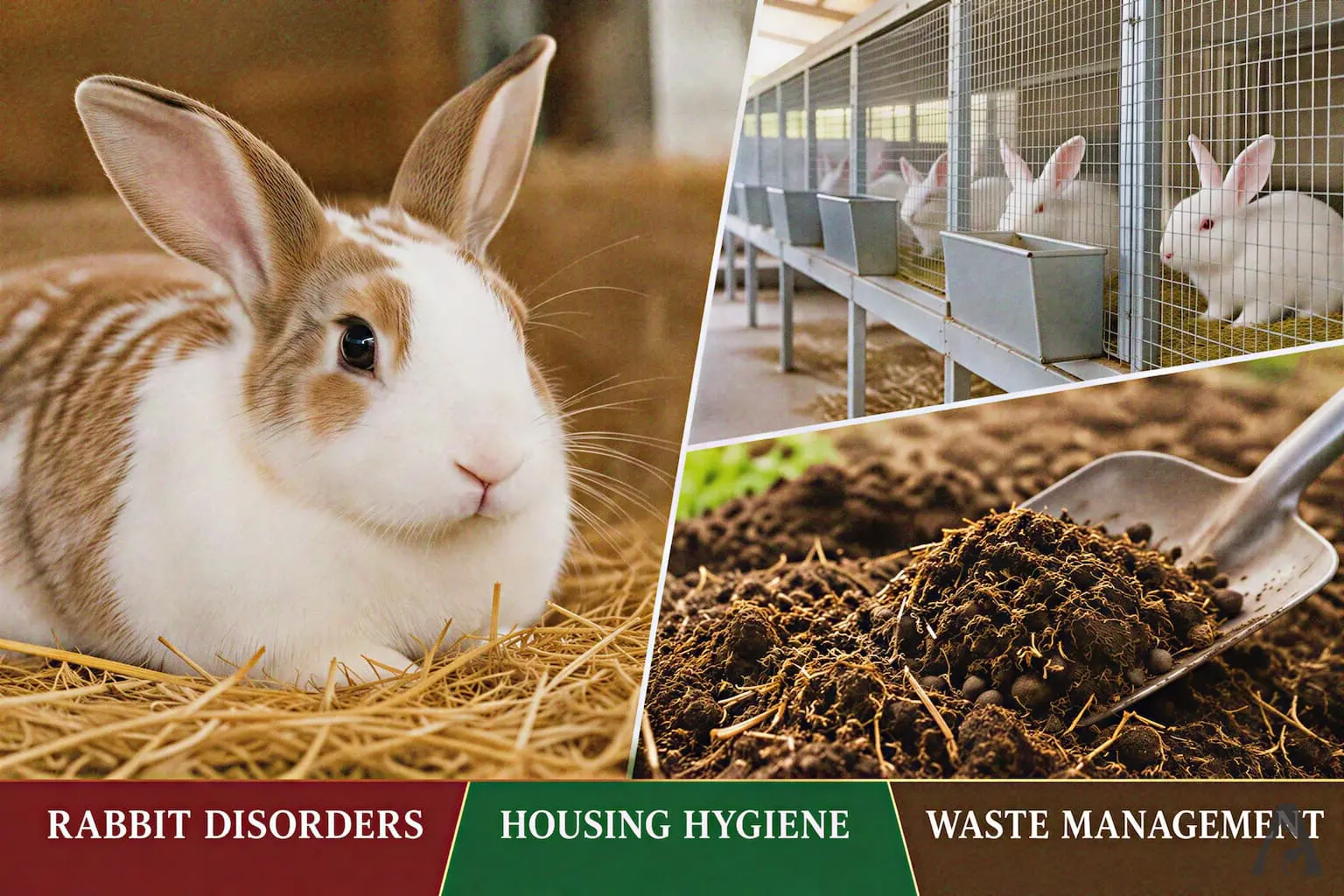
Rabbit Disorders, Housing Hygiene and Waste Management
Proper rabbit health and farm management involve the prevention and control of common disorders, maintenance of hygienic housing, and effective waste management.
This article covers miscellaneous disorders and conditions affecting rabbits, essential hygiene practices for rabbit housing, and the disposal and utilization of rabbit manure.
Miscellaneous Disorder and Conditions
- Bites, injuries, and wounds due to fighting among animals
- Congestion of the mammary glands or caked udder (due to the death of all the bunnies at an early stage)
- Desertion of young and cannibalism (first kindling, lack of maternal instinct, vitamin B deficiency, lack of water, or fear in the doe)
- Fractures
- Fur chewing (in young rabbits due to lack of light, boredom, fungal disease, mange, or magnesium and zinc deficiencies)
- Heat stroke due to high ambient temperature
- Overgrown nails
- Moist dermatitis (slobbers)
- Pododermatitis (sore hocks)
Hygiene of Rabbit Housing
Hygiene of rabbit housing can be maintained by:
- Rabbit housing should be located away from noise and dust.
- A rat-proof shelter is essential.
- Anything that cannot be easily cleaned and disinfected should not be allowed.
- Regular cleaning, disinfection, and drying of feeders and waterers are essential.
- In tropical countries, the building should buffer temperature variations.
- For easy cleaning, galvanized metal should be used for rabbit equipment.
- Humans are the most important permanent vectors of disease. A footbath is essential at the entrance. Before handling the animals, hands should be cleaned and disinfected.
- If the infection is severe, all animals should be culled, and the premises should be disinfected and left vacant for 1 to 2 weeks before introducing new rabbits.
- Boiled and cooled drinking water or disinfected/sterilized water should be provided to all animals, particularly young and growing animals.
Disposal and Utilization of Rabbit Waste
The amount of manure produced on any rabbit farm will depend on a number of factors, such as breed, ration fed, amount of bedding used, and so on. A bulky ration will produce more manure than a concentrated ration.
The weight of rabbit manure varies between about 450 and 640 kg per cubic meter, and a large-breed doe with young would produce about 0.34 cubic meter of manure throughout the year, that is, between 150 and 200 kg. On a dry matter basis, the manure contains approximately 2.7% nitrogen, 1.5% phosphoric acid, and 1% potash.