CONTENT
Angora Rabbit Wool Production: Harvesting, Quality and Composition
Angora rabbits are valued for their distinctive fleece, which possesses desirable characteristics such as lightness, softness, and fineness. The properties and commercial value of the fleece are influenced by how it is collected, handled, graded, and stored.
Understanding these aspects is important for maintaining fiber quality and ensuring efficient utilization in textile applications.
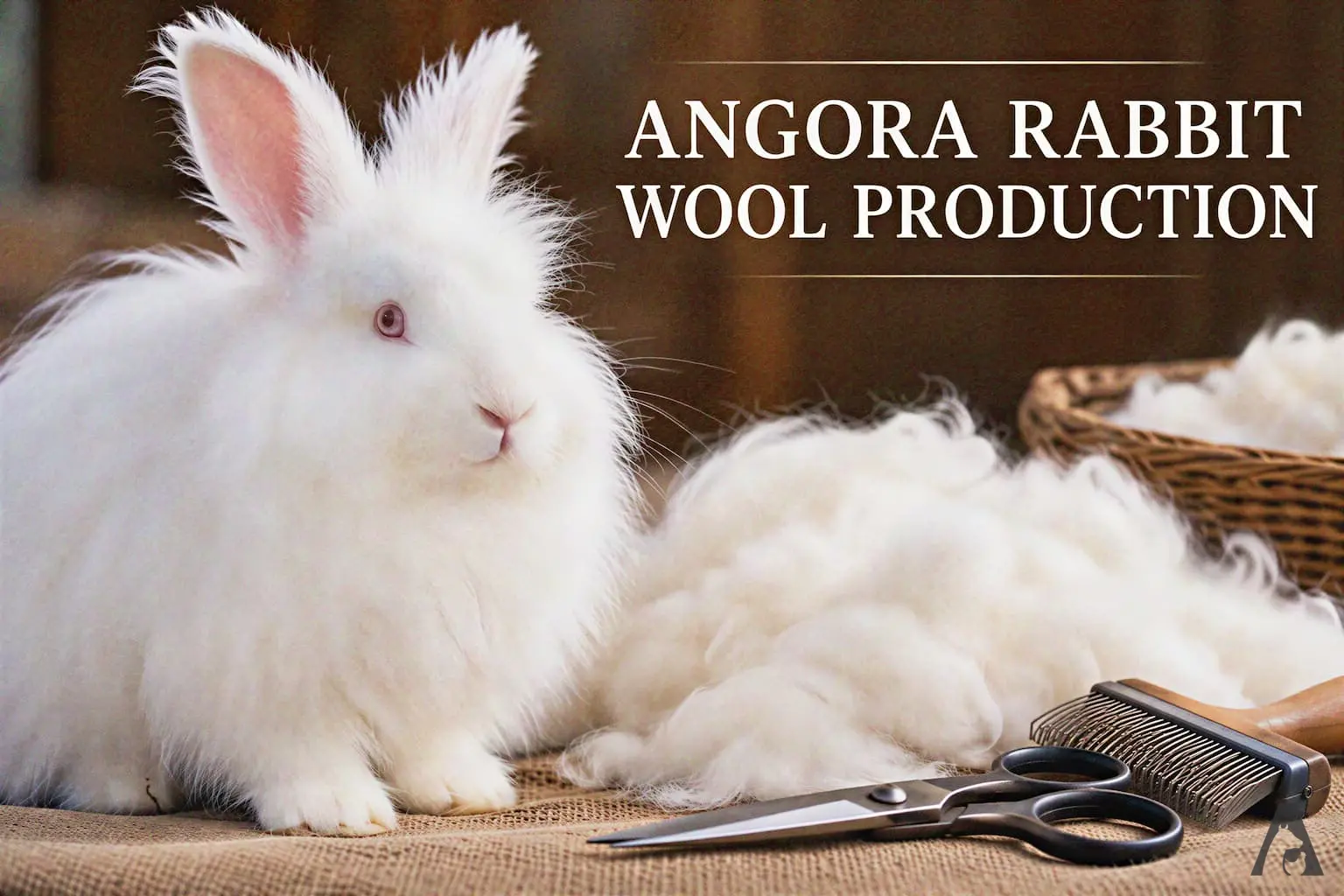
Angora wool is a specialty animal fiber produced by Angora rabbits. Other specialty fibers are:
- Lamb wool produced by sheep;
- Mohair produced by Angora goats;
- Cashmere/pashmina produced by Pashmina goats;
- Camel wool produced by camels; and
- Alpaca, llama, and vicuña wool produced by alpacas, llamas, and vicuñas.
These specialty fibers have great economic value and are used in the wool industry either as pure fibers or in various blends for the manufacture of specialty fabrics and yarns.
Harvesting of Wool
Harvesting of wool is done mainly by shearing or plucking methods, but there are some other methods, as mentioned below, which are not currently practiced.
Depilation
The depilation method of removing wool from the skin of the rabbit involves the use of depilatory agents, either by local application or through injections, which cause the shedding of wool. This technique is not currently practiced.
Plucking
The plucking method of wool harvesting is mainly adopted in China. In this method, small tufts of wool at the hair tips are pulled out using the thumb and the second finger. Plucking is done 4–6 times a year, depending on loosening and molting.
The length of the wool fiber is longest with this method. However, this method is somewhat painful to the animals and takes longer than other methods. That is why this method of wool harvesting is limited to a few countries.
Combing
The combing method of wool harvesting is mostly followed in France, where it is called “Epilation.” It is accomplished by using a short-handled, comb-like implement that helps the operator remove patches of wool.
This process is done by securing the animal on a table with 2–4 tight straps. It is considerably more labor-intensive and time-consuming. This process is also painful and sometimes causes wounds to the skin.
Shearing
This method of wool harvesting is commonly preferred in most countries, including India. The wool matures at approximately 14 weeks, but shearing takes place at intervals of 12–13 weeks.
In some cases, shearing is done 5 times a year. This may produce wool of shorter length but a greater yield per year.
Wool shearing is commonly done using ordinary barber’s hair-cutting scissors. In this method, the animal is handled by the operator with the left hand, and the wool is clipped with the right hand. First, the wool from the back, shoulders, rump, and neck is removed, followed by the wool from the belly, legs, forehead, and ears.
The operator should secure the rabbit correctly and use the scissors properly to avoid cuts to the skin. Care should be taken to avoid cuts to the teats and scrotum. Some wool should be left on the skin, depending on weather conditions, to provide thermoregulatory protection during inclement weather.
On large commercial Angora farms and in research organizations, wool shearing is done using electric shearing machines. In this technique, the rabbit to be shorn is secured on a table. The animal is held with the left hand, and the machine is operated with the right hand.
First, the wool is clipped from the back and shoulders and then from the face, neck, and legs. Lastly, the wool is sheared from the belly, tail, and around the genitalia. One adult Angora can be clipped within 8–10 minutes using this technique. However, the operator should be skilled and experienced.
Machine shearing is a convenient method, as it is quick and does not cause cuts or wounds to the rabbit. Adjusting the blades and cutters to leave 2–3 mm of wool unshorn helps protect the Angora rabbit from the cold.
The clipped wool should be uniform. However, care should be taken to ensure that the teats of the female and the scrotum/testicles of the male are not cut or wounded due to carelessness by the shearer. The main advantages/disadvantages of electric machine shearing are given below:
- No trouble or pressure on the rabbit, allowing shearing without pain to the animal.
- The rabbit can be protected from cold and hot weather by adjusting the length of wool left unclipped.
- Saves time and labor through electric machine shearing.
- Produces fibers of uniform and equal length during clipping.
- Convenient at the time of grading.
Shearing Room and Storage
It must be ensured that any vegetable matter, burrs, and other foreign matter are removed from the body of the Angora rabbit before shearing. Angora wool, being a very light material, can be blown away by the slightest breeze. To prevent this, there should be a separate room set aside solely for the purpose of shearing. The room should be free from drafts but have adequate lighting and ventilation. It should be protected from rodents and have adequate storage space for the wool after shearing.
After grading, the wool should be stored in airy wool bins, preferably made of wood and wire mesh with lids. The packing and transportation of wool from the farm to the marketplace should be done in suitable plastic bags. A perforated container containing naphthalene balls should be placed in each bag to protect the wool from insect/moth attack.
Angora Wool Quality and Composition
There is no animal fiber that has the same lightness, softness, and purity of fleece as Angora wool. The weight of Angora wool is 1.1 g per cubic centimeter, whereas Merino sheep wool weighs approximately 1.3 g per cubic centimeter.
In textile terminology, fineness can be expressed in terms of the Tex number, which is 7 Tex for Angora wool, meaning that it is possible to spin 1,000 meters of yarn from 7 g of Angora wool. The Tex number of fine Merino wool would be around 20 under core spinning.
The softness of Angora wool is produced by the extreme smoothness of the cuticle, which confers fluffiness to other fibers when blended with them. Fiber length, fiber diameter, and the proportion of guard hair are the main characteristics determining the quality of wool.
Angora wool comprises woolly fibers and guard hairs. The guard hairs are of different lengths and thicknesses. The guard hairs may be classified into two types—the finer type has a uniserial medulla of a ladder shape, whereas the coarser type has one or two medullary rows at the base and becomes multiserial at the middle or sheath portion, which has the largest diameter. The thickness is greater toward the head than at the tail.
The composition of different Angora fleeces is as follows:
| Type | Average length (cm) | Average diameter (µ) | Percentage in fleece | |
|---|---|---|---|---|
| Head | Tail | |||
| Guard hairs | 12–13 | 90–100 | 60 | 0–2 |
| Guard hairs | 10–11 | 80–90 | 50–60 | 4 |
| Wool hairs | 8–9 | 60–80 | 16–30 | 15–20 |
| Wool | 6–7 | 15–25 | 10–15 | 70–25 |
All Angora rabbit hairs are medullated and ladder-shaped. This medullation can be seen under a projection microscope as black streaks, which may be uniform or of different lengths.
Crimping in the wool is also an important characteristic and is measured as the crimping ratio. This indicates the number of crimps per cm. The greater the number of crimps, the better the wool, with other characteristics being equal. The best strains of German Angoras probably have the highest ratio, averaging 7, compared with 6 for French Angoras and 5 for British Angoras.