CONTENT
Poultry Waste Disposal and Value-Added Management Methods
Poultry production and hatchery operations generate substantial quantities of organic residues that require appropriate handling to minimize environmental impacts and disposal costs. Rather than treating these materials solely as waste, effective management can recover useful resources and contribute to more sustainable poultry production. Appropriate processing also helps improve waste handling, reduce potential pollution, and create opportunities for beneficial use within agricultural and other industries.
Eggshells and their membranes hold distinct potential as a nutrient- and protein-rich resource in various markets. It makes good economic and environmental sense to take advantage of these qualities.
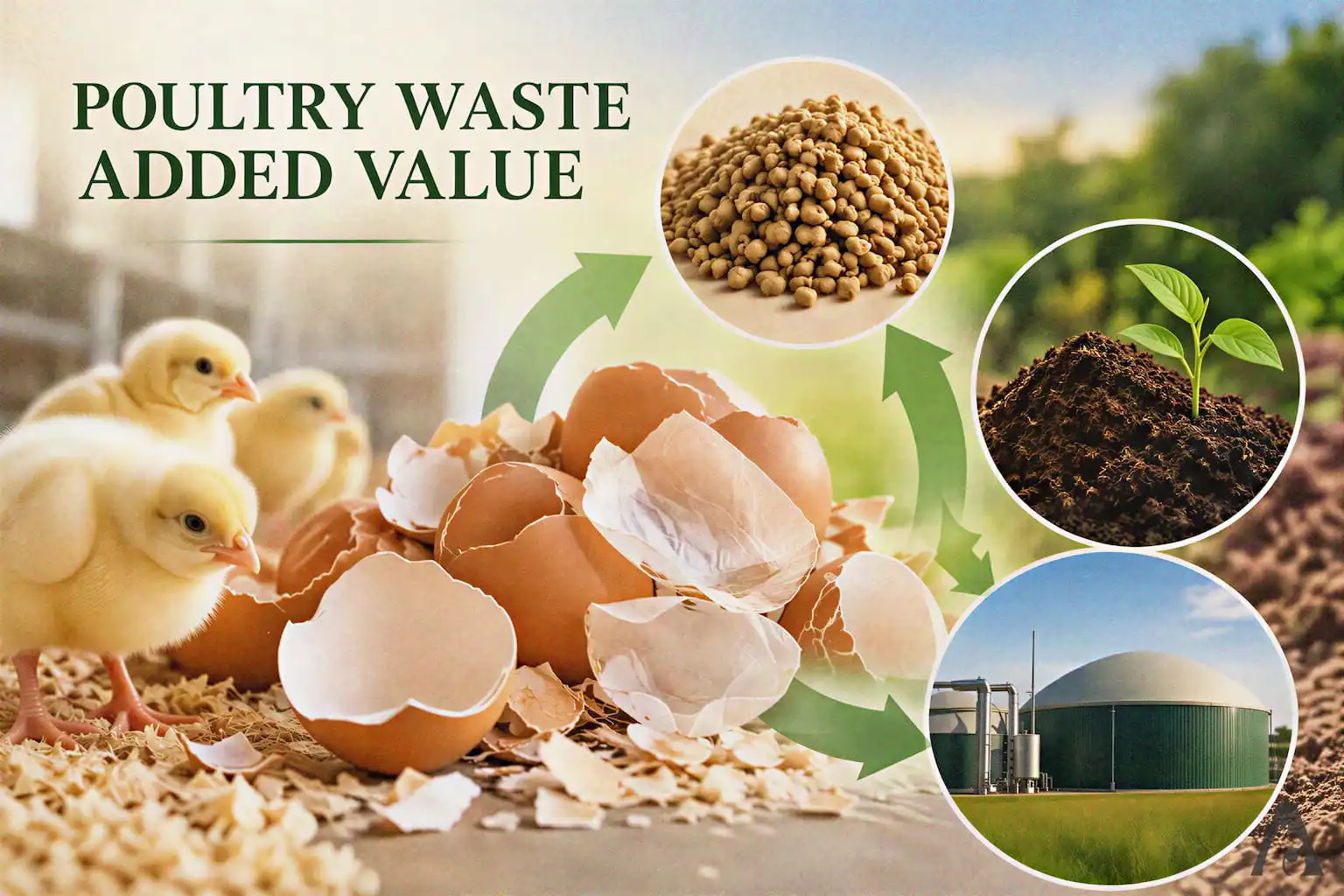
The eggshell membrane contains 10% collagen, which has a high market value in medicine (from skin grafts to dental work, plastic surgery, and osteoporosis treatment) as well as in food processing, biodegradable plastics, and environmental cleanup. Eggshells can also be ground into a powder and used in calcium supplements.
General solid waste can be recovered as value-added products through composting, rendering, and anaerobic digestion. These options are expanded upon below. It is worth noting that many countries have regulations for processing animal by-products. Be sure to check local requirements or ship hatchery waste to an appropriate government-approved facility. Registered operators are listed by sector on the European Commission website for both EU and non-EU countries.
1. Rendering into Animal Feed
One option for recycling hatchery waste is to send it to a feed processing plant. To produce a protein-, fat-, and nutrient-rich animal feed that is also safe, hatchery by-product meal must have a pathogen-free status. This is possible through autoclaving or extrusion followed by temperature disinfection and drying, or pressure boiling and drying. Waste must also be heat-treated to inactivate a protein called avidin found in egg whites (responsible for eye, locomotor, and reproductive problems).
Hatcheries sending their waste for livestock feed processing must keep their waste in an acidic or low-pH environment. On-site ensiling with formic and propionic acids produces an acidic environment, slows spoilage, and supports the growth of beneficial lactic acid bacteria.
2. Composting
Composting is a well-known option for converting biodegradable hatchery material into a nutrient-rich, pathogen-free resource. Many stakeholders in the poultry chain can benefit from combining industry wastes at composting facilities. Soiled poultry litter, as well as sawdust, yard trimmings, biochar, etc., reduces moisture and pathogen load and enhances micronutrient content.
Composting facilities use either a batch or continuous system, depending on how often input materials are received. Batch systems accept material at set intervals throughout the year, while continuous systems accept a set volume of material daily.
Poultry litter is more commonly associated with batch composting due to all-in, all-out flock cycles, whereas hatchery waste is removed multiple times per week and is more suitable for continuous composting. By combining forces, hatcheries and poultry growers could support a continuous composting system. It takes about eight weeks to generate compost fit for field application, but further curing would improve compost stability for soil amendment and fertilizer use.
In general, on-site in-vessel composters have a quicker turnaround time. “DiCom” is a new composting vessel that converts solid waste into biogas and stable compost for agricultural application. Finished compost can be used internally, donated, or sold. The retail price of compost depends on its quality, consistency, and market demand.
It may cost less to build and operate a poultry litter and eggshell composting facility than to send waste to disposal sites. Estimates show that it costs less per ton to compost in small- or large-scale systems, accounting for all initial, fixed, and variable costs (land, machinery, labor, materials, etc.), than to pay disposal fees.
3. Anaerobic Digestion
For large-scale hatcheries, an on-site anaerobic digester system efficiently produces methane-rich biogas, which can be used for in-house power generation, as well as biosolids, which can be sold as a high-quality fertilizer. The process of anaerobic digestion eliminates pathogens and is already established for treating human effluent and slaughter plant waste.
Anaerobic digestion is suitable for any biodegradable waste; indeed, anaerobic co-digestion using mixed livestock sources (swine, poultry, cattle, and dairy waste by-products) increases nutrient balance and treatment efficiency, making it ideal for agricultural zones. Loading rates, nutrient ratios, internal temperature, and pH need to be managed for optimal performance, quality control, and safety.