CONTENT
Organic Chicken Meat Standards, Housing, Feeding & Health
Organic chicken meat production follows defined standards for housing, stocking density, outdoor access, feeding, health management, transportation, and slaughter age. These standards are designed to support poultry welfare, product quality, and sustainable production practices while maintaining traceability throughout the production system.
*ADVERTISEMENT*
Contact hello@mkvisuals.org to advertise here
Requirements may vary among countries and certification systems.
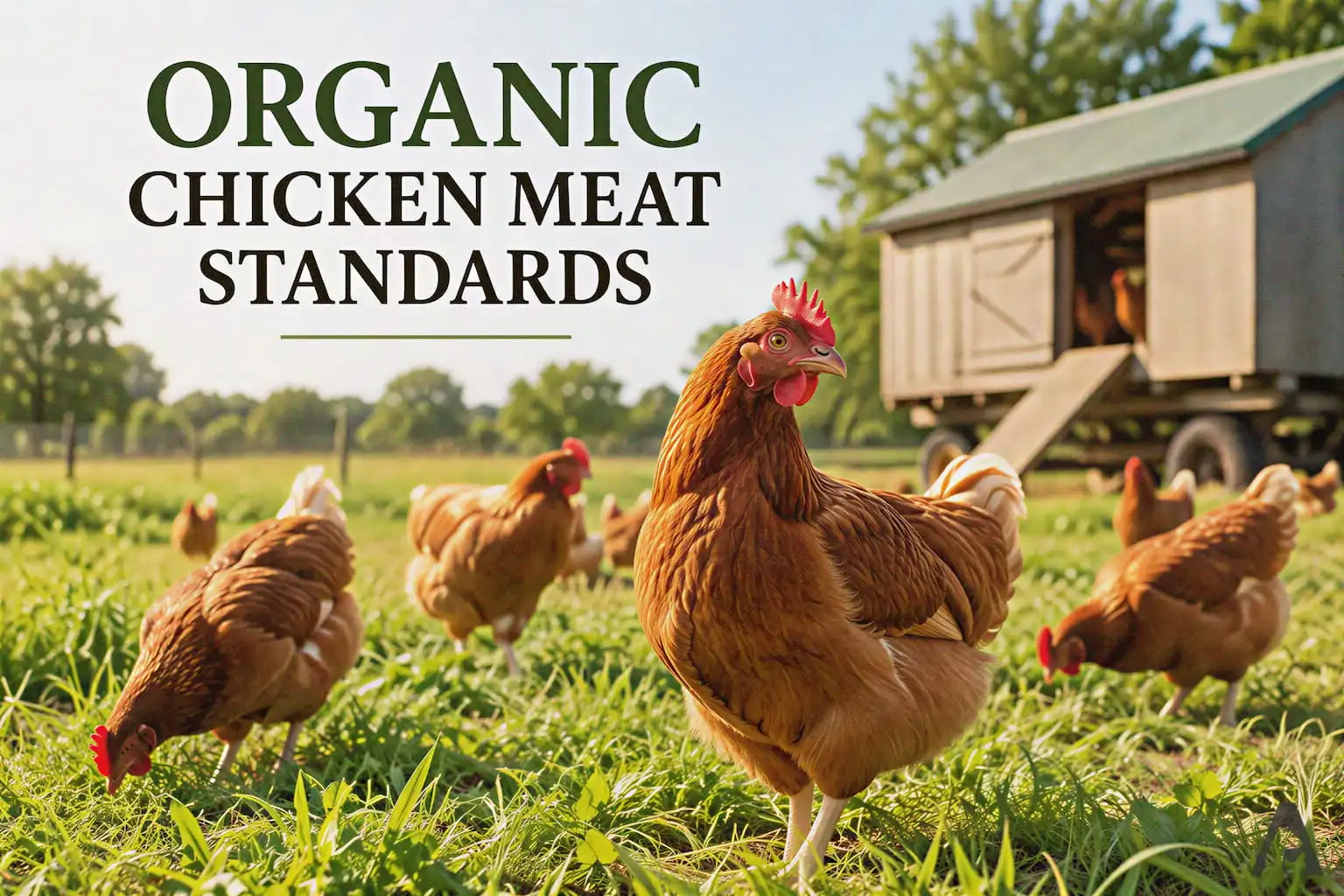
This article outlines important standards and practices associated with organic chicken meat and egg production, including free-range management, feeding principles, health planning, and the French Label Rouge system.
- Reared in movable housing
- Stocking rate of 833 birds per hectare
- Birds selected for slow growth potential and higher age at slaughter
- Large, shaded open spaces and controlled flock sizes.
- Feed contains 75% cereal content, and the remaining 25% is composed of vegetable-based protein.
House
- In France, the maximum size of a house is 400 m², with range areas on both sides.
- In the U.K., wooden houses measuring 2 m × 5 m × 1.5 m in height are placed on skids and moved by tractor.
- The density requirement in France is 11 birds/m²; the maximum threshold for broilers in mobile housing is 16 birds or 30 kg/m².
- Slaughter age – minimum 81 days
- Minimum free range – 2 m²/bird; under EU standards, it is 2.5 m² per bird.
- Birds must not be transported for more than 100 km or 2 hours by road.
Feeding for Organic Egg/Meat Production
There are two regulations within the legislation that need to be considered.
- Feed is intended to ensure quality production rather than maximizing production.
- Disease prevention involves the use of high-quality feed, together with regular exercise and access to pasturage, which encourages the natural immunological defense of the animal.
- The ingredients must be clear and traceable.
Health
- Generally, it is accepted that mortality rates are likely to be higher in birds kept under free-range conditions.
- The estimated mortality rate is 10% for organic table birds.
- The development of an animal health plan is an essential part of any organic farming system.
- It takes into account all aspects of the individual, including stress, general well-being, as well as physical symptoms.
Label Rouge
- Label Rouge traditional free-range poultry is found in France.
- The Label Rouge system has a unique label on the finished product.
- Each bird carries a label that serves as its individual “identity card.”
- A detailed summary of the bird’s history on the label offers the consumer total reassurance with respect to the quality and safety of the product.
*ADVERTISEMENT*
Contact hello@mkvisuals.org to advertise here