CONTENT
Poultry Manure as Organic Fertilizer: Nutrient Management
Poultry manure and litter contain substantial amounts of plant nutrients, particularly nitrogen and phosphorus, making them important resources in integrated crop and poultry production systems. However, their value depends on how effectively these nutrients are conserved and utilized.
Understanding nutrient cycling, manure handling, land application, and dietary strategies is essential for improving nutrient utilization and limiting environmental losses. These factors play an important role in developing sustainable manure management practices in poultry production.
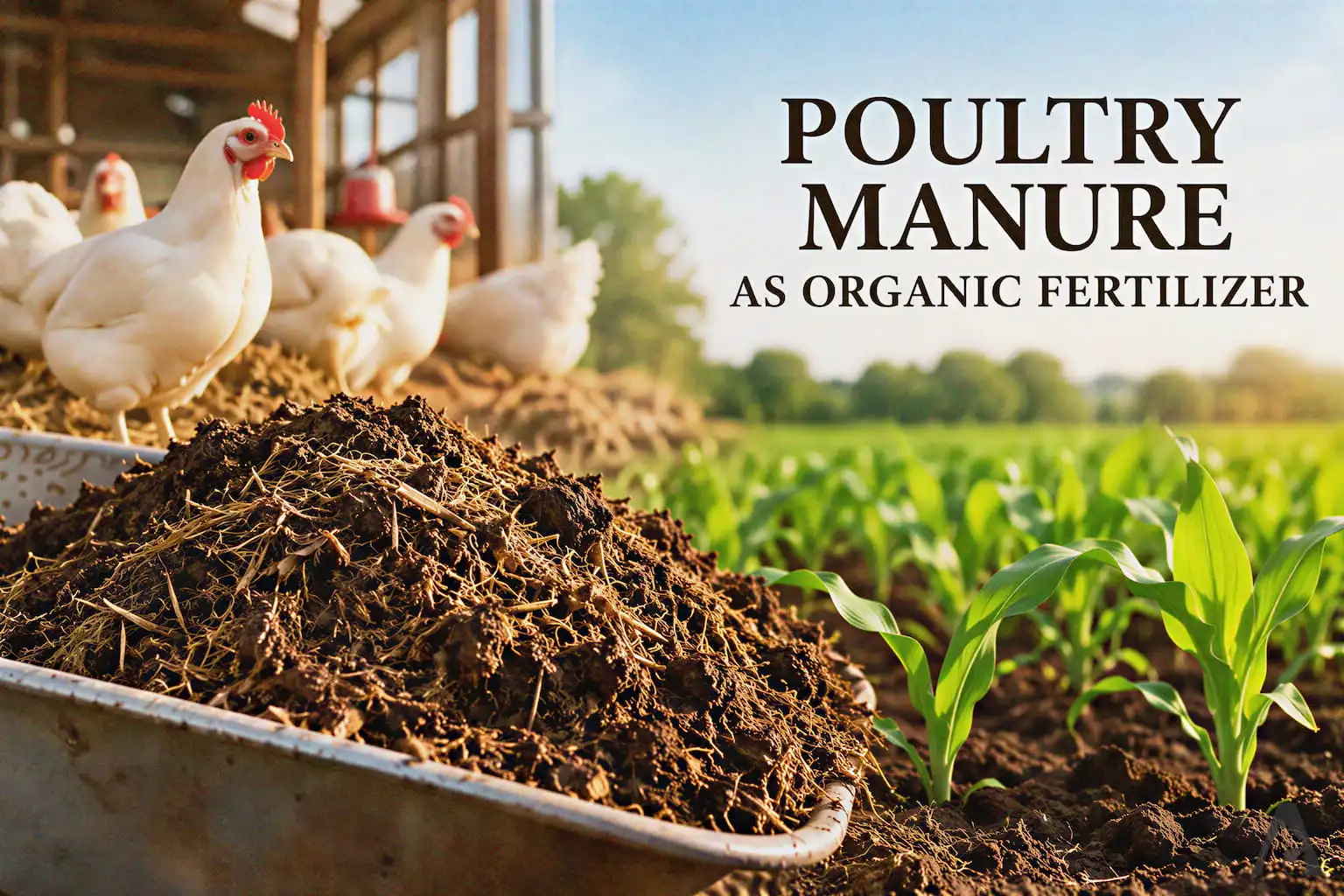
Particular areas of concern to poultry and egg producers include confined poultry feeding operations and nutrient management for manure, litter, and soil (water). Studies have shown that poultry manure and litter can compete economically with commercially available fertilizers if properly used and if transportation costs are not too great.
Nutrient Cycling in Poultry Production
Nutrients enter the poultry farm in the feed. These nutrients then pass from the bird into the manure and from the manure into the soil. Food sources such as plants grow in the soil and obtain their nutrients from the soil. These plants are then consumed as feed, and the cycle is repeated.
The cycle occurs because only portions of the nutrients are digested by poultry, with the remainder of the undigested nutrients passing into the manure. Because poultry operations are frequently concentrated in localized areas, the amounts of nitrogen (N) and phosphorus (P) generated in the litter and manure often exceed the fertilizer requirements for crop production on adjacent farms.
When the continual application of poultry manure and litter exceeds the nutrient requirements of the crops, enrichment of nitrates in groundwater and phosphorus in surface water can occur. There has also been some disagreement as to what represents an acceptable content of phosphorus in the soil.
Management and Application of Poultry Manure
With proper management and controlled transportation costs, poultry manure and litter can be sold and used as fertilizers, feed, or sources of energy. However, if proper procedures are not followed for managing the litter or manure after their removal from the chicken house, valuable nutrients can be lost.
Methods such as stockpiling uncovered manure during the winter season for application to cropland in the spring can result in up to a fivefold reduction in the nitrogen content of the manure.
When poultry litter and manure are applied to the soil surface, about half of the nitrogen and other components are available for plants to use. Excess phosphorus presents a special problem because, as a result of its low solubility, it tends to be immobile in the soil. Consequently, it does not leach but adheres to soil particles, contaminates surface water, and contributes to water pollution through soil erosion.
Poultry growers frequently do not appreciate the large amounts of nitrogen being applied to the soil when spreading manure and take little or no account of its nutrient content when planning application rates of manure, litter, and subsequent inorganic fertilizers.
A key to successful waste management is good nutrient management, which takes into account the nutrients present in poultry diets, excreted nutrients, and the loss of nutrients during storage, transportation, and application to the land, as well as the use of the nutrients by plants.
Dietary Strategies to Reduce Nutrient Excretion
The nutrient content of poultry diets should also be analyzed whenever poultry feed formulations are developed. The primary function of dietary protein is to supply the amino acids required by the bird for structural and functional purposes. A large part of the nitrogen loss is a consequence of an imbalance in the amino acid makeup of the dietary protein or of inefficiencies in digestion and absorption. It therefore follows that the excretion of nitrogen in the feces and urine can be influenced by dietary manipulation.
The use of synthetic amino acids and the application of ideal protein and digestible amino acid concepts could reduce dietary protein concentrations, nitrogen excretion by poultry, and ammonia production from their manure.
Phosphorus is one of the mineral elements that constitute the inorganic part of plant and animal tissues. It is essential for the formation and maintenance of bones and exists in both organic and inorganic forms. Significant amounts of phosphorus are present in cereal grains and vegetable proteins; 50–80 percent of phosphorus is stored in plant feed sources as phytin or phytic acid and is largely unavailable to monogastric animals.
Phytase is an enzyme that assists in increasing the available phosphorus content of plant sources and decreases the need for supplemental dietary phosphorus. This, in turn, leads to a reduction in phosphorus excretion. Feeding enzymes such as carbohydrases, lipases, and proteases can also modify feed ingredients by improving dietary nutritive value and thereby reducing manure production.