CONTENT
Structure of Chicken Egg: Parts and Composition
A chicken egg is a complex biological structure composed of the yolk, albumen, shell membranes, and eggshell, with each component having distinct structural and functional characteristics.
Understanding the structure and composition of chicken eggs is important in poultry science for evaluating egg quality, nutritional value, embryonic development, storage, and handling.
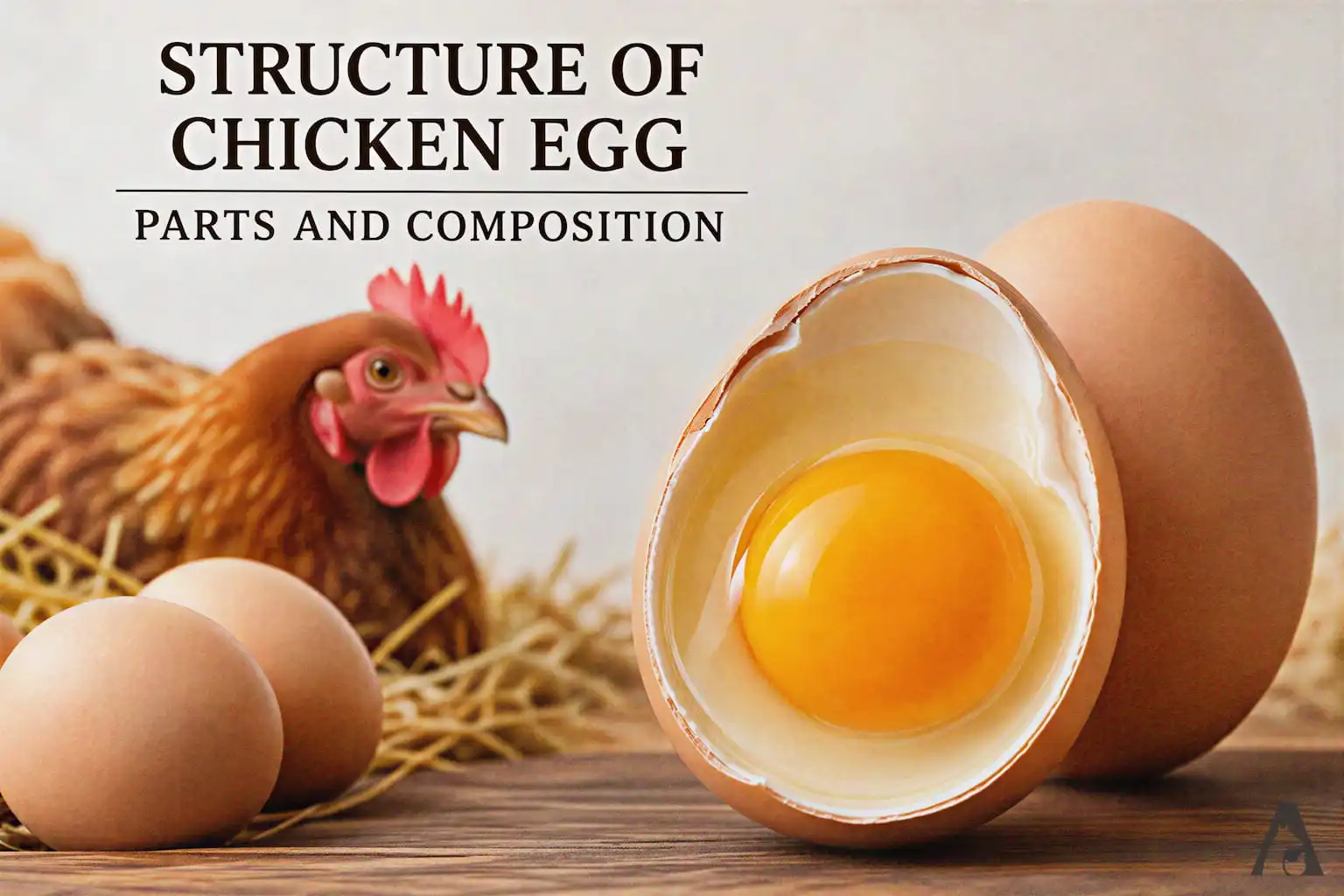
An egg consists of 4 major parts, namely:
- Yolk
- Albumen
- Shell membranes
- Shell
1. Yolk
The yolk layer consists of:
- Concentric layers of dark and light yolk composition.
- Latebra is the center of the yolk, which is a small, nearly circular core of light-colored fluid that does not completely harden on boiling.
- The neck of the latebra is a thin column of light-colored material connecting the latebra to the nucleus of Pander and the germinal disc. The nucleus of Pander is a cup-shaped structure, which is an extension of the neck of the latebra, connecting to the base of the germinal disc.
- The “germinal disc” or “germ spot” is the reproductive nucleus. It is a light-colored spot located on the surface of the yolk, just under the vitelline membrane. In an infertile egg, it is unicellular (ovum) and contains a haploid number of chromosomes, called “Blastodisc.” It is circular in shape, with a diameter of about 3.5 mm and with vacuoles in it. Whereas in a fertile egg, it is a multicellular structure having a diploid number of chromosomes, called “Blastoderm.” It is oval in shape, with an average diameter of about 4.5 mm and with no vacuoles in it.
- The “Vitelline membrane” is a semi-permeable elastic membrane surrounding the yolk and separating the yolk material from the albumen.
2. Albumen
The albumen consists of 4 layers, namely:
- Chalaziferous or inner thick white, which forms 3% of the total albumen;
- Inner thin albumen – 17% of the total albumen;
- Outer thick, firm, or dense albumen – 57% of the total albumen; and
- Outer thin albumen – 23% of the total albumen.
The chalaziferous layer is very close to the yolk, immediately surrounding the vitelline membrane of the yolk. This is very firm (thick) albumen. It twists into two cords on either side of the yolk called chalazae, which are formed due to the rotational movement of the egg in the oviduct.
Functions of Chalaza
- Chalazae hold the yolk firmly in its central position and thus serve as an anchor for the yolk.
- The chalazae are believed to contain a protein called lysozyme, which possesses antimicrobial properties and helps to prevent microbial spoilage of the egg. Aging, improper storage, and microbial spoilage make thick albumen watery.
3. Shell Membrane
The shell membrane consists of an air cell, outer shell membrane, and inner shell membrane. The inner and outer shell membranes measure 40-70 µ and 10-20 µ in thickness, respectively, and the air cell is situated between the two membranes, usually at the broader end, as a result of contraction of the egg contents soon after oviposition due to differences in the temperatures to which the egg is exposed before and after oviposition.
The outer shell membrane is attached firmly to the shell by numerous cones on the shell surface extending into the membrane. It has only 3 layers, which are parallel to the shell and at right angles to each other. The inner shell membrane closely surrounds the albumen.
4. Egg Shell
The egg shell consists of the outermost cuticle, spongy or calcareous layer, mammillary layer or matrix, and pores. The pores are funnel-shaped, distributed at right angles to the shell surface, and form connecting passages between the shell membrane and cuticle.
The average number of pores is about 8,000 per egg, which are distributed unevenly over the shell surface, with a greater number of pores toward the broad end than at the narrow end.
Physical and Chemical Composition of Chicken Egg
Egg is the most nutritious, natural, unadulterated, and easily digestible food on earth, with the highest biological value, chemical score, net protein value, and net protein utilization. The physical and chemical composition of egg, as well as its nutritional value, are as follows.
| Part | % of Egg |
|---|---|
| (a) Shell | 10.5 |
| (b) Shell membranes | 0.5 |
| (c) Albumen | 58.0 |
| (d) Yolk | 31.0 |
| Total | 100.0 |