CONTENT
Improve Reproductive Performance in Dairy Cattle: 7 Key Management Factors
Improving reproductive performance in dairy cattle is essential for maintaining profitable and efficient dairy operations. Reproductive efficiency directly affects milk production, replacement rates, herd productivity, and overall farm profitability. Poor fertility can lead to prolonged calving intervals, increased insemination costs, reduced lifetime productivity, and higher culling rates.
Fertility is a factor that has a great effect on the economics of dairy farming. Fertility is, to a large extent, influenced by management. This means that the individual dairy farmer or herd manager plays a very important role in fertility control. In order to achieve the best possible reproductive results, sound management skills are required.
A useful parameter for determining the quality of reproductive management should include all important fertility characteristics. The parameter used in this manual for this purpose is the “calving interval.” The calving interval is the period between one calving and the next.
Important fertility aspects, such as the pregnancy rate after the first insemination, the number of inseminations per conception, and the number of days from calving to conception, all influence the length of the calving interval. The calving interval itself does not explain which aspect of herd reproductive management needs improvement.
Improving Reproductive Performance
To improve the reproductive performance of the herd, one should consider all possible ways to achieve optimal results.
This may involve many different managerial factors, which are all interrelated. Seven of these factors are discussed below:
- Heat detection
- Inseminating at the right time
- Interval from calving to first insemination
- Repeat breeders
- Quality of inseminations
- Nutrition
- Hygiene
1. Heat Detection
Heat detection has a major influence on the length of the calving interval. An optimal calving interval can be achieved only if the herd manager maintains a healthy, properly fed herd in which each mating is carefully planned.
Planning starts months before the intended mating; therefore, it is very important to have a well-planned and properly executed heat detection program.
2. Inseminating at the Right Time
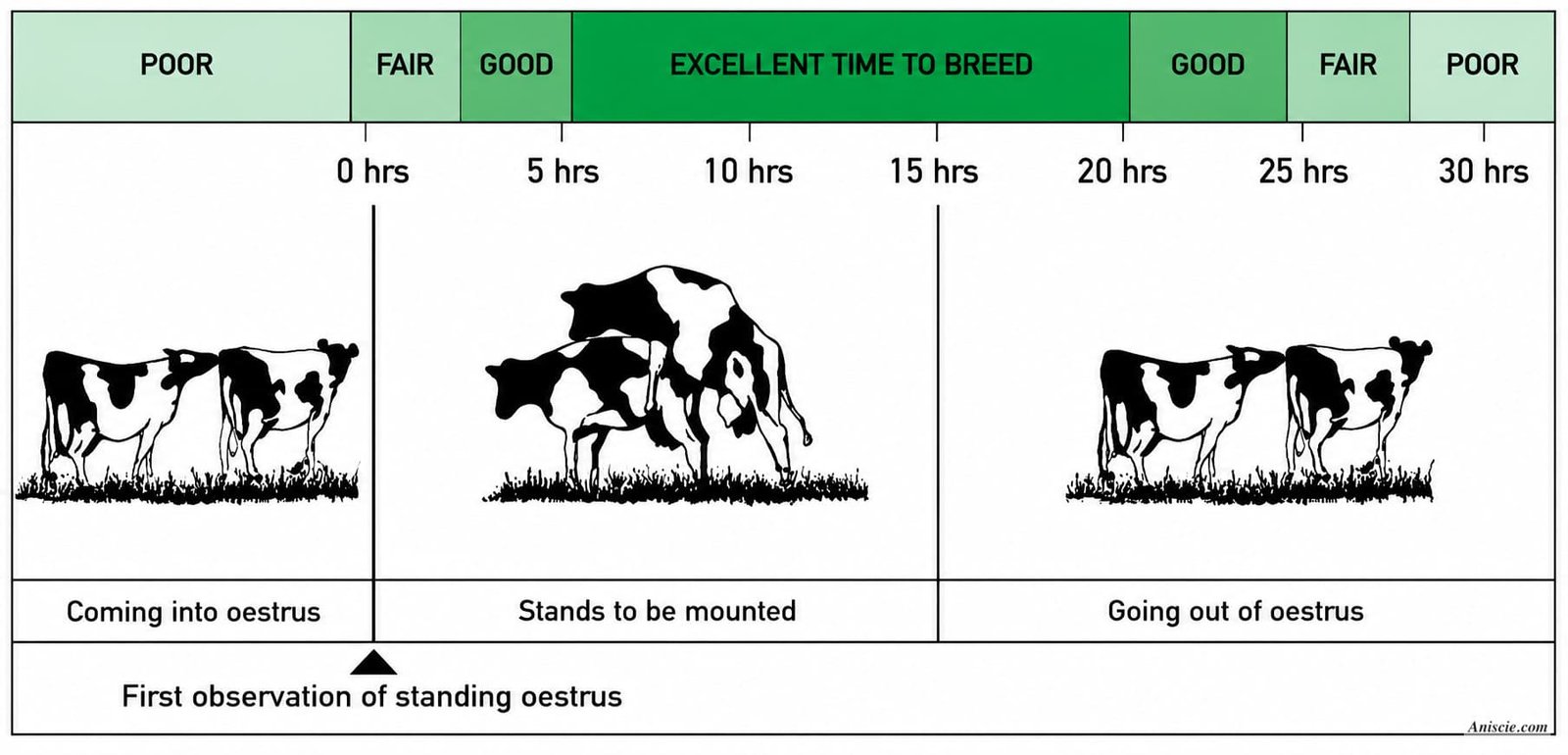
Inseminating a cow at the end of the standing heat period or at the start of the late heat period ensures the best results, as illustrated in the figure. Inseminating when the cow is still in early heat is ineffective. Where insemination is performed by an AI technician, all cows observed in heat in the morning should be inseminated later that day.
Cows that are still in heat the following morning should be re-inseminated. When heat is first observed in the afternoon or evening, insemination can safely be postponed until the next morning (AM-PM rule). Where farm staff perform inseminations, cows should be inseminated about 12 hours after they are first observed in heat.
3. Interval from Calving to First Insemination
Although advancing the date of first service after calving will also advance the average date of conception, it is not wise to inseminate cows as soon as possible after calving because all cows need time to restore body reserves during early lactation, and first-calf heifers require time to establish themselves in the herd before a new pregnancy is initiated.
- The conception rate will be very low.
- Calving intervals of less than 365 days are not advisable.
To achieve the best pregnancy results, a cow must be in excellent physical condition. This means that a cow must be fed according to her nutritional requirements and must not have any health problems.
In order to maintain an average calving interval of one year, the average cow should be pregnant 90 days after calving. Therefore, cows should generally be inseminated for the first time between 50 and 75 days after calving. This usually corresponds to the second or third heat after calving.
For high-yielding cows or cows with fertility problems, such as retained placenta or endometritis, it may be advisable to postpone the first insemination. Cows that do not show heat within about 60 days after calving should be examined by a veterinarian.
4. Repeat Breeders
Unfortunately, not all inseminations result in a successful pregnancy. Sometimes a cow does not conceive after several inseminations. It also happens that cows conceive successfully, but the embryo or fetus dies after conception.
The loss of a conception during the first 42 days of pregnancy is called embryonic death, while fetal death occurs between 43 and 151 days of pregnancy. After this period, it is referred to as an abortion. Embryonic loss can occur without any obvious visible signs.
It is very important that heat detection continues after a cow has been inseminated. Especially when no heat signs have been observed 3 weeks after insemination, one may assume that the cow is pregnant. However, this is not yet certain. Therefore, continued observation should take place at intervals of 3 and 6 weeks after insemination.
If the cow returns to heat (repeats), she should be inseminated again to avoid losing time and money.
Cows without any signs of heat should be pregnancy-tested by a veterinarian about 6–8 weeks after the last insemination in order to be certain that the cow is pregnant. This may prevent disappointments. If a cow is not pregnant after several inseminations, one should consider culling the cow. If there are multiple cows with such problems, it is advisable to consult a veterinarian.
The decision between giving a cow another chance or culling her because of reproductive problems should mainly depend on economic considerations; for example, the milk production and breeding value of the cow should be taken into account. Problem breeders can be identified early through accurate record-keeping.
5. Quality of Inseminations
The person performing the inseminations has a great influence on the pregnancy rate. The best results are generally obtained by an experienced AI technician.
In hot climates, where cows have a shorter heat period, AI services should be available throughout the day. Under these circumstances, owner insemination (do-it-yourself) often gives better results. However, proper training in AI techniques is essential to achieve optimal results.
Monitoring the individual results of technicians performing inseminations helps evaluate and improve pregnancy outcomes. In addition to the performance of the AI technician, semen quality also has a major influence on pregnancy rates. There is considerable variation in semen quality among different bulls. Furthermore, to achieve good pregnancy results, semen should be stored in a regularly tested storage tank.
6. Nutrition
Good nutrition means the provision of sufficient energy, protein, minerals, and vitamins. Providing a well-balanced ration not only results in increased milk production but also improves reproductive performance. In early lactation, when milk production is at its peak, it is very difficult to adjust daily dry matter intake to meet the nutrient requirements of the cow, especially a high-yielding cow.
A cow’s dry matter intake develops slowly during early lactation, and as a consequence, an energy deficit is common during this period. This deficiency can be compensated for by mobilizing body reserves, primarily fat and a small amount of protein. Therefore, it is important for the cow to receive the required level of nutrition during the preceding lactation and dry period.
Cows that are excessively fat at calving are more likely to experience calving problems and develop insufficient dry matter intake during early lactation compared with cows that calve in appropriate body condition.
If the diet of cows does not contain sufficient green forage or contains a high level of by-product feeds, deficiencies of vitamin A, phosphorus, copper, cobalt, iodine, and/or selenium may arise. This may cause problems in high-yielding cows. It is important that cows continuously have access to good-quality mineral supplements of the required composition.
Feeding rations containing sufficient quantities of high-quality forage and formulated to provide appropriate levels of protein, energy, minerals, vitamins, and trace elements will normally result in a short interval between calving and first heat.
7. Hygiene
Good hygiene, especially around calving, is essential. Cleaning the cow’s vulva, obstetrical ropes, and your hands before the calving process, and providing a clean, disinfected calving pen, will normally be sufficient. If these measures are neglected, uterine inflammation (endometritis) may occur. This affects the cow’s subsequent fertility and prolongs the time required for the uterus to be ready for another pregnancy.
Endometritis can be diagnosed by the presence of a white mucous discharge from the vulva. It can be treated by a veterinarian; however, in some cases, the uterus may clear the infection naturally when the cow returns to heat.
Summary
For profitable dairy farming, it is important to strive for optimal reproductive performance, with a target calving interval close to 365 days. To achieve these results, herd reproductive management should be maintained at a high standard. Good management is the best guarantee of good results.
The basic guidelines for good reproductive management are:
- Practice frequent heat detection, at least three times a day and for at least 20 minutes each time.
- Record all data relating to the cow’s reproductive status, predict heats using these records, and observe the cow closely on those dates.
- Cows that are observed in heat and are eligible for insemination should be inseminated about 10–15 hours later; most cows should be inseminated for the first time 50–75 days after calving, which is usually during the second or third heat.
- Cows that have been inseminated should be checked for heat at intervals of 3 and 6 weeks after the last insemination.
- Pregnancy diagnosis performed by a veterinarian 6–8 weeks after the last insemination provides confirmation that the cow is pregnant.
- Inseminations should be performed by a trained AI technician.
- Aim for appropriate body condition at calving, especially during early lactation.
- Cows should be fed well-balanced rations consisting of high-quality forage and concentrates, with the required minerals available at all times.
- Maintain high standards of hygiene at calving.