CONTENT
Breeding Management of Cattle: Estrous Cycle, Heat Detection, Breeding Time, and Reproductive Management
Efficient breeding management is essential for maintaining reproductive performance, improving herd productivity, and ensuring economic profitability in cattle farming. Successful breeding programs depend on a thorough understanding of puberty, the estrous cycle, heat detection, appropriate breeding timing, and reproductive management practices. Accurate identification of estrus and timely breeding can significantly improve conception rates and overall reproductive efficiency. This article discusses the key aspects of breeding management in cattle, including the estrous cycle, signs of heat, optimal breeding time, and practical measures for improving reproductive performance.
Generally, a heifer attains puberty (the stage at which an animal becomes sexually mature and secondary sexual characteristics become conspicuous) between 8 and 12 months of age. Heifers of smaller breeds generally attain puberty earlier than those of larger breeds. Although a cow attains puberty at an early age, body weight plays an important role in determining the appropriate time for breeding. A cow should be mated only after attaining 75% of her adult body weight. Normally, crossbred animals become sexually mature by 18 months of age.
Estrous Cycle
The estrous cycle begins at puberty. It is a regular cycle that occurs once every 21±3 days throughout the reproductive phase. During the cycle, a mature ovum is released from the ovary, the cervix becomes receptive to spermatozoa, and the female exhibits behavioral changes and attraction toward the male.
Estrus
Estrus is the period during which the animal exhibits sexual desire. This period lasts for 12 to 18 hours. Estrus, or heat, is followed by ovulation, which normally occurs 12–16 hours after the end of estrus.
Signs of Estrus/Heat in Cattle
- Sudden drop in milk production is a sign of heat.
- The cow may search for a male and make deep bellowing sounds.
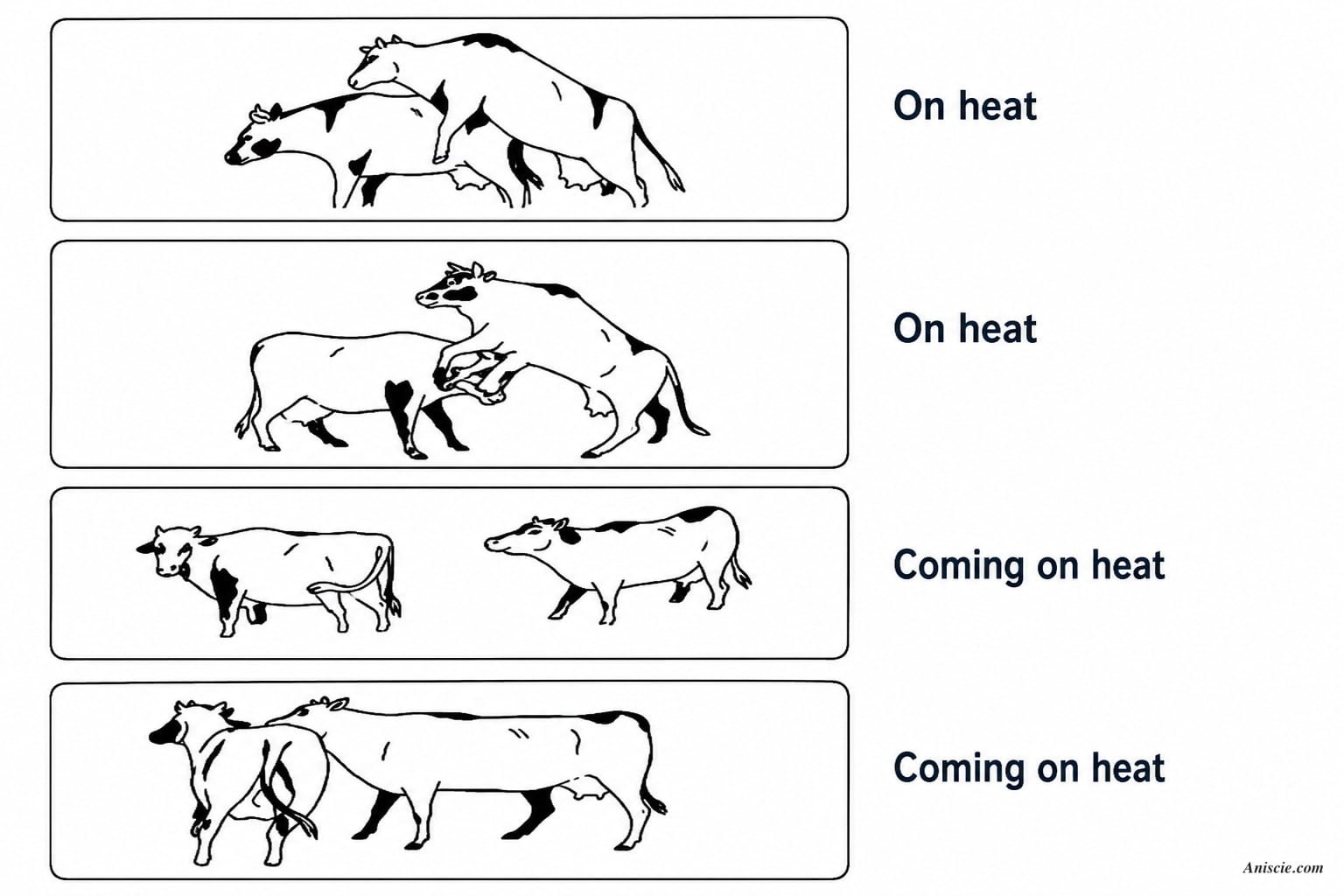
- Homosexual behavior, such as mounting other cows and accepting mounting by other cows.
- During estrus, the cow will accept mounting by a bull or another cow. The behavior of standing quietly while being mounted by another cow or bull is called standing heat and is the most reliable sign of heat.
- Mucus discharge from the vulva, which may stick to the tail head.
- Hair on the tail head may be pushed forward.
- There may be dirt on the sides of the abdomen due to mounting by other animals.
Reproductive Management
Standing heat is the best and simplest indication of estrus in cows, but this behavior will be manifested only if sufficient loafing area is provided.
Under stall-fed conditions, animals may not show mounting behavior, and the best time to detect heat in such animals is early morning.
The milker or herdsman can detect cows in estrus very easily. A cow in estrus is usually very active and is often the first cow to stand up in the morning.
The best time to detect estrus is before feeding; therefore, the attendant or milker should observe the hindquarters of the animal for any discharge.
In buffaloes, the expression of estrus signs is often poor. Particularly during the summer, buffaloes may exhibit only silent heat. Silent heat means the animal does not show any visible signs of estrus. It occurs more frequently in first-calving animals than in older animals and more commonly during early lactation than later lactation. It is also more pronounced in buffaloes during the summer.
Estrus signs can be detected using teaser bulls. Teaser bulls are vasectomized bulls or bulls fitted with aprons in front of the penis to prevent intromission. These bulls can detect cows or buffaloes in estrus very effectively. In large dairy farms, teaser bulls can be used for efficient heat detection.
Other modern techniques, such as chin-ball marking devices, pedometers, and evaluation of cervical mucus crystallization patterns, can also be used to detect estrus.
Right Time for Breeding a Cow
The best time for breeding cattle is from the middle of standing heat until six hours afterward.
As a routine practice, if a cow is observed showing signs of early heat in the morning, it may be inseminated in the evening. If such signs are observed in the evening, the cow should be bred the following morning.
A cow is expected to show estrus within 30–40 days after calving. Cows that fail to show heat even after 50 days generally have a reproductive problem and should be examined.
Practices for Improving Reproductive Performance
Maintaining accurate breeding records, including the dates of calving, estrus, and insemination, provides valuable information about the reproductive status of the animal. The use of teaser bulls in large dairy and buffalo farms can improve the accuracy of heat detection.
Problem cows, such as those with irregular estrus, retained placenta, or abnormal vaginal discharge, should be attended to and treated promptly.
The manager should examine a cow 24–36 hours after insemination for metestrus bleeding. This may help determine the optimal breeding time during the next estrous cycle.
The cow should be examined for pregnancy at 45–60 days after breeding so that necessary steps can be taken to rebreed non-pregnant animals at the earliest opportunity.