CONTENT
Care of the Cow and Newborn Calf Immediately After Calving: Postpartum Management and Neonatal Care
The period immediately after calving is critical for the health and productivity of both the cow and the newborn calf. Proper postpartum management helps prevent complications such as retained placenta, metabolic disorders, and infections in the cow, while appropriate neonatal care ensures successful adaptation of the calf to extrauterine life. Essential management practices during this period include monitoring the cow’s recovery, maintaining udder and reproductive health, ensuring adequate respiration and hygiene in the newborn calf, proper navel care, and timely preventive healthcare measures.
The udder and hindquarters should be washed with lukewarm water containing an antiseptic potassium permanganate solution and dried with a clean cloth.
Cows may be milked to relieve udder pressure. If day-old weaning is not practiced, the calf can be allowed to remain with the mother in the calving pen for 7 to 10 days. Otherwise, the calf can be removed immediately to a calf pen. If the maternal instinct is strong, the cow’s eyes can be blindfolded before the calf is removed.
The placenta should be expelled within 12 hours after parturition. If not, it should be removed manually. Before manual removal, the body temperature should be noted. In cases of pyrexia, attempts should be made to reduce the fever systemically. Otherwise, a systemic infection may develop.
The cow should be monitored carefully for signs of metabolic disorders such as milk fever, grass tetany, ketosis, and acidosis and treated immediately if necessary.
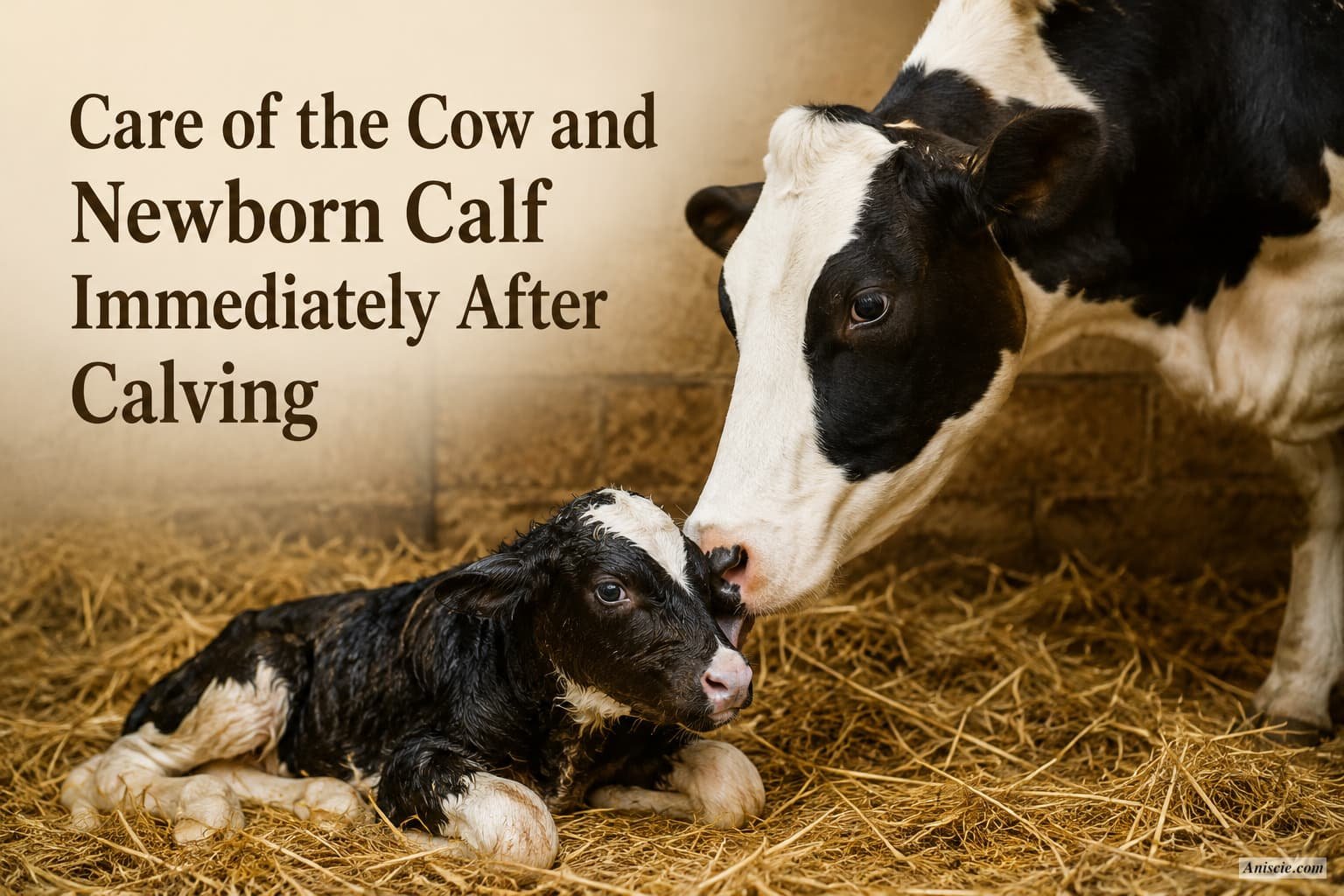
Care of the Newborn Calf Immediately After Birth
Normally, the cow will lick and dry the calf immediately after parturition, which may stimulate circulation and respiration. If the cow fails to do so, it can be stimulated to lick the calf by sprinkling a handful of bran or salt over the calf’s body.
Sometimes primiparous cows may be nervous and inexperienced, or the cow may be exhausted after prolonged labor. Under such circumstances, mucus from the nostrils of the newborn calf should be wiped away and cleaned with a dry towel.
The calf should be massaged vigorously for some time with a handful of straw rolled into a ball.
Sometimes the respiratory passages may be blocked with mucus, interfering with the calf’s respiration. Under such conditions, the calf should be lifted by holding the hocks so that the head is positioned downward, allowing the mucus to drain. Care should be taken while lifting the calf, as it may slip. A handful of straw can be used to improve grip while lifting.
The calf can also be induced to sneeze by tickling the inside of the nostrils with a twig of hay or grass.
If the above methods fail, little time remains. The attendant should place his or her mouth over the calf’s nostrils and suck out the mucus. Afterward, expired air should be blown into the calf’s nostrils while keeping its mouth closed. The carbon dioxide in the expired air blown into the calf’s lungs will act as a respiratory stimulant and help initiate respiration. This should be followed by intermittent compression and release of pressure on the calf’s chest wall to provide artificial respiration.
Attending the Navel
The navel or umbilical cord should be ligated with a sterile thread approximately one inch from the body (under field conditions, the thread may be soaked in tincture of iodine), severed 1 to 2 cm distal to the ligature, and painted liberally with tincture of iodine or povidone-iodine. This is very important because infection can easily enter through the navel and cause serious illnesses such as navel ill, navel abscess, and joint ill.
Neonatal Ascariasis
Neonatal ascariasis is common in buffalo calves, and deworming should be carried out as early as possible, preferably during the first week of life. A single oral dose of 10 g piperazine adipate is recommended for calves.
The newborn calf should pass meconium within 4 to 6 hours after the first colostrum feeding. The first feces are tarry in color and consistency.