
CONTENT
Weaning in Calves: Age, Advantages, Disadvantages, and Pail Feeding Training
Weaning in calves is an important management practice in dairy and livestock production that involves gradually or completely separating the calf from its dependence on milk. The primary objective of weaning is to encourage the development of the rumen and transition the calf from a liquid diet to solid feed.
Making the calf independent of its mother is known as weaning. Under the early weaning system, the cow is not allowed to suckle its calf. Instead, the cow is completely milked out, and the required quantity of whole milk or skim milk is fed to the calf.
Age of Weaning in Calves
The age at weaning varies depending on the production system, feeding management, and growth performance of the calf. In dairy calves, weaning is commonly carried out between 2.5 and 3 months of age, provided the calf is consuming an adequate quantity of calf starter feed and showing satisfactory growth.
Advantages of Weaning
- The exact quantity of milk can be fed to the calf so that overfeeding or underfeeding can be avoided.
- The exact amount of milk produced by the dam can be ascertained, and feeding can be scheduled accordingly.
- The amount of whole milk fed to the calf can be reduced by replacing it with a milk replacer, thereby increasing farm profit.
- Weaning reduces the stress associated with the milking operation and also ensures clean milk production.
- Teat injuries caused by suckling calves can be minimized.
Disadvantages of Weaning
- Weaning is problematic in Bos indicus cattle and buffaloes due to their strong maternal instinct.
- Weaning can cause reduced milk yield in such animals and may also lead to early drying off and temperamental problems.
Important Rules in Young Calf Rearing/Milk Feeding
In intensive calf-rearing systems where calves are weaned at one day of age, the following points should be strictly adhered to:
- Each calf should be treated individually. It should be weighed weekly and fed according to its body weight and growth response. Group feeding should be avoided to minimize overfeeding or underfeeding.
- Calves should be fed twice or more times a day. Feeding only once a day may cause indigestion and diarrhea, resulting in dehydration.
- Milk containers, milk pails/buckets, and other equipment should be kept clean and hygienic.
- Milk should be boiled and cooled to body temperature (39°C) before feeding.
- Milk feeding should be carried out 3–4 times a day during the first week and can be reduced to twice a day up to 90 days of age.
- Milk allowance should be adjusted according to the body weight of the calf, and overfeeding should be avoided during the first month of age.
- If calves do not consume milk, the next allowance should be withheld, and they may be drenched with 30–50 mL of castor oil.
- If the milk or milk replacer contains a large amount of foam, it should be removed by drawing a paddle across the surface or by filtering through a clean cloth. Foam causes calves to ingest entrapped air, which may lead to bloat.
- Clean drinking water should be available at all times, and the pen floor should be adequately sloped and kept dry.
- To encourage early rumen development, calves should be provided with good-quality hay (preferably legume hay) from the first week of age, and it should be offered in a hay rack.
- Calves should be dewormed during the first week of life for the prevention of ascariasis.
- Feed additives may be mixed with milk or concentrate feed to support growth and overall health. Antibiotics should be used only when necessary and under veterinary supervision.
Training of Calves for Pail Feeding
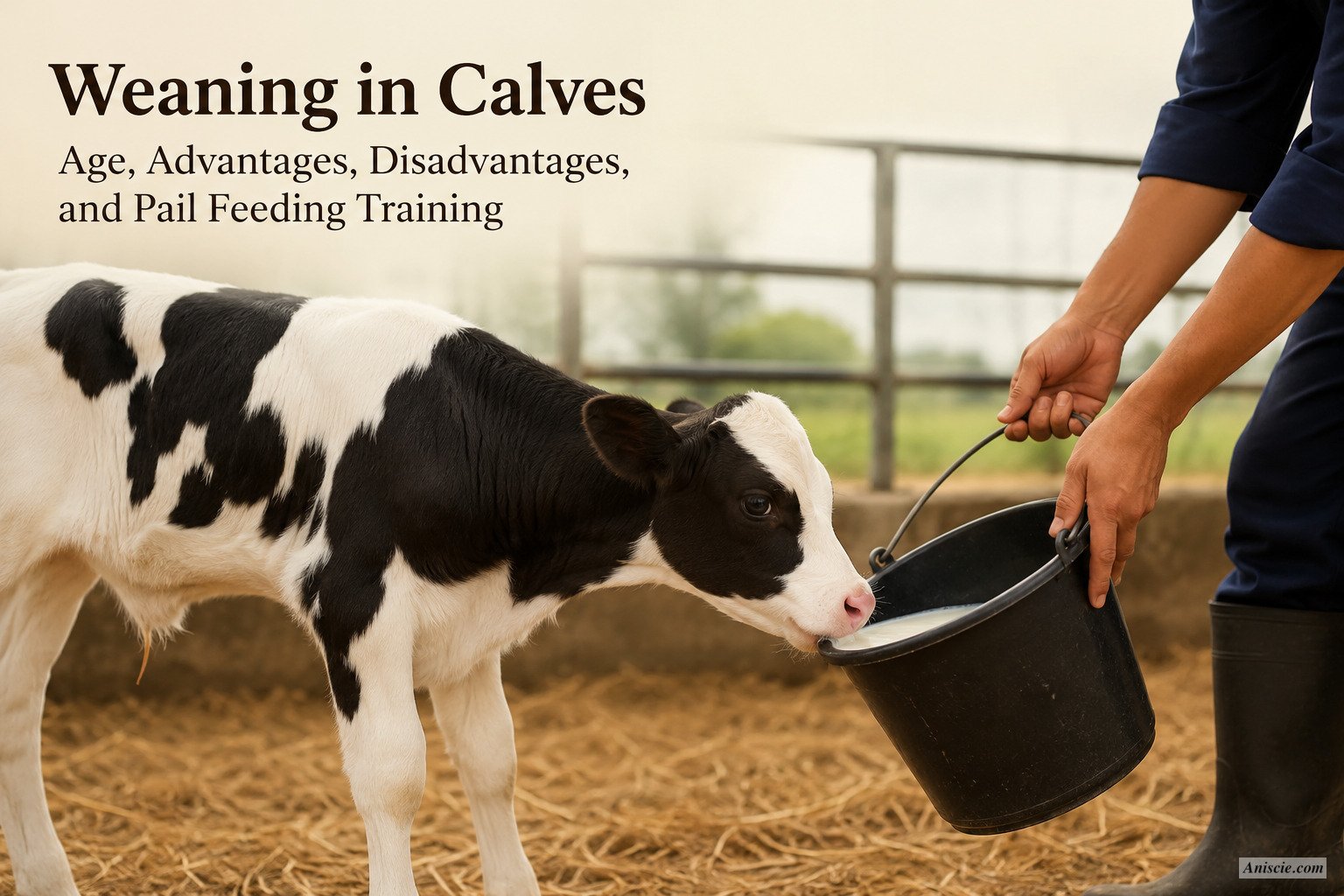
Weaned calves should be trained to drink milk from pails so that feeding management becomes easier.
Generally, crossbred calves learn quickly to drink milk from a pail or nipple. However, it is somewhat more difficult to train buffalo calves. Buffalo calves are often slow to learn how to drink milk or milk replacer from a pail or bucket.
The scheduled quantity of boiled and cooled milk should be poured into the milk pail and offered to the calf. Care should be taken to avoid frightening the calf. Calves should not be forced to drink milk by immersing their heads into the pail. Frightened calves may refuse to approach the pail.
The attendant should first dip two fingers (index and middle fingers) into the milk after cleaning them and hold them close to the calf’s mouth. After tasting the milk, the calf will start suckling the fingers. Gradually, the fingers should be lowered into the pail and dipped into the milk. When the calf takes one or two mouthfuls of milk, the fingers should be removed.
This process may be repeated whenever the calf stops drinking and lifts its head. Training buffalo calves requires patience and effort.