CONTENT
Fodder Production and Classification of Fodders in Livestock Farming
Fodder production plays an important role in livestock farming by ensuring a continuous supply of nutritious feed for animals. Different fodder crops and forage resources are classified based on their season, plant type, nutrient content, duration, and method of utilization. Understanding the classification of fodders helps in efficient feeding management, improved animal productivity, and sustainable livestock production.
Fodders
Fodder crops are cultivated plant species used as livestock feed. The term fodder generally refers to crops that are harvested and used for stall feeding.
Forage
Forage may be defined as vegetative plant material, either fresh or preserved, used as feed for animals. Forage crops include grasses, legumes, crucifers, and other crops cultivated and utilized for hay, pasture, fodder, and silage.
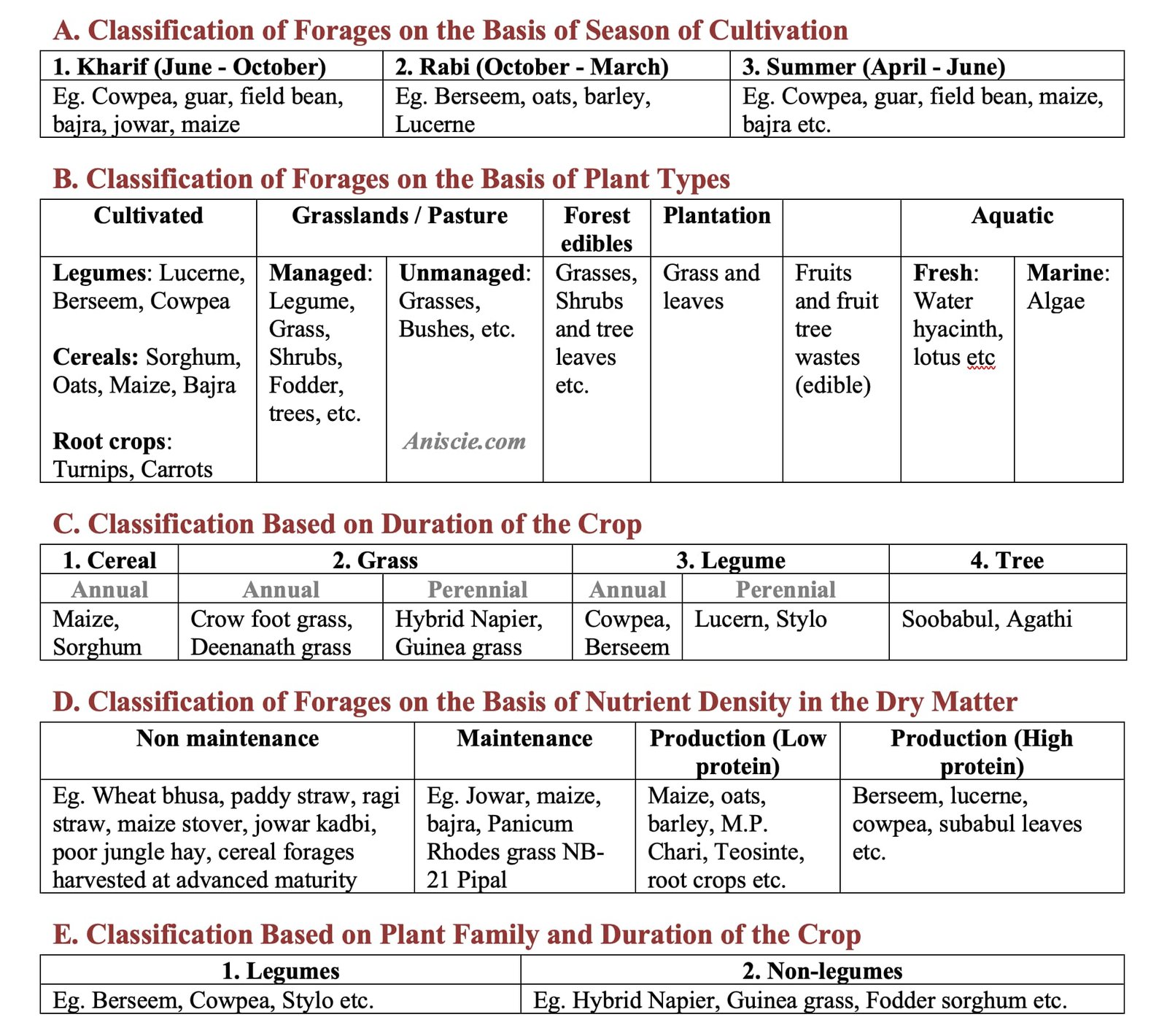
Forages are classified based on various features:
- Classification of forages on the basis of season of cultivation
- Classification of forages on the basis of plant types
- Classification based on duration of the crop
- Classification of forages on the basis of nutrient density in the dry matter
- Classification based on Plant family and duration of the crop
Types of Fodder, Crop Residues, and Feed Resources
The various categories of plant parts, residues, and by-products used for feeding are given below:
- Straw
- Leguminous Pulse Straws
- Husks (Hulls)
- Hay
- Silage
- Stovers
- Haulms
- Bhusa
- Grasses
1. Straw
Straw refers to the dried remnants of a crop from which the seeds have been threshed. The term is most commonly used for wheat, oats, barley, rice, etc.
2. Leguminous Pulse Straws
Leguminous crops that produce fibrous residues include black gram, green gram, cowpea, groundnut, etc. These residues consist of pod husks along with leaves and tender stems, making them more nutritious than cereal straws and stovers. They are excellent feed for sheep and goats. Leguminous crop residues are highly nutritious and palatable.
3. Husks (Hulls)
Husks are available in large quantities from the milling industry, such as rice mills and solvent extraction plants for groundnut oil and corn oil. Examples include groundnut husks and maize husks. They are low in density and generally unpalatable.
4. Hay
Hay consists of the entire herbage of comparatively fine-stemmed grasses or other forage plants. It refers to forage crops that are cut before maturity and dried for storage. Hay is more nutritious and palatable than straw because the entire crop is harvested before ripening and then dried.
5. Silage
Silage is the product formed when green plant material is stored under anaerobic conditions and allowed to ferment. During this fermentation process, acids are produced in the silage.
6. Stovers
Stovers are the by-products remaining after harvesting grains such as maize, sorghum (jowar), millets, etc. They are fed to livestock along with various supplements.
7. Haulms
Haulms are the above-ground parts of plants that are harvested, dried, and used as livestock feed, e.g., groundnut plants.
8. Bhusa
The refuse collected after threshing pulse crops such as red gram, Bengal gram, etc., is commonly known as bhusa. It consists of leaves, immature pods, seeds, and empty pod shells and is available as an inexpensive by-product that is useful as animal feed.
9. Grasses
Grasses are plants belonging to the family Poaceae (formerly Gramineae), which comprises about 450 genera and more than 6,000 species distributed throughout the world.
Characteristics of Fodder Crops
- Rapid regrowth and short duration.
- Profuse foliage and high fodder yield.
- High palatability and nutritive value.
- Adaptability to various agroclimatic conditions and different soil types.
- Capacity to provide a continuous supply of green fodder.
- Resistance to diseases and pests and safe for feeding at all stages of growth.