
CONTENT
Castration in Livestock Animals: Methods, Purpose and Precautions
Castration is the process of making a male animal incapable of reproduction by removing or inactivating the testes. It is one of the common management practices followed in livestock farming to improve animal handling, prevent indiscriminate breeding, and enhance meat quality. Castration is widely practiced in cattle, buffaloes, sheep, goats, pigs, and other farm animals. Different methods such as Burdizzo, surgical, and elastrator methods are used depending on the species and age of the animal.
Making the animal unable to reproduce is generally known as castration. In South-East Asian countries, bullocks are extensively used for agricultural operations. Buffaloes are particularly valued as draught animals in rice-growing areas. Male cattle and buffaloes meant for work should be castrated.
Purpose of Castration
- To render the animal docile.
- To induce faster gain in body weight and to improve the quality of meat.
- To control indiscriminate breeding.
- To prevent certain genital diseases.
- Castration also results in a lean and slender neck, which facilitates the correct fitting of the yoke, especially in working cattle.
Optimum Age for Castration
- Young animals: Within 3 months (surgical method and elastrator)
- Adult animals: Within one year of age (closed method – Burdizzo castrators)
Methods
- Burdizzo Method
- Open Surgical Method
- Rubber Ring or Elastrator Method
1. Burdizzo Method
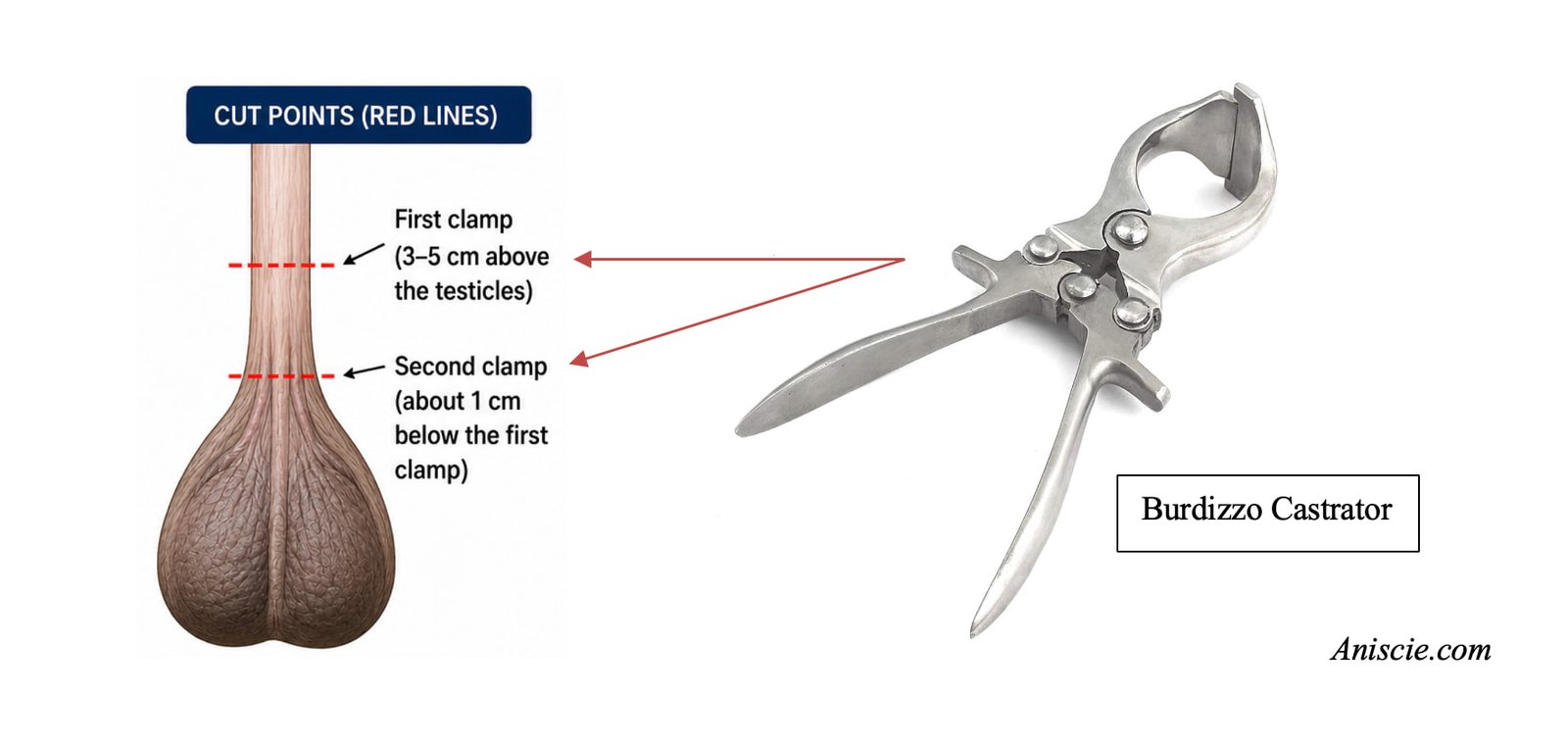
The Burdizzo method is also known as bloodless castration. The Burdizzo castrator is used to crush the spermatic cord, thus stopping the blood supply to the testes. This results in atrophy of the testes and stoppage of spermatozoa production.
After casting, secure the animal. Move the spermatic cord to the side of the scrotum and then clamp the Burdizzo about 3–5 cm above the testicles, and hold it for a few seconds. Then repeat this operation on the same cord at a location about 1 cm below the first one. This method is safe, quick, and has less chance of causing infection.
2. Open or Surgical Method
The scrotum is opened and the testicles are removed aseptically, and the wound is treated with antiseptics.
In young bulls, the cord may be cut straight off, but in the case of mature bulls, the cord should be twisted before severing it.
3. Rubber Ring or Elastrator Method
A strong and tight rubber ring is placed around the cord at an early age of the calf. This creates constant pressure, and the testicles are atrophied and absorbed, and the ring drops down. Elastrator rings are very painful to the animal, so they are not usually recommended.
Optimum age for Rubber Ring or Elastrator Method: Below 3 months.
Precautions for Castration
Castration should be performed during the cold season, and the rainy season should be strictly avoided for fear of fly problems. Castrated animals should be rested for a few days in clean and comfortable pens.